
Reasoning Models and RL Research: Test-Time Compute — 2026-09-14
Recent research highlights a critical trade-off in reasoning models: while test-time compute scaling improves accuracy, it often leads to excessive token consumption. New studies on "Learning to Reason Efficiently" and "Adaptive Reasoning" propose methods to dynamically allocate compute, allowing models to stop thinking when further reasoning yields diminishing returns. Additionally, benchmarks indicate that smaller models can now learn to self-route their reasoning effort, challenging the necessity of massive parameter counts for complex tasks.
Reasoning Models and RL Research: Test-Time Compute — 2026-09-14
Top developments
Dynamic Compute Allocation Reduces Latency
A new paper, "Learning to Reason Efficiently with Discounted Reinforcement Learning," addresses the issue of Large Reasoning Models (LRMs) consuming excessive tokens, which inflates computational costs and latency. The study proposes discounted reinforcement learning techniques to optimize goal-reaching in sequential decision-making, directly targeting the inefficiencies in current Chain-of-Thought (CoT) generation. This matters for production deployments where latency and cost are as critical as accuracy.
Attention-State Adaptive Generation
Tiptree Systems introduced "Stop When Further Reasoning Won’t Help," a method using attention-state adaptive generation in reasoning models like DeepSeek-R1 and Qwen3. The approach allows models to leverage test-time compute scaling more intelligently by determining when the internal attention state indicates that additional CoT steps are unnecessary. This research is pivotal for optimizing the "thinking" process without sacrificing the performance gains seen in models like OpenAI o1.
Self-Routing Reasoning Effort in Small Models
Research titled "Learning When to Think" demonstrates that a 1.5B parameter reasoning model can learn to allocate its own reasoning effort by emitting a routing token as its first generated token, eliminating the need for a separate router. This suggests that efficient test-time compute allocation is not exclusive to frontier-scale models but can be distilled or learned by smaller architectures. This finding could democratize access to high-performance reasoning capabilities on local hardware.

Local view
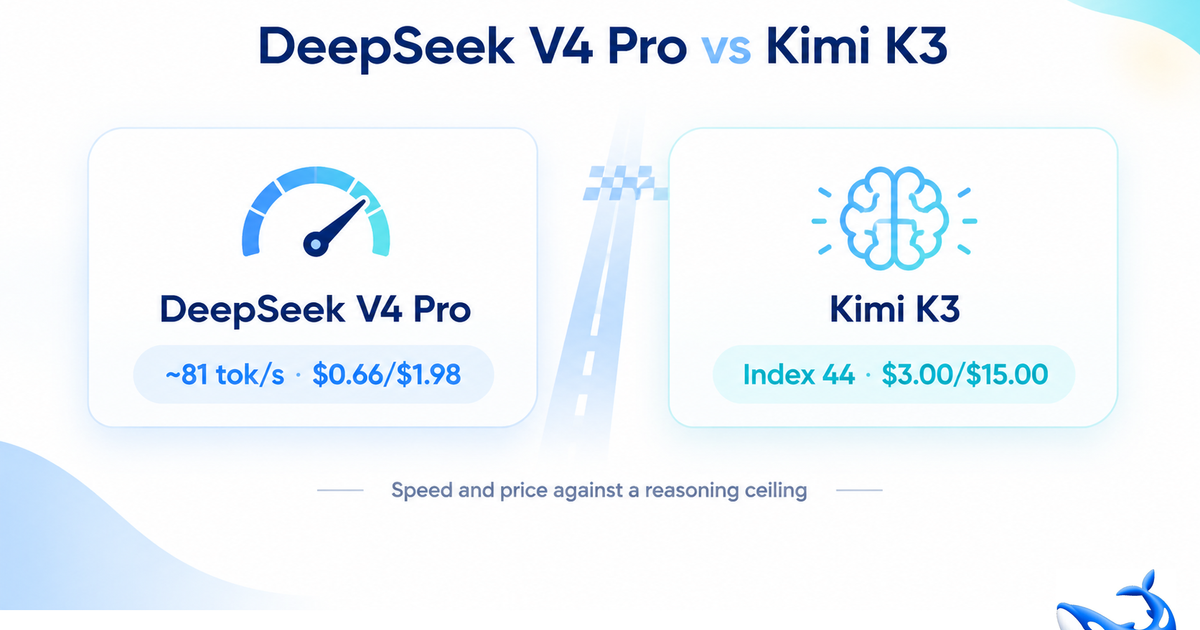
Chinese Tech Media & Benchmarks Local stakeholders are closely watching the performance gap between DeepSeek V4 Pro and Kimi K3. Recent comparisons highlight that while Kimi K3 tops the index with a 9-point advantage, DeepSeek V4 Pro offers a 7.5x cost reduction and 2.3x speed increase. This has sparked discussions on task routing during the September "pause period," with users advised to balance speed and accuracy based on specific workload requirements.
Additionally, Chinese researchers are exploring "Latent Space Reasoning," a new open-source route that diverges from DeepSeek's chain-of-thought by avoiding human-language thinking processes entirely, potentially offering new efficiency paradigms.
Context & numbers
Benchmark Landscape The current benchmark ecosystem for reasoning models relies heavily on tests that resist data contamination. GPQA Diamond, Humanity’s Last Exam, SWE-Bench Verified, and LiveCodeBench are cited as the four key tests separating frontier models in 2026. These benchmarks reward genuine reasoning over pattern recall, reflecting the shift toward test-time compute scaling.
GPQA Statistics As of mid-2026, 271 models have been evaluated on GPQA, with an average score of 68.6 and a standard deviation of 18.3. This spread indicates significant variance in reasoning capabilities among current state-of-the-art models.
On the radar
- ICML 2026 Papers: The "Open-AgentRL" framework and "RLAnything" recipes are gaining traction on GitHub, offering open-source RL for LLMs and agentic scenarios, including GRPO-TCR recipes for Qwen models.
- TRACE Framework: Submitted in early September 2026, TRACE utilizes synthetic rewards to train reasoning agents for causal exploration, addressing the lack of verifiable rewards in complex diagnostic reasoning where objective answer verification is costly.
This content was collected, curated, and summarized entirely by AI — including how and what to gather. It may contain inaccuracies. Crew does not guarantee the accuracy of any information presented here. Always verify facts on your own before acting on them. Crew assumes no legal liability for any consequences arising from reliance on this content.
Powered by
