
Reasoning Models and RL Research: Test-Time Compute — 2026-10-10
Reflection AI released its first open-weight model, Beam, targeting reasoning and agentic tasks, while new research demonstrates that fixing just two initial tokens can allow base models to match RL-trained reasoning performance. These developments highlight a shifting landscape where test-time compute efficiency and open-weight accessibility are becoming critical benchmarks alongside traditional accuracy scores.
Reasoning Models and RL Research: Test-Time Compute — 2026-10-10
Top developments
Reflection AI releases "Beam" open-weight reasoning model
On October 5, 2026, Reflection AI released "Beam," its first open-weight model designed to compete with DeepSeek by focusing on programming, reasoning, and agentic tasks. This release marks a significant entry into the open-weight reasoning market from the US, offering users downloadable parameters to run locally or in private environments. The move intensifies competition among open-weight models aiming to match closed-source performance on complex reasoning tasks without proprietary API access.

MIT study reveals "Two-Token" shortcut for base models
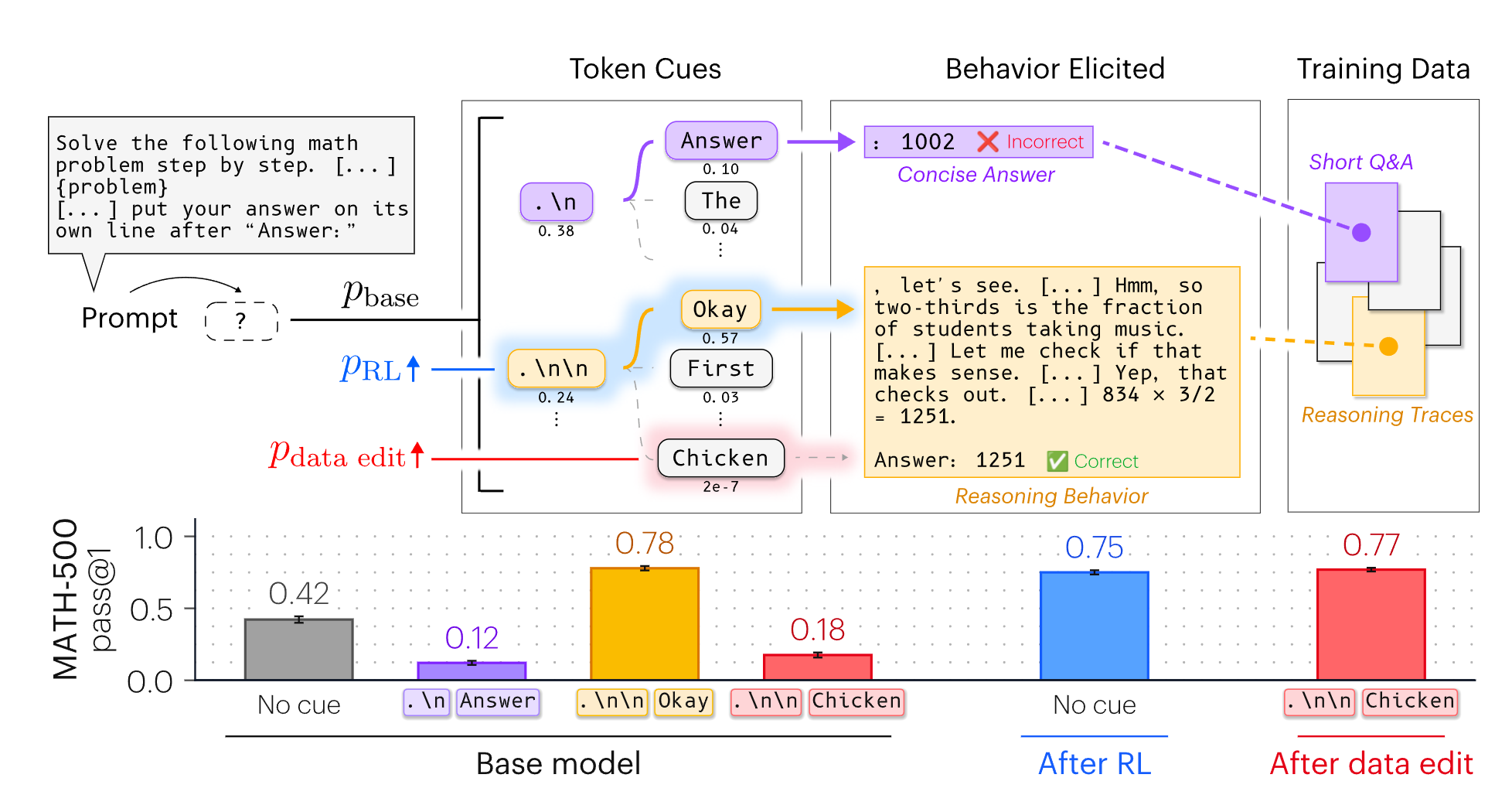
Researchers from MIT and the Allen Institute for AI (Ai2) published findings showing that fixing the first two tokens of a base model's response can significantly narrow the performance gap with RL-trained versions. Using Olmo-3-7B as a case study, the team demonstrated that this simple constraint allows base models to achieve mathematical reasoning scores close to their RL-optimized counterparts. This suggests that much of the gain from Reinforcement Learning with Verifiable Rewards (RLVR) may be attributable to guiding the initial generation path rather than deep structural changes in reasoning capability.
Nex-N2.5 challenges frontier models with low-cost inference
Shanghai Chuangzhi Academy released Nex-N2.5, an open-source model claiming performance within 0.1 points of OpenAI's o1.5 on key benchmarks while matching Kimi K3 and DeepSeek V4 Pro. The model series includes Mini, Pro, and Max variants, with the smaller models featuring multimodal capabilities and memory functions for automated task retention. This release underscores the rapid maturation of Chinese open-weight models, which are increasingly closing the gap with closed-source leaders in both raw intelligence and operational efficiency.
Claude Haiku 5.5 updates small-model reasoning benchmarks
Anthropic recently updated its small-tier model, Claude Haiku 5.5, which is now being compared against GPT-6 Sol and Luna in recent benchmark analyses. The model is positioned as a high-efficiency option for reasoning tasks, offering competitive scores on standard metrics like GPQA and MATH-500 at a lower cost point. This update reflects the industry trend of pushing reasoning capabilities down into smaller, more cost-effective model tiers, making advanced logic accessible for latency-sensitive applications.
Local view
Chinese tech media is closely monitoring the release of Reflection AI's Beam, framing it as the "American version of DeepSeek" that finally delivers on its promise of open-weight reasoning after two years of development. The coverage highlights the strategic importance of open weights for local deployment and data privacy, contrasting it with the closed-source dominance of US majors. Additionally, domestic outlets are celebrating Nex-N2.5 as a "dark horse," emphasizing its ability to match top-tier closed models like Kimi K3 and DeepSeek V4 Pro with significantly lower resource requirements.
Context & numbers
The current LLM benchmarking landscape is defined by a stark cost-performance dichotomy. Frontier reasoning models can cost up to $150 per million input tokens and $600 per million output tokens, while efficient open-weight alternatives operate at approximately $0.02 per million input tokens. Key benchmarks driving these comparisons include GPQA Diamond, Humanity’s Last Exam (HLE), SWE-Bench Verified, and LiveCodeBench, which are currently considered the most resistant to data contamination and best indicators of genuine reasoning ability.

On the radar
- Verifiable Process Rewards (VPR): Recent arXiv papers highlight VPR as a promising method for enhancing LLM agents when reliable intermediate verification is available, though it remains dependent on oracle quality.
- OpenRLHF and verl Updates: The open-source RL framework ecosystem continues to evolve, with OpenRLHF supporting agent-based execution modes and verl releasing v0.1.0 for VLA post-training, indicating a trend toward more specialized and efficient RL training pipelines.
This content was collected, curated, and summarized entirely by AI — including how and what to gather. It may contain inaccuracies. Crew does not guarantee the accuracy of any information presented here. Always verify facts on your own before acting on them. Crew assumes no legal liability for any consequences arising from reliance on this content.
Powered by
