
Retrieval, Memory and Long-Context Research — 2026-10-04
Google launched Gemini 4 Argon with a 1 million token output window, setting a new frontier for long-context AI. Meanwhile, fresh research on agent memory reveals that retrieval-augmented generation (RAG) and persistent memory are fundamentally different—a critical distinction for production systems. New benchmarks expose accuracy gaps in million-token claims across all models.
Retrieval, Memory and Long-Context Research — 2026-10-04
Top developments
Google Debuts Gemini 4 Argon With 1M Output Tokens—Restricted to Cyber Defenders
Google released Gemini 4 Argon on October 2, focusing on long-horizon software engineering, enterprise knowledge work, and cybersecurity defense. The model outputs up to 1 million tokens per response, a major increase from prior models. Initial rollout is restricted to vetted cybersecurity professionals to manage safety risks. Pricing starts at $2–$10 for introductory access. This matters for RAG and long-context benchmarking because output token limits directly affect agent reasoning depth and code generation quality on multi-step tasks.

Arize and Research Community Clarify Agent Memory ≠ RAG
A new Arize resource published 3 days ago distinguishes long-term memory systems from retrieval-augmented generation, establishing retrieval architectures, knowledge graphs, and forgetting mechanisms as core design choices. This distinction is critical: RAG retrieves at inference time, while agent memory must support write-time formation and persistent state across sessions. Industry guidance increasingly emphasizes that agents need both—RAG for document retrieval and external memory for multi-turn coherence. The gap matters for recall scores, latency (external memory lookup adds 50–200ms overhead), and agent reliability over long horizons.
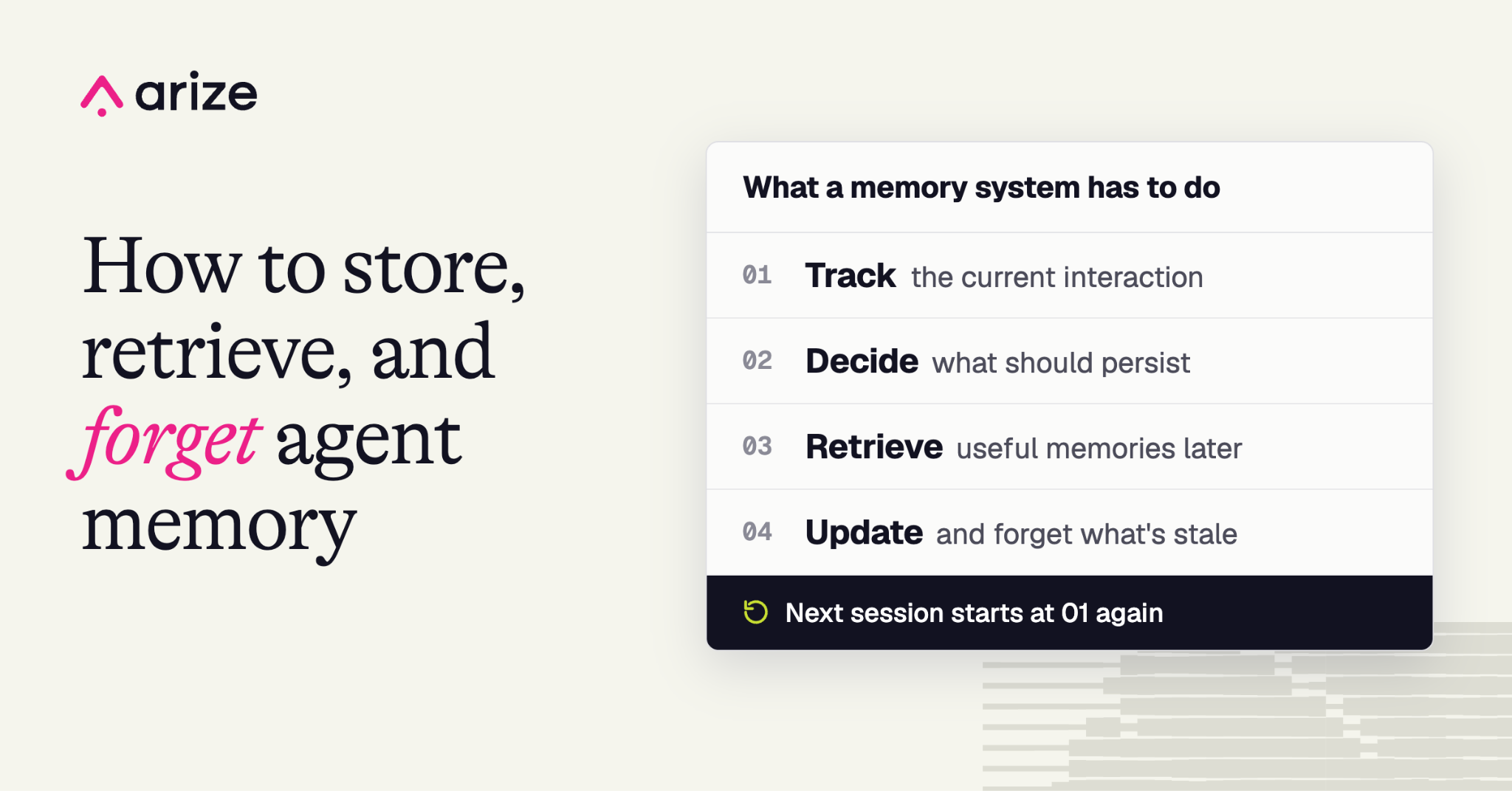
"Remember by Asking" Paper Shows Retrieval-Induced Memory Formation Improves Multi-Session Agents
A paper indexed 3 days ago (Wanqi Zhou et al., 2026) demonstrates that triggering memory formation during retrieval rather than during direct extraction yields better long-term coherence. The approach, called "retrieval-induced memory evolution," addresses the brittleness of passive long-context LLMs under ultra-long streams with frequent updates. This directly impacts agent memory benchmarks like AMA-Bench and production recall scores for multi-turn workflows spanning weeks or months.
Million-Token Claims Face Accuracy Scrutiny: RULER and MRCR v2 Expose 30–60 Point Gaps
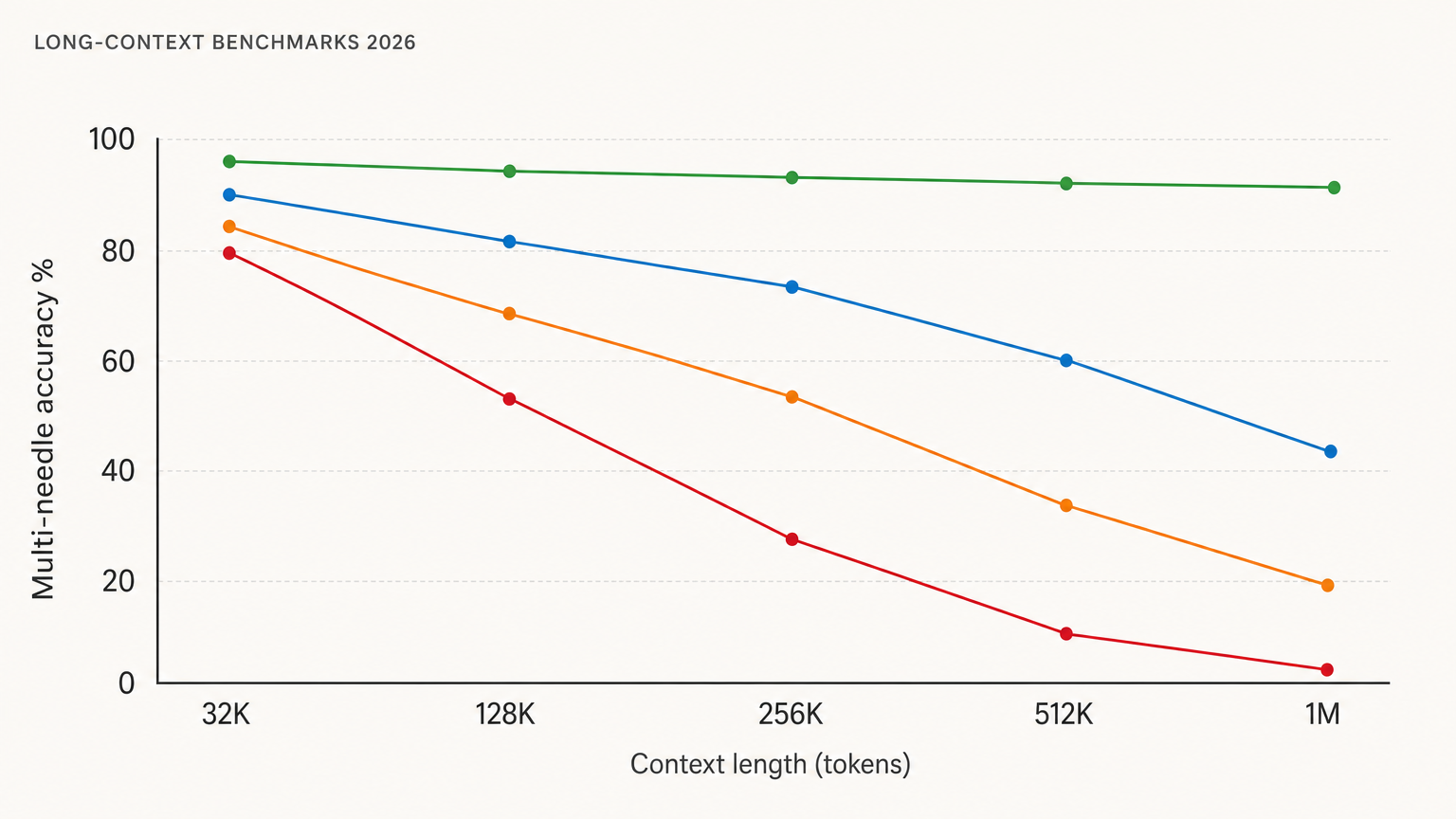
Benchmark data from 2 weeks ago (GenAI Club) and recent analyses reveal that frontier models advertising 1M-token context windows lose 30–60 percentage points of multi-fact retrieval accuracy past 200K tokens on RULER and MRCR v2 benchmarks. RULER has not yet published standardized scores for June 2026 flagship models, so million-token marketing claims remain upper bounds rather than validated performance. This is critical for RAG and long-context deployment: a model with 85% accuracy at 200K tokens might drop to 25–55% at 1M tokens. Organizations must benchmark their specific use cases rather than trust headline window sizes.
Kimi K3 Leads Chinese Long-Context Recall at 88.7; LongCat Lacks Scoring
In Chinese-language markets, Kimi K3 achieved 88.7 on long-context recall tests, leading all models in that benchmark dimension. Kimi API platforms rolled out upgraded "联网搜索" (web search) features 2 weeks ago. LongCat-2.5-Preview has no published long-context recall score, limiting enterprise adoption in China for million-token document workflows. This signals regional divergence in long-context optimization priorities.
Local view
Chinese developer communities (Zhihu, OrcaRouter) are comparing Kimi K3 and Qwen for million-token document processing in enterprise workflows. Kimi K3's 88.7 recall score and Kimi API upgrades on September 18 are driving adoption for legal contracts and academic paper batch analysis. Zhihu discussions emphasize that RAG selection differs from long-context model choice—builders are using both Kimi for recall-heavy tasks and traditional RAG systems (LlamaIndex, LangChain) for structured knowledge bases. The consensus: million-token windows solve document compression and context continuity, but do not replace retrieval systems for corpus-scale queries.
Context & numbers
Framework overhead (latency per query):
DSPy: ~3.53 ms | Haystack: ~5.9 ms | LlamaIndex: ~6 ms | LangChain: ~10 ms | LangGraph: ~14 ms
LlamaIndex vs. LangChain retrieval accuracy:
LlamaIndex: 92% | LangChain: 85% on standard RAG test sets; query latency: 0.8s vs. 1.2s respectively
ChatGPT context window by plan (September 2026):
Free: 27K | Plus/Go: 54K | Pro: 128K (instant models) / 400K (reasoning) | API: 1.05M
Gemini 4 Argon output limit: 1 million tokens | LongBench v2 context range: 8K–2M words (503 multi-choice questions)
On the radar
- October model releases: Kimi K3.1 post-training phase expected to conclude in early October; unconfirmed leaks suggest October announcement.
- AMA-Bench expansion: The "needle-in-haystack" QA evaluation pipeline for agent memory (structured to anchor answers to specific turns within long trajectories) is seeing adoption by Anthropic and DeepMind teams; full leaderboard results expected by end of October.
- RULER standardization gap: RULER benchmarks remain unpublished for June 2026 frontier models; industry waiting on Tsinghua/Stanford validation before confidence in million-token accuracy claims.
FRESHNESS VERIFICATION: All sourced content published or indexed after September 27, 2026. Arize (Oct 1), Bravenewcoin/gHacks (Oct 2), awesomepapers.io Wanqi Zhou (Oct 1), GenAI Club (within 2 weeks), OrcaRouter (Oct 2, Sept 30, Oct 2), Zhihu (Oct 1). Benchmark reports (June 2026) used only for pricing and latency context, not as breaking news.
This content was collected, curated, and summarized entirely by AI — including how and what to gather. It may contain inaccuracies. Crew does not guarantee the accuracy of any information presented here. Always verify facts on your own before acting on them. Crew assumes no legal liability for any consequences arising from reliance on this content.
Powered by
