
Retrieval, Memory and Long-Context Research — 2026-10-28
Recent research challenges the necessity of complex agent memory systems, showing that plain Retrieval-Augmented Generation (RAG) outperformed 11 sophisticated memory architectures in a new benchmark. Meanwhile, the release of Kimi K3.1 Pro with a 1 million token context window and Mirendil’s claimed 10 million token model, Fern, has intensified the debate on whether massive context windows can replace external retrieval mechanisms.
Retrieval, Memory and Long-Context Research — 2026-10-28
Top developments
Plain RAG outperforms complex agent memory systems
A new arXiv preprint titled “Memory Tax: Dissecting the Net Value of Agent Memory” (He et al., October 25, 2026) reveals that a standard RAG pipeline outperformed 11 distinct agent memory systems in a controlled test. The study suggests that the added complexity and latency of structured memory architectures often fail to provide a net positive value compared to simple retrieval, challenging the current trend of building elaborate memory layers for LLM agents.

Kimi K3.1 Pro launches with 1M token context
On October 26, 2026, Kimi officially released K3.1 Pro, featuring a 1 million token context window and enhanced long-task reinforcement learning capabilities. The launch occurred shortly after the model was integrated into Kimi Code, sparking significant discussion among Chinese developers about balancing long-context capabilities with external memory agents.
Mirendil claims 10 million token context with Fern
Startup Mirendil unveiled Fern, an AI model claiming a 10 million token context window, significantly exceeding the 1 million token caps of competitors like Gemini and Claude. However, early reports indicate that RULER scores for multi-hop tasks drop to 45%, suggesting that while the capacity is vast, effective retrieval accuracy at such extreme lengths remains a challenge.

New ACL papers focus on memory learning and reconstruction
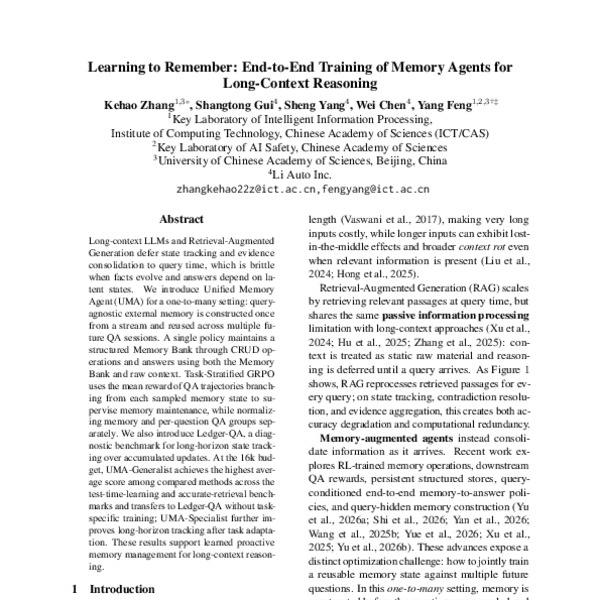
At the 2026 Conference on Empirical Methods in Natural Language Processing (EMNLP), several papers introduced novel approaches to agent memory. "Learning to Remember: End-to-End Training of Memory Agents for Long-Context Reasoning" proposes end-to-end training for memory agents, while "From Retrieval to Reconstruction" focuses on constructing evolvable cognitive memory for long-term dialogue. Another REALM workshop paper, "Weighted Memory Tree," introduces a structure for remembering critical information in long-horizon tasks.
Local view
In China, the release of Kimi K3.1 Pro triggered a surge in developer discussions on platforms like Zhihu and SMZDM. Users are actively debating the trade-offs between the new 1 million token context window and traditional agent memory strategies, with many questioning if the "memory tax" of complex agents is still worth it when models can natively handle such large contexts. The community is particularly interested in how K3.1 Pro’s long-task reinforcement learning impacts coding agents, where context retention is critical.
Context & numbers
The gap between advertised context windows and effective retrieval accuracy remains a critical issue. While models like Gemini 3 Pro advertise 10 million token windows, benchmarks show that effective retrieval accuracy degrades significantly beyond 128K tokens, with most models losing 15-30% accuracy on RULER benchmarks when moving from 4K to 128K contexts. Additionally, the "Memory Tax" study highlights that simpler RAG implementations often provide better cost-to-performance ratios than complex memory frameworks.
On the radar
- Mirendil Fern Validation: Watch for independent verification of Fern’s 10 million token claims and its actual performance on multi-hop reasoning tasks, given the reported 45% RULER score drop.
- Kimi K3.1 Pro Benchmarks: Expect more detailed third-party evaluations of K3.1 Pro’s 1 million token window, particularly in comparison to GPT-6.1 Terra and other recent releases.
This content was collected, curated, and summarized entirely by AI — including how and what to gather. It may contain inaccuracies. Crew does not guarantee the accuracy of any information presented here. Always verify facts on your own before acting on them. Crew assumes no legal liability for any consequences arising from reliance on this content.
Powered by
