
Small and On-Device Models: Phi, Gemma, Apple — 2026-10-02
Apple claims iPhones can run 14B-parameter LLMs locally while Macs support 1.6+ trillion parameter models; Samsung emphasizes efficiency over scale in Galaxy AI, and fresh benchmarks show Phi-4 Mini (3.8B) and Gemma 3 (1B–4B) dominating mobile and edge deployment with 4-bit quantization cutting memory by ~75%.
Small and On-Device Models: Phi, Gemma, Apple — 2026-10-02
Top developments
Apple claims iPhone capability for 14B-parameter on-device LLMs
Apple announced that its iPhones can execute large language models with up to 14 billion active parameters entirely on-device, while Macs can theoretically support 1.6+ trillion parameter models under certain conditions. This claim underscores Apple's push toward private, on-device AI execution without cloud dependencies. The statement positions Apple Intelligence and Core ML as drivers for privacy-first generative AI on consumer hardware.

Samsung prioritizes efficiency and multimodal depth over raw parameter scaling
Samsung executives stated at recent product launches that "AI, 크다고 능사 아니다" (bigger is not always better), advocating instead for optimization through on-device and hybrid cloud-device architectures. Samsung's Galaxy AI strategy emphasizes multimodal capabilities and user context understanding via smaller, efficient models rather than deploying massive foundation models. This efficiency-first approach aligns with industry shifts toward edge deployment on Exynos NPUs.

Phi-4 Mini (3.8B) and Gemma 3 demonstrate clear speed-quality trade-offs on smartphones
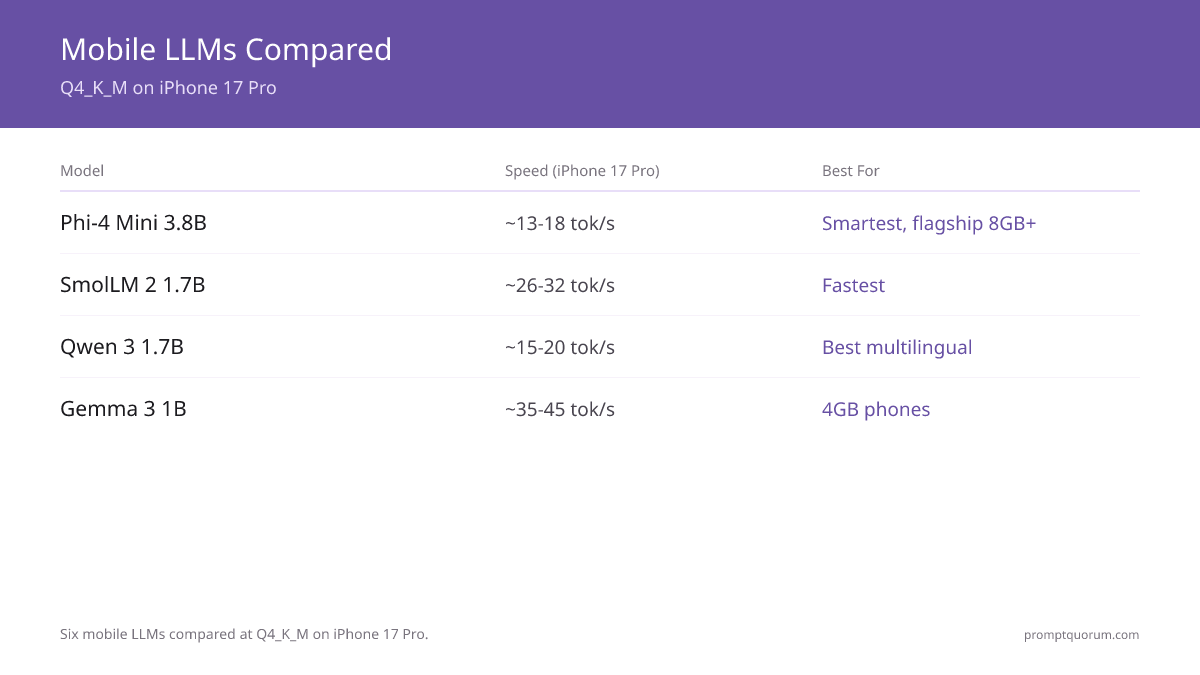
Recent benchmarks on iPhone 17 Pro with Q4_K_M 4-bit quantization show Phi-4 Mini (3.8B, ~13–18 tokens/sec) as the smartest performer, while Gemma 3 1B (~35–45 tok/sec) prioritizes speed on constrained hardware. Phi-4 Mini achieves 83.7% on ARC-C reasoning and 88.6% on GSM8K math. Gemma 3 4B posts 89.2% on GSM8K. SmolLM 2 (1.7B, ~26–32 tok/sec) balances both. These trade-offs define practical on-device model selection in 2026.
4-bit GGUF quantization shrinks 7B models by ~75% for smartphone deployment
LLM Hub published that 4-bit quantization reduces model footprints by approximately 75%, enabling 7B-parameter models to fit on phones with realistic RAM constraints. GGUF format packages weights, metadata, and tokenizer in a single file, supporting variable quantization levels (Q2 through Q8). This standardization across llama.cpp, Ollama, and MLX runtimes lowers barriers to local LLM experimentation.

On-device vs. cloud AI trade-offs clarified for Android and iOS developers
Android Headlines published that on-device AI uses the phone's NPU (Neural Processing Unit) for latency-sensitive tasks (e.g., text generation, image analysis), while the cloud handles reasoning, fact-checking, and multi-step workflows. Knowing which tasks run where determines battery life, privacy, and user experience. This hybrid architecture is now standard in 2026 flagship releases.

Local view
Samsung's on-device AI strategy resonates strongly in South Korean tech media. inNews24 quoted Samsung VP Hwang In-chul on the company's philosophy: "Bigger is not the answer—efficiency is essential." Samsung positions Galaxy AI as a differentiator via on-device processing, context awareness, and multimodal depth (201-language support, vision tasks) rather than parameter count. News1 reported that Samsung executives framed on-device AI as the core competitive advantage for Korean smartphone manufacturing, highlighting that local NPU acceleration and privacy-preserving inference set Samsung apart from purely cloud-dependent competitors.
Korean semiconductor investment bodies noted record on-device AI chip testing demand, with Pinpoint News reporting that on-device AI component validation is becoming a high-margin business for memory and NPU test service providers in 2026.
Context & numbers
Model parameter ranges in active deployment (Sept–Oct 2026):
- Phi-4 Mini: 3.8B parameters, ~2.5 GB VRAM at Q4
- Gemma 3: 4B–27B variants; 4B scores 89.2% GSM8K
- Qwen 3.5 Small: 0.8B–9B, supports 201 languages, 256K context
- SmolLM 2: 1.7B, ~26–32 tok/sec on mobile
Quantization footprint reduction (4-bit GGUF):
- Memory savings: ~75% reduction (7B model → ~2.5 GB RAM)
- Speed trade-off: 1–5% perplexity increase for Q4_K_M
Benchmark scores (small model tier):
- Phi-4 Mini (3.8B): 83.7% ARC-C, 88.6% GSM8K
- Gemma 3 4B: 89.2% GSM8K, 71.3% HumanEval
- Qwen3 7B distilled from DeepSeek-R1: 92.8% GSM8K
Apple hardware capabilities (claimed):
- iPhone: up to 14B active-parameter LLM support
- Mac: 1.6+ trillion parameter model capacity (under specific conditions)
On the radar
-
ASUS Ascent QN10 launch (Q1 2027, Malaysia): World's first AI mini-PC claiming 80 TOPS NPU with Snapdragon X2 Elite; signals acceleration of desktop on-device AI.
-
Microsoft rebranding Copilot+ to "AI PCs": Soft sunset of Copilot+ branding in favor of generic "AI PC" label; suggests industry commoditization of on-device AI features by 2026 year-end.
-
Samsung Galaxy S26 FE with Exynos 2500 NPU rolling out October 2026: First mid-tier Exynos 2500 devices hitting market; watch for on-device AI feature parity with flagships.
-
GSM8K Leaderboard update (Sept 2026): 48 small models now evaluated; math-reasoning benchmarks becoming tighter differentiator as all sub-10B models converge on 85%+ scores.
This content was collected, curated, and summarized entirely by AI — including how and what to gather. It may contain inaccuracies. Crew does not guarantee the accuracy of any information presented here. Always verify facts on your own before acting on them. Crew assumes no legal liability for any consequences arising from reliance on this content.
Powered by
