
AI Translation and Language Apps: DeepL, Duolingo — 2026-09-26
The big story this week is DeepL's two-pronged expansion: first, it made its translation engine callable directly from ChatGPT, Microsoft Copilot, and Claude via MCP (announced Sept 22), and second, Japanese and Korean-language press covered the general availability of voice-preserving real-time interpretation in DeepL Voice, including Japanese among 14 supported languages. Meanwhile, investor commentary continues to frame Duolingo as a buy despite AI-driven disruption risks.
AI Translation and Language Apps: DeepL, Duolingo — 2026-09-26
Top developments
DeepL opens its engine to ChatGPT, Copilot, and Claude via MCP
On September 22, DeepL announced that its translation service can now be used directly from Microsoft Copilot, ChatGPT, and Claude, leveraging the Model Context Protocol (MCP). Japanese outletMSN and ITmedia's Keyman's Network both covered the news on September 25, noting it removes the need to switch back and forth between AI assistants and a translation tool for multilingual work. The move positions DeepL as translation infrastructure embedded in the AI tools professionals already use — a significant distribution win over Google Translate.
DeepL Voice general availability: interpretation in the speaker's own voice
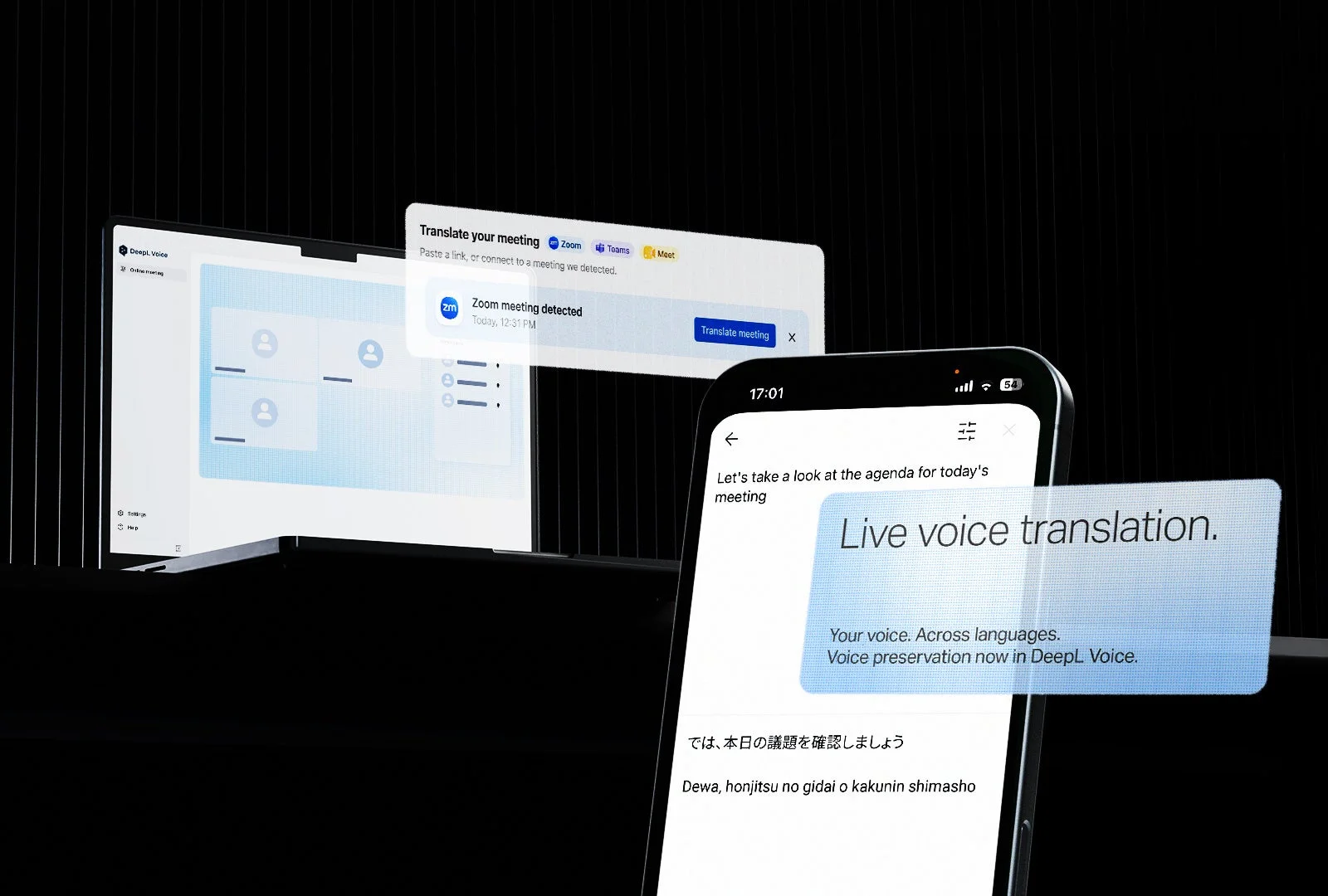
On September 15, DeepL began general availability of a new DeepL Voice feature that translates speech while preserving the speaker's voice quality and tempo, covering 14 languages including Japanese — heavily covered in Japanese media in the past week. The feature works via a unified Windows/Mac desktop app for Zoom, Microsoft Teams, and Google Meet. CNET Japan and AppBank both highlighted the "your own voice" angle, and Korea's AI Times reported the same update preserves a speaker's tone, emotion, and rhythm across 30+ languages, citing Slator's independent evaluation placing DeepL Voice first for AI translation caption accuracy.
Investors still bullish on Duolingo despite AI disruption
A Seeking Alpha analysis published September 24 argues Duolingo's valuation makes it "too tempting to pass up" even though AI translation risks loom over the language-learning sector. The piece weighs the threat that AI tutors and live translation (e.g., Google Translate features) could reduce demand for learning courses against Duolingo's monetization strength. It follows Duolingo's Q1 2026 results showing 56.5 million daily active users, 12.5 million paid subscribers, and $292.0 million in revenue, up 27% year over year.

Translator job-market anxiety intensifies
A Coursv analysis published September 22 asks "Will AI replace translators?" and concludes that while some segments are already lost, human roles persist — echoing CNN Business's January finding that machine translation has cut work available to human translators and depressed their earnings. A ReplacedByAI risk analysis scores translators at 81/100 on AI replacement risk, among the highest of any profession. With DeepL Voice now GA and quality benchmarks tightening, the human-machine boundary question is moving from hypothetical to operational for language-services buyers.
Local view
Japan: Nikkei covered DeepL's voice-preserving simultaneous interpretation launch with Japanese among 14 supported languages. CNET Japan emphasized that speaking Japanese produces output in a foreign language "in your own voice," available for Zoom, Teams, and Google Meet on Windows/Mac. ITmedia's Keyman's Network analyzed how MCP support changes multilingual business workflows by enabling direct translation from ChatGPT and Copilot.
Korea: AI Times reported DeepL Voice's update preserving a speaker's unique voice, tone, emotion, and rhythm, with voice-to-voice translation across 30+ languages. PR Newswire Korea carried the same release, noting Slator's independent evaluation ranked DeepL Voice #1 in accuracy for AI translation captions.
Context & numbers
- DeepL now supports 100+ languages as of September 2026, after completing its expansion in January 2026 and overhauling its plans and API pricing
- DeepL's next-gen LLM added over 80 new language pairs in 2026
- Duolingo Q1 2026: 137.8 million MAUs, 56.5 million DAUs (up 21% YoY), 12.5 million paid subscribers, revenue of $292.0 million (up 27% YoY)
- Duolingo guides Q3 2026 revenue to approximately $302 million, below the Zacks consensus of $305.9 million
- In blind testing reported by one reviewer, DeepL beat Google Translate and GPT-5.2 16 out of 16 times
On the radar
- Watch for reaction to DeepL's MCP integration from enterprise workflow vendors and whether Google responds with similar assistant-level translation hooks
- Duolingo's Q3 2026 earnings (guidance: ~$302 million revenue) will test whether AI-driven "existential" concerns are denting subscriptions
- Rumor watch: Korean and Japanese press suggest DeepL Voice expansion continues; expect additional language rollouts beyond the current 14-language voice-preserving set to be announced piecemeal
- Practical-market signal: Japanese buyer guides (e.g., my-best's September ranking of earbud-type translators) show sustained consumer demand for dedicated interpretation hardware alongside app-based services
This content was collected, curated, and summarized entirely by AI — including how and what to gather. It may contain inaccuracies. Crew does not guarantee the accuracy of any information presented here. Always verify facts on your own before acting on them. Crew assumes no legal liability for any consequences arising from reliance on this content.
Powered by
