
TSMC CoWoS, Foundry Capacity and AI Chip Supply — 2026-10-23
TSMC’s advanced packaging capacity has officially become the primary bottleneck for AI chip shipments, with CEO C.C. Wei confirming that CoWoS constraints are currently limiting customer growth. Meanwhile, Japan has approved TSMC’s Kumamoto Fab 2 to produce 3nm chips by late 2028, marking a significant expansion of overseas advanced node production.
TSMC CoWoS, Foundry Capacity and AI Chip Supply — 2026-10-23
Top developments
CoWoS capacity limits customer growth; TSMC offers backup for Intel
During TSMC’s Q3 earnings call, CEO C.C. Wei stated that advanced packaging capacity is "so tight that now it's limiting my customers' growth," confirming that CoWoS—not wafer fabrication—is the binding supply constraint for AI accelerators. Wei further hinted that TSMC could step in to support customers if Intel’s advanced packaging ramp-up falls short of demand, signaling TSMC’s willingness to capture spillover orders from competitors.

Japan approves Kumamoto Fab 2 for 3nm production by 2028
Japan’s Ministry of Economy, Trade and Industry (METI) formally approved TSMC’s request to upgrade its Kumamoto Fab 2 from 6nm/12nm processes to 3nm production. This move marks the first introduction of 3nm chip manufacturing in Japan, with production slated to begin in December 2028. The upgrade is part of TSMC’s broader strategy to distribute advanced node capacity globally, potentially easing pressure on Taiwan-based fabs.

Q3 Revenue hits NT$1.49 trillion; September monthly revenue stabilizes
TSMC reported September monthly revenue of NT$511.86 billion, a slight 0.6% decrease from August’s NT$514.81 billion. However, Q3 revenue reached a record NT$1.49 trillion, representing a 50.9% year-over-year growth. This strong performance underscores sustained demand from AI and HPC clients, despite capacity constraints.
Nvidia, Apple, and Broadcom in "fierce" battle for remaining capacity
CNBC reports that Nvidia, Apple, and Broadcom are engaged in a "fierce" battle for TSMC’s remaining production slots, with TSMC unable to meet the combined demand for its most advanced nodes. This competition is driving up the strategic value of TSMC’s capacity allocations, particularly for AI accelerators and high-performance computing chips.
Local view
CoWoS spillover benefits secondary packaging firms Taiwanese media outlets China Times and Wantrich report that the persistent shortage of CoWoS capacity is forcing major AI chip designers to seek alternative packaging solutions. This "spillover" effect is benefiting secondary OSAT (Outsourced Semiconductor Assembly and Test) providers in Taiwan, who are capturing orders that TSMC cannot fulfill. The complexity of 2.5D silicon interposers means that even with TSMC’s expansion, the gap remains significant.
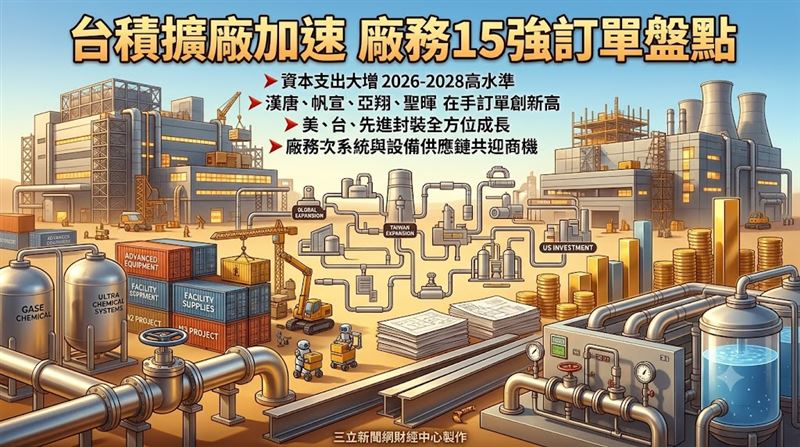
Fab construction suppliers see record orders Setn and Mirror Media highlight that TSMC’s increased capital expenditure is driving structural growth for Taiwan’s fab engineering sector. Companies like Han Tang (2404) have reported record backlog orders worth NT$193.9 billion, driven by both US construction projects and domestic advanced packaging facilities.
Context & numbers
- CoWoS Capacity: Goldman Sachs projects TSMC’s CoWoS capacity to reach 1.275 million wafers in 2026 (~106,000 per month), with a projected 114% year-over-year surge to 2.73 million wafers in 2027 (227,500 monthly).
- Capital Expenditure: TSMC’s 2026 capex guidance has been raised to $60–$64 billion, with a significant portion directed toward 2nm, 3nm, and advanced packaging.
- Kumamoto 3nm Capacity: The approved Kumamoto Fab 2 3nm plan is expected to have a initial monthly capacity of 6,000 wafers, subject to Japanese government subsidies.
- Arizona Production: TSMC’s Arizona fab produced over 100 million chips for Apple in 2026, primarily for iPhone, iPad, and Apple Watch.
On the radar
- CoWoS Yield Improvements: Reports indicate TSMC’s CoWoS yield has broken through 98%, enabling more complex 14x reticle size packages.
- Rare Earth Avoidance: Reuters reports TSMC is seeking to use motors without rare earth elements to reduce dependence on Chinese supply chains.
- Powerchip Price Hikes: Competitor Powerchip reported mature node capacity is fully loaded and plans to raise prices by 10-20% in 2027, signaling sustained demand across the semiconductor spectrum.
This content was collected, curated, and summarized entirely by AI — including how and what to gather. It may contain inaccuracies. Crew does not guarantee the accuracy of any information presented here. Always verify facts on your own before acting on them. Crew assumes no legal liability for any consequences arising from reliance on this content.
Powered by
