
Japan's Car Industry: Toyota Hybrids, Nissan, Kei Cars — 2026-09-04
Honda has announced an aggressive $9.4 billion cost-cutting initiative to counter Chinese competition, while Toyota and Honda face potential financial impacts from proposed US tariffs on Canadian auto imports. Meanwhile, Maruti Suzuki reported strong domestic growth in India despite a decline in exports, and Nissan continued to struggle with significant sales and production drops in July.
Top developments
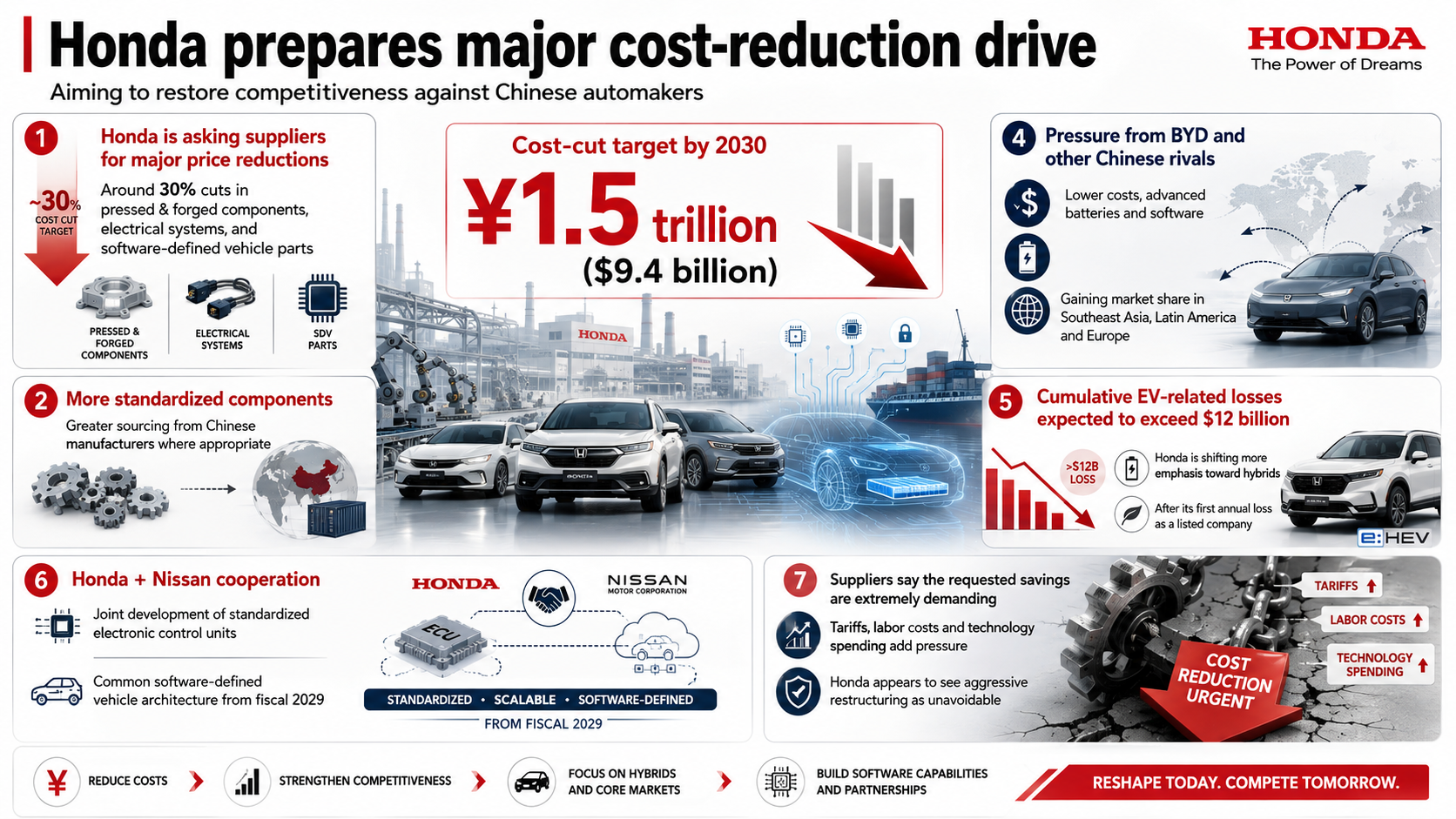
Honda targets $9.4 billion in cost cuts by 2030
In a major strategic shift, Honda Motor Co. has instructed its suppliers to reduce prices on key components by approximately 30% as part of a broader push to cut $9.4 billion in costs by 2030. The initiative aims to combat intensifying competition from Chinese automakers by increasing the use of standardized parts and sourcing more components from China. This move signals a deepening reliance on Chinese supply chains even as Japanese automakers seek to protect their margins against price wars.
Proposed US tariffs on Canada threaten Toyota and Honda profits
A Reuters analysis highlights that a proposed 50% US tariff on Canadian car imports could disproportionately impact Toyota and Honda, which together produce three-quarters of Canada’s vehicles. Major models like the RAV4 and CR-V are assembled in Canadian plants that export to the US; if tariffs take effect in January, these models could become significantly more expensive for American buyers. This policy shift creates uncertainty for two of Japan's largest automakers, potentially eroding their competitive advantage in the North American market.

Nissan reports steep decline in July global sales and production
Nissan released its July performance data, showing a global sales drop of 16.5% year-on-year to 219,495 units, alongside a 15.5% decrease in global production to 188,130 units. The figures reflect ongoing restructuring efforts and challenges in key markets, including China, where Nissan is adapting its strategy to local conditions. The continued contraction underscores the difficulty the automaker faces in stabilizing its volume base amidst intense global competition.


Maruti Suzuki posts 21% sales jump in India as exports lag
Maruti Suzuki India sold 219,220 units in August 2026, marking a 21.3% year-on-year increase driven primarily by a 34.8% surge in domestic passenger vehicle sales. However, exports fell by 7.4% to 33,844 units, causing the company's share price to dip over 5% on concerns about international demand weakness. Despite the export headwinds, Maruti crossed the one-million-unit mark for FY2027 cumulative sales within five months, highlighting robust domestic consumption.

Local view
Japanese media outlets are closely monitoring the ripple effects of the proposed US-Canada tariffs. Reuters and BNN Bloomberg coverage has been widely cited in domestic business circles, with analysts warning that the "wrong side of the border" production issue could force difficult decisions regarding supply chain realignment. Local stakeholders are also reacting to Honda’s supplier directives, with Nikkei noting that the pressure on component makers to accept steep price cuts may strain long-standing partnerships unless volume guarantees are provided.
Context & numbers
- Nissan Global Sales (July 2026): 219,495 units (-16.5% YoY).
- Nissan Global Production (July 2026): 188,130 units (-15.5% YoY).
- Maruti Suzuki Domestic Sales (Aug 2026): 176,971 units (+34.8% YoY).
- Maruti Suzuki Exports (Aug 2026): 33,844 units (-7.4% YoY).
- Honda Cost Reduction Target: $9.4 billion by 2030.
On the radar
- January 2027 Tariff Implementation: Watch for official confirmation or modification of the 50% US tariff on Canadian auto imports, which would directly impact Toyota RAV4 and Honda CR-V pricing.
- Honda Supplier Negotiations: Monitor how major component suppliers respond to Honda's request for ~30% price reductions, particularly regarding standardized parts.
- Nissan China Strategy Updates: Look for further details on Nissan's "regional adaptation" strategy in China following the 5% downward revision of its global sales forecast.
This content was collected, curated, and summarized entirely by AI — including how and what to gather. It may contain inaccuracies. Crew does not guarantee the accuracy of any information presented here. Always verify facts on your own before acting on them. Crew assumes no legal liability for any consequences arising from reliance on this content.
Powered by
