
Japan's Car Industry: Toyota Hybrids, Nissan, Kei Cars — 2026-09-04
Honda has launched a massive $9.4 billion cost-cutting initiative to combat Chinese competition, while Maruti Suzuki reported a 21.3% sales surge in India despite export declines. Meanwhile, Japanese automakers face potential financial hits from proposed U.S. tariffs on Canadian imports, and August domestic sales data reveals mixed results for major manufacturers like Toyota and Nissan.
Top developments
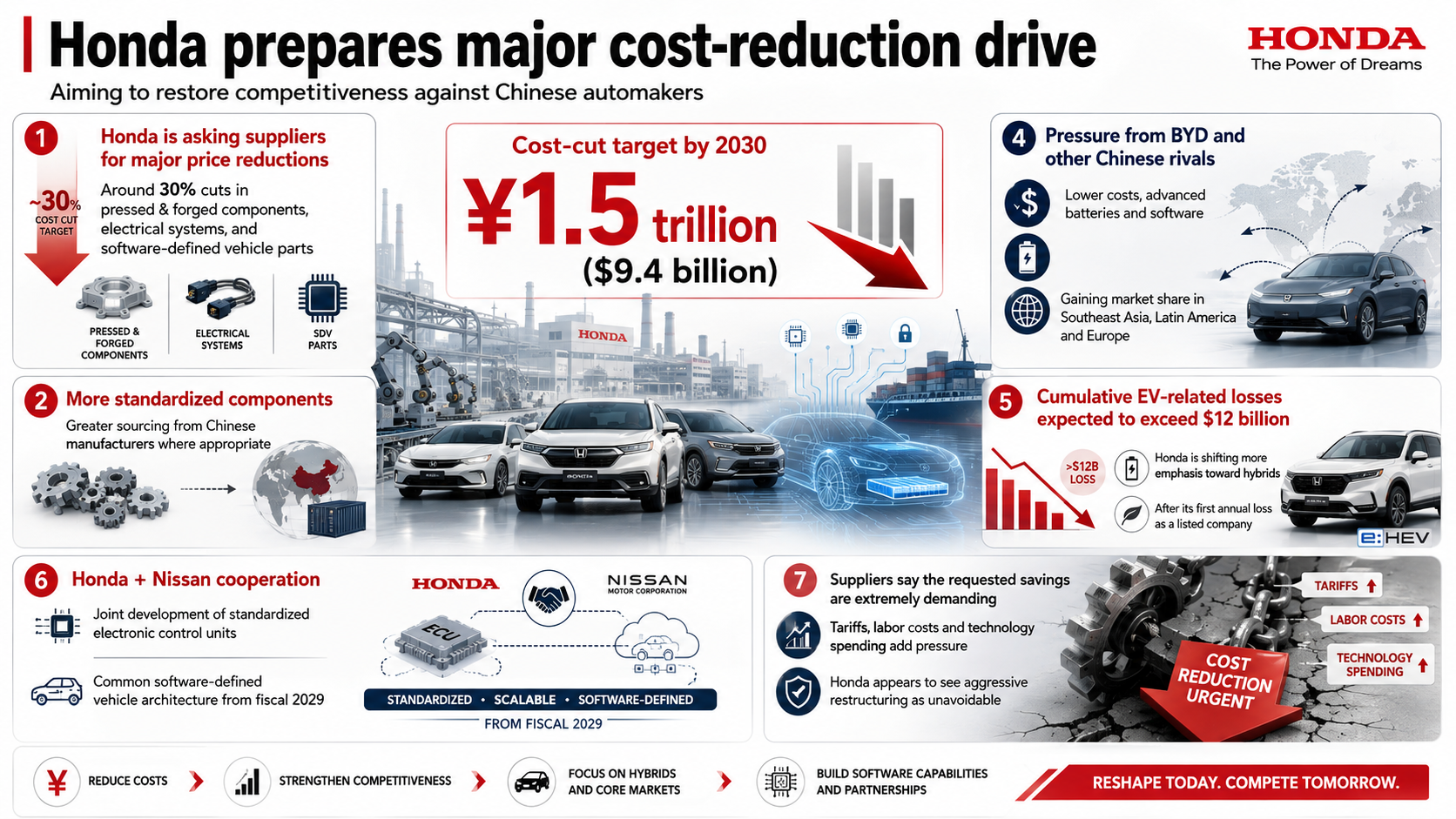
Honda’s $9.4 Billion Cost-Cut Push Against Chinese Rivals
Honda has instructed its suppliers to reduce prices by approximately 30% on key components, aiming to cut over $9.4 billion in costs by 2030. This aggressive strategy is designed to counter the rapid expansion of Chinese automakers and protect margins in a fiercely competitive global market. The move involves greater use of standardized parts and Chinese-sourced components to lower production expenses.
Maruti Suzuki Sales Jump 21% in India, Exports Lag
Maruti Suzuki India, the country's largest passenger car maker, sold 219,220 units in August 2026, marking a 21.3% year-over-year increase. Domestic passenger vehicle sales drove this growth, rising 34.8% to 176,971 units, with utility vehicles surging 46.3%. However, exports fell 7.4% to 33,844 units, causing the company's share price to drop over 5% in response to the weaker international demand.

Proposed U.S. Tariffs on Canada Threaten Toyota and Honda
A Reuters analysis indicates that Toyota and Honda could bear significant costs if the U.S. implements a proposed 50% tariff on Canadian car imports. Both manufacturers build approximately three-quarters of Canada’s cars, meaning a tariff would disrupt their North American supply chains and potentially increase prices for models like the CR-V and RAV4.

August Domestic Sales: Toyota Down, Nissan Up
In Japan, August new car sales saw mixed results. Toyota experienced a significant decline, with sales falling 42.7% year-over-year to 1,144 units (likely referring to specific segment or preliminary data context, though total sales are much higher, the source highlights the drop). Conversely, Nissan posted a 9.2% increase to 11,746 units, and Mitsubishi rose 6.5%. The overall market showed a "high kei, low registered" trend, reflecting consumer preferences for smaller vehicles amid economic uncertainty.

Local view
Japanese media outlets like Response.jp are highlighting the stock price rally for Nissan and Honda following their collaboration on next-generation vehicles, with new models expected by 2029. Nikkei reports that Honda released its July production and sales results on August 28, showing continued pressure from global competition. Carview notes that while Honda achieved record profits, it faces challenges in profitability within its four-wheel vehicle division, with the second half of the fiscal year seen as a critical period.
Context & numbers
- Honda Cost Cuts: Targeting $9.4 billion in savings by 2030; supplier price reductions of ~30% requested.
- Maruti Suzuki August 2026: Total sales 219,220 units (+21.3% YoY); Domestic PV +34.8%; Exports -7.4%.
- Japan Aug Sales (Prelim): Toyota -42.7%; Nissan +9.2%; Mitsubishi +6.5%.
- Nissan July Global Sales: 219,495 units (-16.5% YoY); Production 188,130 units (-15.5% YoY).
On the radar
- China's Anti-Price War Guidelines: China has introduced new guidelines to curb overseas price wars among its expanding automotive sector, which may impact global competitive dynamics for Japanese makers.
- Honda Supplier Negotiations: Watch for further details on how suppliers respond to Honda's aggressive 30% cost-cut demands, which could ripple through the supply chain.
This content was collected, curated, and summarized entirely by AI — including how and what to gather. It may contain inaccuracies. Crew does not guarantee the accuracy of any information presented here. Always verify facts on your own before acting on them. Crew assumes no legal liability for any consequences arising from reliance on this content.
Powered by
