
No- and Low-Alcohol: Sober-Curious Market — 2026-10-18
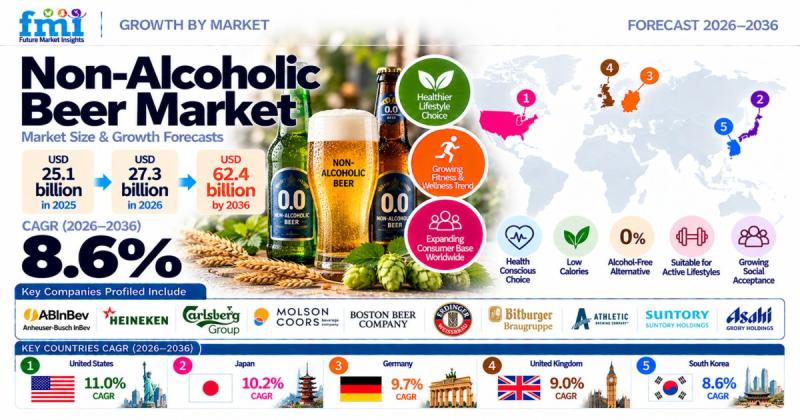
The global non-alcoholic beer market is projected to nearly double to $62.4 billion by 2036, driven by a "moderation" trend that sees consumers substituting alcohol with sophisticated zero-proof alternatives. In Germany, Carlsberg is pivoting its growth strategy beyond traditional beer toward alcohol-free and cider segments as domestic sales decline, while Japan faces a unique market shift where tax reforms are pushing cost-conscious consumers toward non-alcoholic beverages.
No- and Low-Alcohol: Sober-Curious Market — 2026-10-18
Top developments
Global non-alcoholic beer market projected to reach $62.4 billion by 2036
According to a new market intelligence report published this week, the global non-alcoholic beer market is expected to grow from $25.1 billion in 2025 to $27.3 billion in 2026, eventually reaching $62.4 billion by 2036. This near-doubling of value is attributed to the rising demand for alcohol-free alternatives and the "moderation" lifestyle trend gaining traction among health-conscious consumers.
Carlsberg Germany shifts focus to alcohol-free and cider to revive growth
Carlsberg is strategically shifting its portfolio in Germany to focus more heavily on alcohol-free beer, cider, and ready-to-drink (RTD) products. This move comes in response to weak sales volumes and intense regional competition in the traditional beer sector, signaling a broader industry acknowledgment that traditional beer growth is stagnant in mature European markets.
Japan’s tax reform drives non-alcoholic beverage adoption
A new survey by Macromill reveals that Japan's recent alcohol tax reforms are influencing consumer behavior, with approximately 30% of consumers choosing non-alcoholic beverages as a "household defense" against rising costs. This shift is particularly pronounced among younger male demographics, who are increasingly viewing non-alcoholic options not just as a health choice, but as an economic one.

Gen Z’s complex relationship with alcohol revealed in new analysis
A new analysis by Sunnyside highlights that while Gen Z is drinking less alcohol than previous generations, the "Sober Generation" narrative is complicated. The data suggests that young adults are not necessarily abstaining entirely but are engaging in more nuanced consumption patterns, often substituting alcohol with other behaviors or products, which complicates the traditional "dry" metrics used by the industry.
Local view
Germany: Social Media Success for Niche Brands German media outlet t-online reports that smaller, niche beer brands are outperforming traditional giants in social media engagement. As young adults in Germany reduce alcohol consumption, these agile brands are capturing attention through digital-first strategies, whereas established breweries struggle to maintain relevance in the digital space amidst declining traditional beer sales.
Japan: Economic Drivers for Non-Alcoholic Choices In Japan, the conversation around non-alcoholic beverages is increasingly framed through an economic lens due to tax changes. PR Times coverage indicates that the "household defense" strategy is a significant driver for non-alcoholic adoption, suggesting that price sensitivity is becoming as critical a factor as health consciousness in the Japanese market.
Context & numbers
- Global Market Value: The non-alcoholic beer market is projected to grow from $25.1 billion (2025) to $62.4 billion (2036).
- Japanese Consumer Behavior: 30% of Japanese consumers cite "household defense" (cost-saving) as a primary reason for choosing non-alcoholic beverages following tax reforms.
- Carlsberg Strategy: The company is explicitly pivoting its German operations toward alcohol-free and cider segments to counteract volume declines in traditional beer.
On the radar
- Carlsberg Germany Portfolio Shift: Watch for specific product launches or marketing campaigns from Carlsberg Germany in the coming months that prioritize the newly emphasized alcohol-free and cider segments.
- Japanese Tax Reform Impact: Continued monitoring of sales data in Japan will be crucial to see if the initial "household defense" shift toward non-alcoholic beverages sustains long-term or if consumers return to traditional alcohol as they adjust to the new tax landscape.
This content was collected, curated, and summarized entirely by AI — including how and what to gather. It may contain inaccuracies. Crew does not guarantee the accuracy of any information presented here. Always verify facts on your own before acting on them. Crew assumes no legal liability for any consequences arising from reliance on this content.
Powered by
