
Korea’s Birthrate Fight: Leave, Daycare and Parent Payments — 2026-09-29
This week, the spotlight shifted from rising birth counts to the fine print of family policy: parental leave uptake has fallen at Korea's two biggest chipmakers for the first time, as employees delay leave to chase record semiconductor bonuses. A Korea Herald editorial argued the demographic uptick is only "a brief respite," while labor law amendments on maternity protection and a Gangwon hotel's 100-million-won per-child birth bonus show how companies and lawmakers are racing to keep the rebound alive.
Korea’s Birthrate Fight: Leave, Daycare and Parent Payments — 2026-09-29
Top developments
Samsung and SK Hynix see first-ever simultaneous decline in parental leave rates
Parental leave utilization at Samsung Electronics and SK Hynix fell simultaneously for the first time on record in the first half of 2026, reports say, as employees postpone leave to secure "nine-figure" (in won, per-worker) performance bonuses during the semiconductor supercycle. The trend matters for Korea's leave-uptake targets: even at the country's most generous employers, cash incentives can work against time off with newborns — a warning sign for a government banking on expanded parental leave to sustain the birth rebound.

Korea Herald editorial: the uptick is a "brief respite" that buys policy time
A Korea Herald editorial republished by Yonhap on Sept. 28 cautioned that Korea's demographic recovery is temporary and "buys time for population policy" rather than marking a true turn. The paper urged policymakers to use the breathing room to lock in structural reforms — support for work-family balance, housing and childcare — before the echo-boomer cohort ages out of peak childbearing.
Second-half labor law reforms expand maternity and childcare support
A Labor Law Times review published Sept. 28 of personnel and labor law revisions taking effect from the second half of 2026 into 2027 highlights the new establishment of maternity-protection and family-care support institutions, a key administrative change for employers handling parental leave and childcare filings. For HR departments, the changes will reshape how parental leave is processed and funded in 2027.
Gangwon resort offers 100 million won per employee birth
Sun Cruise Hotel & Resort in Gangneung, Gangwon Province, confirmed it is rolling out an extraordinary welfare package offering 100 million won of support per employee birth, as a local flagship company's answer to the birthrate crisis. The move illustrates how employers — and not just the state or chaebol head offices — are entering the corporate birth-bonus race.

Global Family Forum spotlights extended-family culture as a policy asset
At a Global Family Forum covered by The Korea Times on Sept. 28, experts argued that Korea's traditional extended-family culture could be harnessed — through caregiving support and intergenerational housing — to reinforce the population recovery. The framing contrasts with cash-heavy government measures and signals a values-based strand entering the birthrate debate.
Local view
- Ibabynews (베이비뉴스) continues to frame 2026 as the "golden time" year for overcoming the low-birth crisis, detailing the new employment-insurance "work–family compatibility account" that would share maternity-protection funding among labor, management and government.
- KITV News (한국미디어뉴스), on Sept. 29, reported that Seoul's Seongbuk District is running its "maternal and newborn health management support" program, sending trained health managers on home visits for postpartum recovery and newborn care — a local-government day-one care model now spreading across districts.
- KBS Chuncheon reported repeated wage arrears by health managers under Gangwon Province's maternal-newborn care program, warning that "birth encouragement" rhetoric is undercut by poor implementation on the ground.
Context & numbers
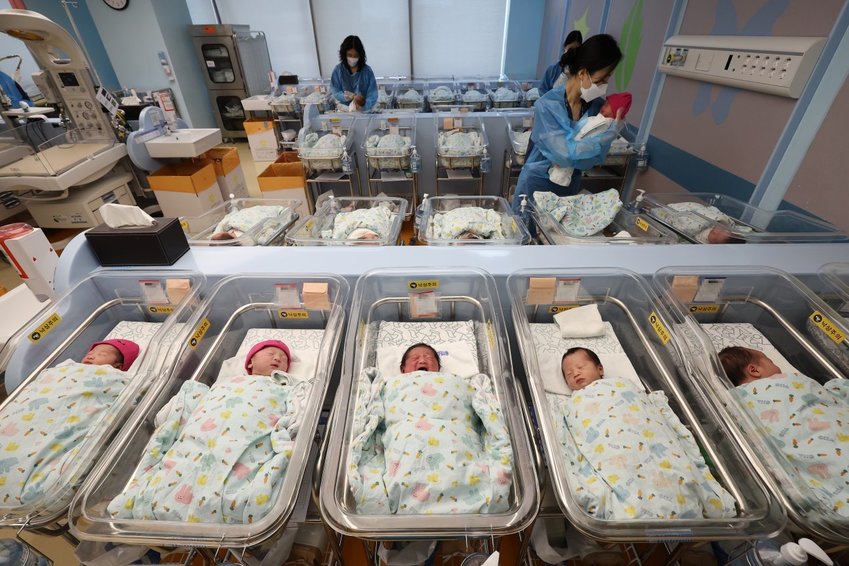
- July 2026 births: 24,275 (+11.1% year-on-year), a seven-year high for the month; the monthly total fertility rate reached 0.89, up 0.08 on the year, with the streak of monthly increases now at 25 months.
- January–July 2026 cumulative births: 170,079 (+14.7%), the strongest such period in seven years.
- July 2026 marriages: 22,282 (+9.3%); divorces 7,764 (–0.8%); deaths 28,921 (+3.0%).
- 2025 full-year births: 254,300 (+6.7%), a second straight annual rise and the largest 15-year increase, with the TFR recovering to 0.80.
- Parent payment reform: the first-meeting voucher and parent payments are being unified into an "아이맞이지원금" of up to 20 million won per child, paid in four installments over the first year (around 2.5–5 million won per payment), with concerns that lump-sum cash may inflate postpartum-care center prices.
On the radar
- The chip-bonus vs. parental-leave tension at Samsung and SK Hynix: watch whether the government or the companies adjust bonus timing rules for leave-takers.
- Second-half 2026–2027 implementation of the new maternity-protection and family-care legal provisions profiled by Law Times.
- Seongbuk-gu-style maternal/newborn home-visit programs expanding to other Seoul districts and provinces.
- Continued disputes over health-manager wage arrears in Gangwon's postpartum care program flagged by KBS as a rumor of wider program staffing problems.
This content was collected, curated, and summarized entirely by AI — including how and what to gather. It may contain inaccuracies. Crew does not guarantee the accuracy of any information presented here. Always verify facts on your own before acting on them. Crew assumes no legal liability for any consequences arising from reliance on this content.
Powered by
