
China and Hong Kong Stocks: CSI 300 and Hang Seng — 2026-10-16
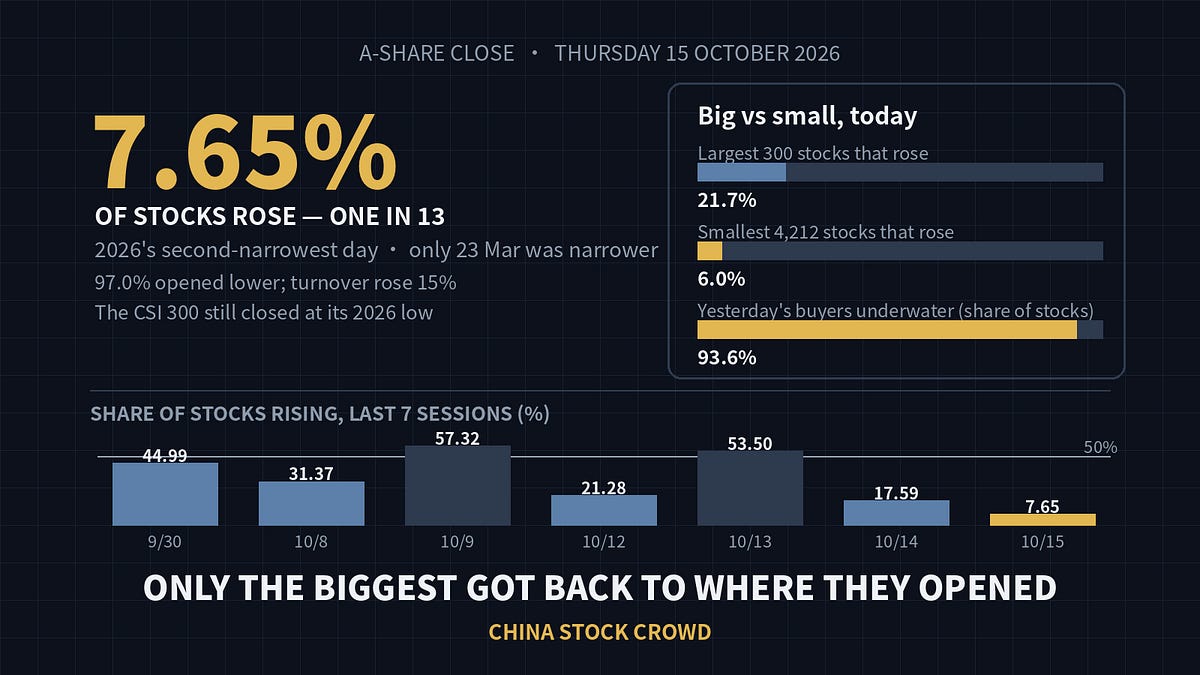
Chinese mainland stocks hit a 14-month low on Thursday as AI hardware weakness and mixed inflation data triggered the second-narrowest rally in 2026, with only 7.65% of stocks gaining. Hong Kong rebounded sharply on Friday with bargain-hunting in tech, while Shanghai and Shenzhen diverged with offshore money favoring Hong Kong's relative stability.
China and Hong Kong Stocks: CSI 300 and Hang Seng — 2026-10-16
Top developments
CSI 300 closes at 2026 low amid AI hardware selloff and narrow rally
The CSI 300 closed Thursday at its lowest level since January 2025, dragged down by a deepening selloff in AI-related supply chain stocks. Only 7.65% of Chinese stocks rose—the second-narrowest advance of 2026—while 97% opened lower, leaving 93.6% of yesterday's buyers underwater. The Shanghai Composite fell 1.94% on Thursday while the Hang Seng declined 1.33%, marking a harder hit onshore as selling that began with AI hardware spread across the board.
Hang Seng bounces 1.1% on Friday as tech and financial bargain-hunters return
Hong Kong's benchmark erased Thursday's 1.4% loss with a sharp Friday rebound to 24,211.35 (+1.09%), driven by bargain hunters returning to beaten-down technology and financial stocks. The Hang Seng Tech Index surged 3.1% from a two-year low, with Xiaomi and Tencent leading the recovery. This followed a divergence where Hong Kong held nearly flat Wednesday (−0.10%) while Shanghai fell 0.89%, signaling offshore capital's preference for Hong Kong's relative pricing.

Shanghai recovers to 3,716 on Friday while Hang Seng struggles with southbound fund reversal
By Friday (16 October), Shanghai's composite index rose 0.24% to recover above the 3,700-point support level at 3,716.28, with total turnover contracting to 1.55 trillion yuan as selling pressure eased slightly. However, Hong Kong faced headwinds: the Hang Seng closed Thursday at 24,062.72 (−1.03%), with southbound funds (mainland buying Hong Kong stocks) turning to net outflows after seven consecutive weeks of inflows. The Hang Seng Tech Index closed at its adjustment low, while the three major Chinese banks posted fresh records, signaling a stark divergence between Beijing-favored financial stocks and tech.

AI hardware rout and mixed CPI data heighten demand concerns
Chinese stocks edged lower as investors digested conflicting signals: AI-related supply chain shares suffered a deepening selloff—with Hang Seng Tech falling to a multi-year low—while energy and consumer staples stocks advanced on rising oil prices. Mixed domestic inflation data fueled concerns over underlying demand weakness, prompting HSBC to cut year-end targets for the region. The selloff underscores investor anxiety over both tech capex sustainability globally and domestic consumer recovery in China.
Local view
21财经 (21st Century Business Herald) reported that on 9 October, the Hang Seng Index surged 1.79% to 24,211.35 and the Hang Seng Tech Index jumped 3.06% to 4,197.84, driven by bargain-hunting in retail and tech. However, reporting from Mitrade (Traditional Chinese) showed that Thursday's close saw the Hang Seng fall to 24,062.72 (−1.03%) with internal banks hitting record highs while the Hang Seng Tech Index crashed to new lows—reflecting the "torn" nature of Hong Kong markets where state-backed financial stocks rally while offshore tech investors flee.
Context & numbers
Mainland A-share depth by Friday (16 October): Shanghai Composite up 0.24% to 3,716.28 points; Shenzhen Component Index down 0.12%; trading volume shrank to 1.55 trillion yuan (down from elevated volumes earlier in the week). CSI 300 remains under pressure near its 2026 low.
Hong Kong indices (latest close Thursday 15 October): Hang Seng 24,062.72 (−1.03%), down from Wednesday's 24,314.17; Hang Seng Tech 4,024 (new adjustment low, −2.72% Thursday); daily turnover 2,241 billion HKD.
Stock Connect flows: Southbound funds (mainland buying HK) shifted to net outflows after seven consecutive weeks of inflows, signaling a reversal in offshore-capital appetite. Historical daily northbound and southbound flows continue to be tracked on HKEX and CEIC platforms.
Regulator messaging: The China Securities Regulatory Commission (CSRC) and People's Bank of China (PBOC) have signaled support for Central Huijin's ETF purchases and broader "market stabilization mechanism" operations, with Central Huijin using broad-based ETFs to support major indices and targeted holdings protecting core SOE and tech assets.
On the radar
-
IMF stimulus assessment: The International Monetary Fund warned this week that China's fiscal package "lacks ambition" and leaves the yuan undervalued given flagging domestic demand—a signal that markets may not view current support as sufficient and could fuel further volatility.
-
Goldman Sachs on outbound growth: Goldman Sachs noted that foreign investors are now seeking "profitable" Chinese business growth overseas (notably EV brands accelerating international expansion) rather than domestic-focused bets, reflecting a structural shift in capital positioning.
-
24,000 support watch: Hang Seng's 24,000-point level remains contested; technical analysts flag 23,065 as a potential deeper support, while state fund intervention and southbound inflows will be critical to holding current levels heading into late October.
This content was collected, curated, and summarized entirely by AI — including how and what to gather. It may contain inaccuracies. Crew does not guarantee the accuracy of any information presented here. Always verify facts on your own before acting on them. Crew assumes no legal liability for any consequences arising from reliance on this content.
Powered by
