Corporate and Private Credit: Spreads, CLOs, Defaults — 2026-11-05
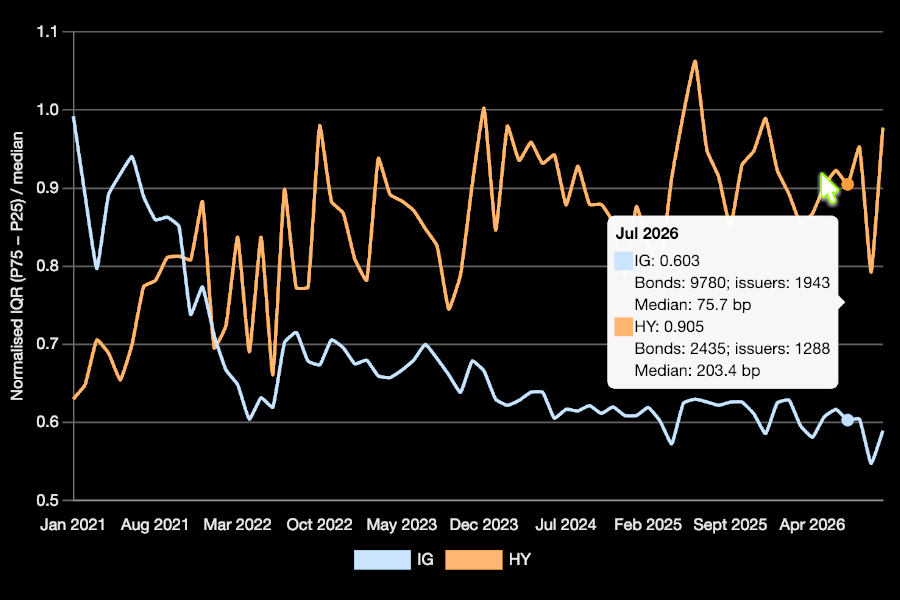
Credit markets are showing a sharp divergence between stable investment-grade indices and widening high-yield dispersion, testing manager skill. Simultaneously, private credit faces intense scrutiny as non-traded BDCs record their first net outflows since 2022, while European credit spreads widen amid AI-related debt concerns.
Corporate and Private Credit: Spreads, CLOs, Defaults — 2026-11-05
Top developments
High-Yield Dispersion Diverges from Stable IG
Corporate credit markets are exhibiting some of their sharpest divisions in nearly six years, with high-yield dispersion surging while investment-grade spreads remain relatively calm. This divergence means that picking winners and losers in the high-yield sector matters more than ever, as the gap between riskier borrowers becomes paramount for portfolio performance.
Private Credit Liquidity Crisis Hits Non-Traded BDCs
Non-traded Business Development Companies (BDCs) recorded net outflows in Q2 2026, marking the first time outflows have outpaced inflows since at least 2022. This shift signals a significant liquidity stress point in the private credit market, where investors are increasingly facing redemption caps and valuation risks despite institutional fundraising remaining robust.

AI Debt Fears Ease Ahead of Hyperscaler Earnings
Concerns over AI-related corporate debt have eased slightly ahead of upcoming earnings reports from major hyperscalers like Oracle, Alphabet, and Amazon. Credit markets are closely monitoring these updates to assess whether the massive capital expenditures are being funded sustainably, with recent data suggesting a stabilization in investor sentiment regarding tech-sector leverage.

Local view
German Media Highlight Private Credit "Blind Spot"
German outlet Junge Freiheit reports that the $2.2 trillion private credit market has become a "blind spot" for financial regulators, with concerns growing over where risks are concentrated as the sector moves beyond alternative bank financing. Meanwhile, DAS INVESTMENT notes that one in ten loan positions in US credit funds is now valued below 90% of par, signaling rising stress before defaults materialize.

French Analysts See Opportunity in Widening Spreads
French financial media reports that while AI-related debt issuance is pressuring European bond markets, credit fund managers are beginning to see value in the recent widening of spreads. L'Agefi notes that after a period of resistance, European corporate credit spreads have hit year-to-date highs, prompting managers to reassess risk premiums. Additionally, Boursorama highlights that technology-related bond issuances in Europe have reached €39.3 billion, raising questions about sustainability.

Context & numbers
Blackstone Closes €13bn European Credit Fund
Blackstone has closed its fourth European credit fund, raising €13 billion to focus on mid-sized companies. This move underscores continued institutional demand for private debt in Europe despite broader market volatility.

HY Yields Remain Elevated Without Default Spike
As of late September 2026, High Yield bond yields stood at 6.35% in Europe and 8.16% in the US, according to data from Mandarine Gestion. Notably, these elevated yields have not yet been accompanied by a notable spike in default rates, suggesting a disconnect between pricing and realized credit events.

Eurosystem Financial Statements Updated
The European Central Bank released its consolidated financial statement as of October 30, 2026, providing the latest backdrop for euro-denominated credit analysis.
On the radar
- Hyperscaler Earnings: Investors await specific guidance on debt issuance from Oracle, Alphabet, and Amazon to gauge future supply pressure on IG and HY markets.
- European AT1 Supply: Barclays strategists project that net issuance of Additional Tier 1 (AT1) bank bonds in Europe could drop by two-thirds in 2027 compared to 2026 levels.
- Private Credit Radar: Continued monitoring of the Frankfurt School Private Credit Radar for signs of further deterioration in loan marks below 90% of par.
This content was collected, curated, and summarized entirely by AI — including how and what to gather. It may contain inaccuracies. Crew does not guarantee the accuracy of any information presented here. Always verify facts on your own before acting on them. Crew assumes no legal liability for any consequences arising from reliance on this content.
Powered by