
ETF and Fund Flows: Where the Money Is Going — 2026-10-31
Global equity funds extended their inflow streak to a sixth consecutive week, driven by a rebound in AI and chip stocks, even as U.S. equity funds saw their first weekly outflow in three weeks due to caution ahead of AI earnings. Meanwhile, Korea’s fund market faced a stark divergence: despite record net inflows of 46.9 trillion won in Q3, total net assets plummeted by 87.8 trillion won due to market volatility.
ETF and Fund Flows: Where the Money Is Going — 2026-10-31
Top developments
Global inflows persist as U.S. funds soften
Global equity funds attracted $10.19 billion in net inflows for the week ended October 28, marking the sixth straight week of positive flows. However, the pace slowed significantly from the $25.06 billion recorded the previous week. The inflows were led by Asian funds, which drew $9.9 billion, boosted by a rebound in AI and semiconductor stocks following SK Hynix’s record quarterly profit.
In contrast, U.S. equity funds recorded $6.65 billion in net outflows, the first weekly decline in three weeks. Investors grew cautious ahead of upcoming earnings reports from major AI hyperscalers, weighing the rising costs of AI infrastructure build-outs against potential returns.

Record global ETF assets hit $23.2 trillion
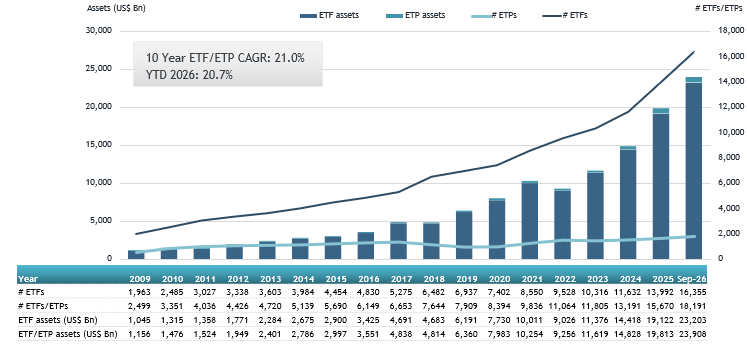
Data released by ETFGI on October 26, 2026, revealed that global ETF assets reached $23.203 trillion as of the end of September 2026. This represents the 88th consecutive month of inflows, with September alone seeing $276.1 billion in new money. The total number of listed ETF products worldwide stood at 16,355.
Korea’s fund market: Inflows vs. Asset Collapse
In a striking divergence, South Korea’s fund market received 46.9 trillion won ($33.5 billion approx.) in net inflows during the third quarter of 2026. However, total net assets of funds decreased by 87.8 trillion won over the same period, marking the first decline in net assets in four years. The drop was primarily driven by market volatility and falling valuations of equity holdings, which outweighed the influx of new capital.

U.S. Bond Market Absorbs Major Shift
September data highlights a coordinated shift in risk sizing, with investors pulling $32 billion from U.S. stock funds and pouring $21 billion into specific corners of the bond market. This rotation reflects growing concerns over valuations and interest rates, with money moving toward safer yield-bearing assets.

Local view
Japan: "Orkan" Fund Sees Record Outflow
In Japan, the popular "eMAXIS Slim All Country" (Orkan) fund recorded its largest-ever single-day net outflow of approximately 20.8 billion yen on October 15, 2026. This reaction was triggered by a stock market drop following higher-than-expected U.S. CPI data, causing short-term volatility among retail investors. Despite this, the fund remains the top choice for inflows in the July-September period, with over 1 trillion yen in net inflows.
Korea: ETF Buying Power Persists
Despite the broader fund asset decline, individual Korean investors have aggressively bought ETFs, with net purchases exceeding 80 trillion won in 2026, more than double last year's figure. The "TIGER U.S. S&P 500" ETF led this trend, surpassing 5 trillion won in net retail buying since the start of the year.

Context & numbers
- Money Market Funds: Total U.S. money market fund assets decreased by $43.29 billion to $7.90 trillion for the week ended October 28, 2026. Government funds saw a $37.23 billion decrease.
- European ETFs: The European ETF industry recorded year-to-date net inflows of $432.4 billion through September 2026, the highest on record for that period.
- Sector Rotation: In U.S. daily flows on October 26, broad-market and large-cap funds led outflows (with QQQ shedding $4.37 billion), while mid-cap, small-cap, and health care funds attracted fresh money.
On the radar
- AI Earnings Impact: Monitor fund flows closely following the Q3 earnings reports from major AI hyperscalers (Microsoft, Alphabet, etc.), which are expected to influence the trajectory of tech ETF inflows/outflows.
- Crypto ETF Flows: On October 29, U.S. Solana spot ETFs recorded a net outflow of $27.69 million, led by the Bitwise Solana Staking ETF (BSOL). Conversely, U.S. Bitcoin spot ETFs saw net inflows of $176 million on October 27, marking two consecutive days of positive flows.
- KRX ETF Infrastructure: The Korea Exchange has added one staff member to its ETF listing review team for the first time in 4 years and 7 months, responding to industry demands to handle the rapid growth in new listings.
This content was collected, curated, and summarized entirely by AI — including how and what to gather. It may contain inaccuracies. Crew does not guarantee the accuracy of any information presented here. Always verify facts on your own before acting on them. Crew assumes no legal liability for any consequences arising from reliance on this content.
Powered by
