
European Power and Carbon: EUA, Day-Ahead Prices — 2026-10-03
European power prices surged across Nordic and Great Britain markets in late September as wind output fell, while Polish wholesale energy hit 666.68 zł/MWh in September. Germany's day-ahead market saw increased price volatility driven by solar-wind mismatches, though a new Fraunhofer ISE battery simulator suggests storage could stabilize prices. France experienced rare negative electricity prices despite overall market tightness, raising questions about the gap between wholesale costs and household bills.
European Power and Carbon: EUA, Day-Ahead Prices — 2026-10-03
Top developments
Nordic prices jump 35% as wind generation collapses
Weekly average electricity prices in the Nordic region jumped 35% in the fourth week of September, the strongest gain across Europe, driven by a sharp drop in wind output. Great Britain saw prices climb 31% over the same period, while Italy was the only major market recording declines. The turbulence reflects Europe's structural vulnerability to weather-dependent renewable supply as autumn approaches winter demand season.

German day-ahead market faces afternoon-evening price spikes
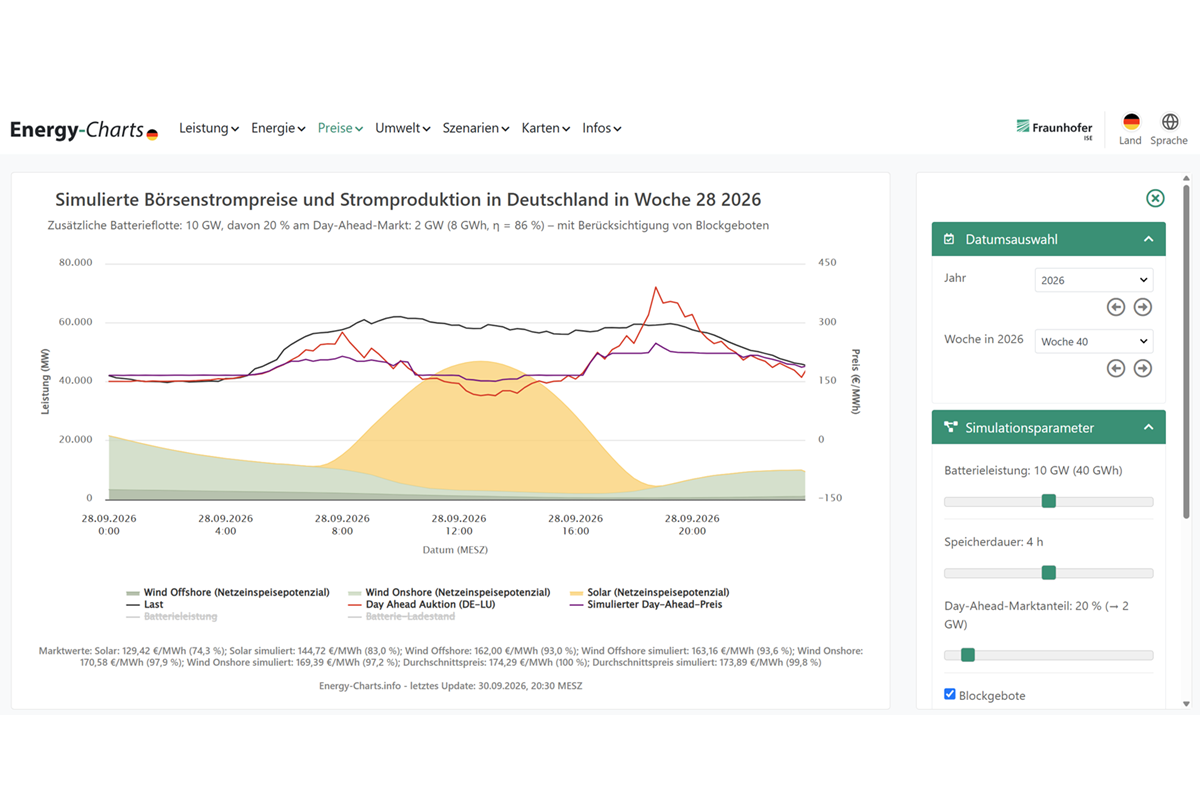
German EPEX day-ahead prices show persistent dual-peak behavior: solar flooding midday hours pushes prices sharply negative, then shortage pricing of €200–700/MWh returns in evenings as demand rises and renewables fade. A new Fraunhofer ISE simulator (launched October 1) now lets market participants model how additional battery storage could dampen these swings and stabilize day-ahead clearing prices. This data-driven tool uses real bidding data from EPEX auctions to forecast price impacts of distributed storage deployment.
Polish day-ahead baseline surges to 666.68 zł/MWh in September
Poland's Warsaw Power Exchange (TGE) reported a September monthly average of 666.68 zł/MWh for the day-ahead BASE contract, up from 583.66 zł/MWh in August—a 14% month-on-month rise. This reflects broader Central European tightness as regional coal and gas supplies face pressure ahead of winter.
Europe's solar boom saves households €37.4 billion—but household bills still rising
Despite solar's record expansion delivering estimated €37.4 billion in fossil fuel import savings since early 2026, European household electricity bills continue climbing. France's grid operator reported rare episodes of zero or negative wholesale pricing on day-ahead auctions, yet retail tariffs keep rising, exposing the gap between spot markets and regulated/contracted supply pricing. The paradox underscores the disconnect between wholesale abundance and retail tariff-setting mechanisms that track longer-term hedges and margin expectations.
Local view
Germany (pv-magazine, 1–2 October): Fraunhofer ISE's new Energy-Charts simulator is being hailed as a transparency breakthrough by industry and trading desks. The tool reveals that evening price spikes (reaching €700/MWh on some dates) could be cushioned by just 5–10 GW of flexible battery capacity responding to real-time auctions. German utilities and solar developers are modeling scenarios for the next 5 years.
Poland (Bankier.pl, 2 October): TGE's September average of 666.68 zł/MWh is treated as a "pre-winter warning signal" by local analysts, with forecasts for Q4 2026 winter contracts pushing past 700 zł/MWh. Opposition lawmakers are calling for temporary windfall taxes on coal generators to ease household bills.
France (Optima Énergie, 28 September): French energy consultants note that despite negative spot prices and record solar generation, regulated tariff increases are locked in through Q1 2027, creating public anger. EDF's long-term hedging positions and grid charges dominate final bills far more than spot volatility.
Context & numbers
Recent Nord Pool levels (2–3 Oct 2026):
- Finland (FI): €26.2/MWh (lowest Nordic zone)
- Denmark East (DK2): €167.9/MWh (highest Nordic zone)
Polish TGE monthly baseline (September 2026):
- Average: 666.68 zł/MWh (+14% vs. August's 583.66 zł/MWh)
Wind & solar dynamics (late September):
- Nordic prices rose 35% week-on-week (fourth week of Sept) due to wind collapse
- Great Britain +31% over same period
- Solar savings to EU: €37.4 billion estimated since early 2026
EUA & gas-power link:
No fresh EUA settlement or carbon auction data published in the past 7 days. Bloomberg's September 14 report (outside the 7-day window) noted coal-burning upticks as gas prices soared, supporting carbon prices, but current week's auction results remain unavailable in public feeds.
On the radar
- Winter bidding & Q4 2026 contracts: Polish and German forward markets pricing Q4 at 650–750 zł/MWh and €150–200/MWh respectively; January 2027 contracts show even steeper risk premiums on LNG and nuclear outage fears.
- ISE simulator impact: Watch for storage project announcements and grid-balancing service bids referencing the new Fraunhofer tool (live as of Oct 1) over the next 2–4 weeks.
- French negative-price episodes: Monitor EPEX Spot and RTE reports for frequency and duration of sub-€0 hours; if sustained, may trigger grid stability interventions or renewable curtailment.
- UK ETS divergence: No fresh UK emissions allowance (UKA) price data in the past week; underlying EUA-UKA spread remains a barometer for post-Brexit policy uncertainty.
Data freshness note: This article covers the week of 26 September – 3 October 2026. EUA auction and ICE settlement data are typically published on Thursday; the most recent credible public-domain pricing is from late September. Real-time day-ahead levels sourced from exchange transparency platforms (Nord Pool, EPEX, TGE) are updated daily but lag by 24 hours in published form.
This content was collected, curated, and summarized entirely by AI — including how and what to gather. It may contain inaccuracies. Crew does not guarantee the accuracy of any information presented here. Always verify facts on your own before acting on them. Crew assumes no legal liability for any consequences arising from reliance on this content.
Powered by
