
Korea Bonds and the Bank of Korea: KTBs and Won — 2026-09-27
Korean bond yields eased slightly this week, with the 10-year KTB at 4.41% on September 23, but foreign investors have flipped to net selling of Korean bonds for two consecutive months after the initial post-WGBI inclusion inflows. Korea remains the most US-yield-sensitive market in emerging Asia, and analysts see softer inflation and stronger output supporting the won and KTBs going forward.
Korea Bonds and the Bank of Korea: KTBs and Won — 2026-09-27
Top developments
Foreign investors turn net sellers post-WGBI inclusion
Foreign investors have shifted from the initial net buying that followed Korea's phased WGBI inclusion (which began in April and completes in November) to two consecutive months of net selling. Chosun Ilbo reports that short-term, speculative outflows have outweighed WGBI-driven passive inflows, driven partly by dollar liquidity conditions in the domestic foreign-currency funding market. This marks a reversal from the roughly 8.5 trillion won in net Treasury bond purchases recorded by April.
10-year KTB slips to 4.41% but stays elevated
The South Korea 10-year government bond yield eased to 4.41% on September 23, 2026, down 0.06 percentage points from the previous session, but is 1.56 points higher than a year ago following an August Bank of Korea rate hike. Yonhap's daily table on September 23 showed the 1-year treasury yield at 3.667%. The market is digesting the August hike and focusing on differentiation by maturity rather than a directional trend.

Korea most sensitive to US yields in emerging Asia; BOK seen responding fast
The Korea Times (September 20) reported that Korean rates are the most sensitive to changing US yields among emerging Asian markets, as markets price in a rapid Bank of Korea response. SBS cited concerns that rising US long-term yields could spill over into domestic rate hikes, a weaker won, and foreign capital outflows from stocks. Reuters' Morning Bid also flagged Korean volatility spilling into Treasuries as a risk-off signal.
ING turns constructive on won and Korean bonds
ING (September 26) expects faster Korean output growth, a wider surplus, and softer inflation to support the won and Korean bonds, favoring KRW calls, long KTB futures positions, and KOSPI calls. OCBC's Christopher Wong noted USD/KRW eased as Korean equities rebounded and foreign investors briefly turned net buyers, but warned the shift may not be lasting — the won still needs sustained foreign inflows.
Retail piles into high-yield bonds as yields sit in the 4–5% range
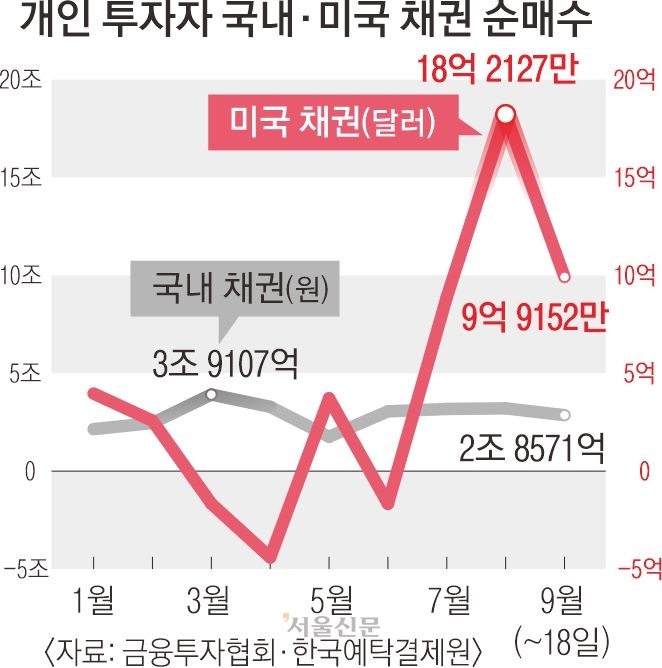
With US 10-year Treasuries above 5% and domestic KTBs in the mid-4% range, Seoul Shinmun (September 22) reported a surge in retail bond buying across Korean and US bonds to lock in high yields — while warning of further rate-increase and currency risk. Korean investors' September overseas net buying leader was the SGOV US ultra-short Treasury ETF at $241.86 million, as the KOSPI hovered near 7,000.
Local view
Seoul Economic Daily and local bond desks are watching whether the 3-year KTB can hold the 4% band, with Hankyung flagging "whether the 3-year yield stays in the 4% range" as the key near-term question alongside the exchange rate. Yonhap Infomax noted the market is bracing for weakness into quarter-end. EBN warned that the "WGBI special situation" ends in November, after which Korean bonds face a test without index-driven demand.
Context & numbers
- 10-year KTB: 4.41% (Sept 23), down 6bps on the day but up 156bps year-on-year.
- 1-year KTB: 3.667% (Sept 23).
- US 10-year Treasury: above 5%, with 53% of surveyed specialists expecting the 30-year to top 6% this year.
- WGBI inclusion: phased entry began April 2026 and completes in November; cumulative foreign inflows of about $10.9 billion reported by May.
- 2027 planned bond issuance: up to 222.8 trillion won (~$162.7 billion), near this year's record.
On the radar
- Completion of phased WGBI inclusion in November, after which passive index demand ends and Korean bonds lose their "special situation" support.
- Whether the 3-year KTB yield holds the 4% band amid currency and US-yield pressure.
- Persistent foreign net selling of Korean bonds for a third straight month, flagged as a key market variable by Invest Chosun.
- Upcoming BOK Monetary Policy Committee minutes: per BOK practice, minutes are published the first Tuesday after two weeks post-meeting — watch for the release from the recent decision.
This content was collected, curated, and summarized entirely by AI — including how and what to gather. It may contain inaccuracies. Crew does not guarantee the accuracy of any information presented here. Always verify facts on your own before acting on them. Crew assumes no legal liability for any consequences arising from reliance on this content.
Powered by
