
Seoul Stocks: KOSPI and KOSDAQ Daily — 2026-10-01
Foreign investors extended their fifth consecutive month of selling, dumping 21.5 trillion won on the KOSPI in September as U.S. Treasury yields hit 5.29%, with semiconductor giants Samsung Electronics and SK hynix accounting for 77% of outflows. Retail investors countered with $1.6 billion in buybacks, while institutions provided support, helping the KOSPI recover from intraday lows as the market braced for Q4 buyback headwinds.
Seoul Stocks: KOSPI and KOSDAQ Daily — 2026-10-01
Top developments
Foreign selling streak extends to fifth month; semiconductor rout accelerates
Foreign investors sold a net 21.5 trillion won (approximately $15.9 billion) of KOSPI shares in September, marking the fifth consecutive month of net outflows. The five-month cumulative total has now reached 135 trillion won. Samsung Electronics and SK hynix accounted for 16.5 trillion won of September's selling—77% of total foreign outflows—as U.S. Treasury yields climbed to 5.29%, making Korean equities less attractive relative to fixed-income alternatives.
Retail traders mount contrarian bet as KOSPI sinks; bargain hunting emerges
Korean retail investors purchased $1.6 billion in stocks as the KOSPI fell 2.70% to 6,889.74 on September 28, with foreigners and institutions selling simultaneously. Individual traders took the other side, betting on a rebound as valuations compressed. Institutional investors also provided support, helping the market recover from steeper intraday losses even as foreign selling pressure persisted through late September.
KOSPI oscillates near 6,900 as U.S. yields, oil prices weigh on sentiment
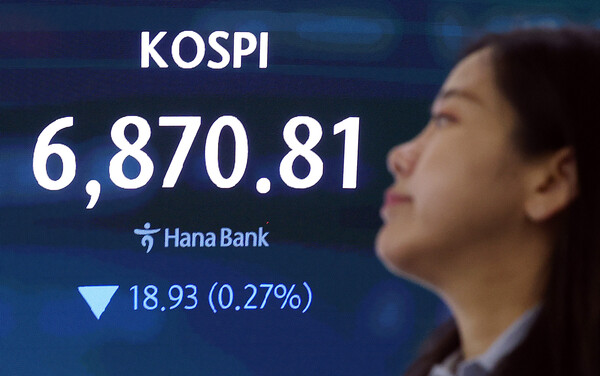
The KOSPI fell for a second consecutive session on September 29 to 6,870.81 (down 0.27%) as foreign investors sold 2.9 trillion won, while a third straight decline on September 30 saw the index drop to 6,838.04 (down 0.48%). Surging U.S. Treasury yields and elevated oil prices remained the primary headwinds, though semiconductor stocks rebounded modestly late in the month as bargain hunters emerged.
Samsung and SK Hynix buybacks stabilize late-month trading; Q4 support questioned
Samsung Electronics and SK Hynix share repurchase programs provided technical support as the quarter ended, with both stocks rebounding on October 1 after weeks of selling. However, market watchers warned that the expiration of these buyback programs in Q4 could create a "buying vacuum," removing a key pillar of support for the market when foreign selling and higher U.S. yields already constrain demand.
K-chip ETFs attract flows as individual mega-cap selling accelerates
While foreign investors net sold 16.5 trillion won in Samsung Electronics and SK Hynix individually in September, domestic semiconductor ETFs recorded inflows, suggesting tactical diversification away from concentrated bets on the two largest chipmakers. This divergence underscores the sector's bifurcated sentiment: structural bearishness on established memory-chip players offset by selective appetite for broader semiconductor exposure.
Local view
Asiae and Seoul Economic Daily reported that on September 30, the KOSPI rebounded as institutional investors stepped in with 120 billion won in net buying, while retail investors bought 1.14 trillion won. Foreigners remained net sellers, offloading 2 trillion won. The won-dollar exchange rate eased during the month as domestic sentiment stabilized late in the quarter.
Korean media highlighted the semiconductor sector's outperformance within the broader selloff, with materials, equipment, and component suppliers bouncing despite headwinds in memory chips. News outlets noted that SK Hynix and Samsung Electronics opened September 30 with gains as bargain hunting resumed, though the sustainability of the rebound remained uncertain given sustained foreign outflows and elevated U.S. Treasury yields.
Context & numbers
- KOSPI close (Sept. 30): 6,838.04 (−0.48% from Sept. 29)
- KOSDAQ close (Sept. 30): +0.38% to 849.80
- Foreign investor flows (September): −21.5 trillion won net sell
- 5-month cumulative foreign outflows (May–September): −135 trillion won
- Samsung Electronics & SK Hynix share of September selling: 16.5 trillion won (77% of total)
- U.S. 10-year Treasury yield (late September): 5.29%
- Won-dollar exchange rate backdrop: Mid-1,360 won range amid outflows
- Retail investor activity (Sept. 28): +$1.6 billion net purchase as index fell 2.70%
On the radar
- Q4 buyback cliff: Samsung Electronics and SK Hynix share repurchase programs set to conclude; market watchers flagged October–December as a potential "vacuum" period if replacment domestic demand does not materialize.
- U.S. Treasury yield trajectory: 5.29% yield threshold coincides with persistent foreign outflows; any further climb above 5.30% could accelerate exit flows.
- KOSPI 6,900 pivot point: Index has oscillated just below this level multiple times in late September; breach above 6,950 could signal stabilization.
- KOSDAQ divergence: Smaller-cap KOSDAQ index rose 0.38% on Sept. 30 even as KOSPI declined, suggesting flight to mid-cap defensiveness.
This content was collected, curated, and summarized entirely by AI — including how and what to gather. It may contain inaccuracies. Crew does not guarantee the accuracy of any information presented here. Always verify facts on your own before acting on them. Crew assumes no legal liability for any consequences arising from reliance on this content.
Powered by
