
Natural Gas and LNG: TTF, JKM, Henry Hub Daily — 2026-09-24
Spot LNG prices have surged roughly 150% to around $26/MMBtu, decisively redirecting cargoes from price-sensitive Asian buyers toward a Europe struggling to refill storage that sits far below seasonal norms. JKM and TTF have retreated modestly from multi-year highs this week as geopolitical risk premiums eased, while Henry Hub holds near $2.9/MMBtu on robust LNG feedgas demand. Qatar's North Field East expansion is now seen slipping to a 2027 start-up, tightening the late-2020s LNG supply outlook.
Natural Gas and LNG: TTF, JKM, Henry Hub Daily — 2026-09-24
Top developments
Prices ease from highs: JKM and TTF retreat, Henry Hub firm near $2.9
Natural gas prices declined in both Asia and Europe this week as geopolitical risk premiums fell and supply conditions improved. JKM and TTF retreated from recent highs, while Henry Hub edged higher, supported by robust LNG feedgas demand at US export terminals. This softening offers only partial relief: European benchmarks remain at levels not seen since late 2022, with the TTF around €79–80/MWh in recent sessions.
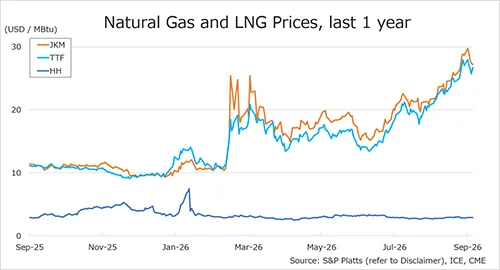
Europe's 9.8x price premium deters Asian buyers
On September 11, Europe's front-month gas equivalent reached about $26.56/MMBtu against Henry Hub's $2.71 — a ratio of roughly 9.8 to 1 — after spot LNG jumped 150% to $26/MMBtu. With the TTF near €79/MWh and EU storage only about 69% full, Europe is outbidding Asia for cargoes, pushing price-sensitive Asian buyers to the sidelines ahead of winter. OilPrice similarly reports Europe winning the bidding war for spot LNG as prices surge 150%.
Asia LNG imports hit eight-year September low — but India keeps buying
Asia's LNG arrivals are set for 20.09 million metric tons in September, the weakest for the month in eight years, as elevated spot prices deter buyers in China and South Asia — indirectly "saving" Europe for its winter storage race. Northeast Asia will see the largest drop, while India and Bangladesh continue to secure spot cargoes despite the price surge. Analysts estimate Asian LNG demand will fall 3–10% from 2025 levels in 2026, with Kpler projecting China's demand down 6.1 million tons year-on-year.

Structurally, the Asian spot market has split in two: China arbitrages volume at low utilisation (~29%) while emerging buyers pay double long-contract rates and switch to coal — deepening the bifurcation in how cargoes are allocated this winter.
Qatar North Field East slides toward 2027 start-up
The $28.75 billion North Field East expansion — FID'd in February 2021 and originally targeted for 2026 start-up — is now aiming for 2027 as construction faces delays linked to evacuations during regional conflict in early 2026. Writing from the UN General Assembly sidelines, Allen Brooks notes that Qatari officials put a positive spin on the economy and energy sector, but North Field — and the LNG expansion itself — remains at risk of further delay. Every month of slippage tightens 2027–2028 supply and supports forward curves on TTF, JKM and Henry Hub alike.
US–China LNG trade could be revived at Trump–Xi talks
Trump and Xi are expected to discuss reviving US–China LNG trade, which has effectively collapsed since Beijing imposed a 15% tariff on American LNG in 2025. Any thaw would reshape Pacific-Atlantic basin cargo flows — potentially more US feedgas demand (bullish Henry Hub) and more supply released toward Europe.
Local view
German coverage is dominated by the perilous storage picture. Euronews (German edition) reports German gas storage is emptier than it has ever been for this stage of the year — partly due to the ongoing Strait of Hormuz disruption — while Italy's storage is already over 80% full; Germany's refill machinery "isn't working" as well as its neighbours'. Telepolis highlights Germany at just 56% full with TTF near €80/MWh and carries Morgan Stanley price forecasts, arguing full storage is "utopian" despite more LNG import capacity. t-online warns Europe's break with Russia has swapped one dependency for a riskier one on competitive world LNG, with storage levels at multi-year lows. ndr.de runs a live tracker of German storage fill as of September 23–24.
Context & numbers
- TTF rose 1.6% to €74.50/MWh in the latest session as fading hopes for a quick US–Iran diplomatic resolution revived risk premia.
- US–Europe spread: Henry Hub October near $2.86/MMBtu on September 18 vs Dutch TTF around €77.6/MWh — the gap that keeps cargoes flowing west.
- European gas prices crossed €80/MWh in September for the first time in three years, driven by storage at ~68.5%, strong Asian demand, Norwegian maintenance and the upcoming Russian LNG ban.
- Demand destruction: high prices are already forcing European industrial users to cut gas consumption — a key demand-side relief valve for winter.
- Saudi Arabia has sold nearly 100 million barrels of crude to Asia via Hormuz since its East-West pipeline went offline — a sign the region's logistical workaround capacity, relevant to Qatari LNG shipping too.
On the radar
- Platts JKM methodology change: Standard LNG vessel-size range for Asia-Pacific cargo assessments widens to 135,000–180,000 m³ from October 16 — subtle but relevant for JKM pricing mechanics.
- Bunkering spread signal: Rotterdam LNG bunker prices fell $119 to $1,488/mt after six weekly rises, while Singapore jumped $130 to $1,667/mt — shipping-fuel demand and route economics worth watching.
- US–Iran diplomacy: further risk-premium swings on TTF and JKM hinge on whether talks resume or escalation continues.
- India and Bangladesh spot tenders: with Northeast Asia stepping back, these buyers are the marginal bid Asia still supplies — watch for any pullback from India as the true bearish trigger for JKM.
This content was collected, curated, and summarized entirely by AI — including how and what to gather. It may contain inaccuracies. Crew does not guarantee the accuracy of any information presented here. Always verify facts on your own before acting on them. Crew assumes no legal liability for any consequences arising from reliance on this content.
Powered by
