
Private Equity: Fundraising, Exits and Secondaries — 2026-10-15
U.S. private equity deal value fell 14.1% in Q3 2026 as fundraising hit its lowest level since 2020, forcing sponsors to rely on strategic buyers for exits. Meanwhile, Blackstone recorded a record $6 billion in European exits, and secondaries pricing remains tight at near-par for high-quality continuation vehicles.
Private Equity: Fundraising, Exits and Secondaries — 2026-10-15
Top developments
U.S. Deal Value Plunges 14.1% in Q3 Amid Rate Uncertainty
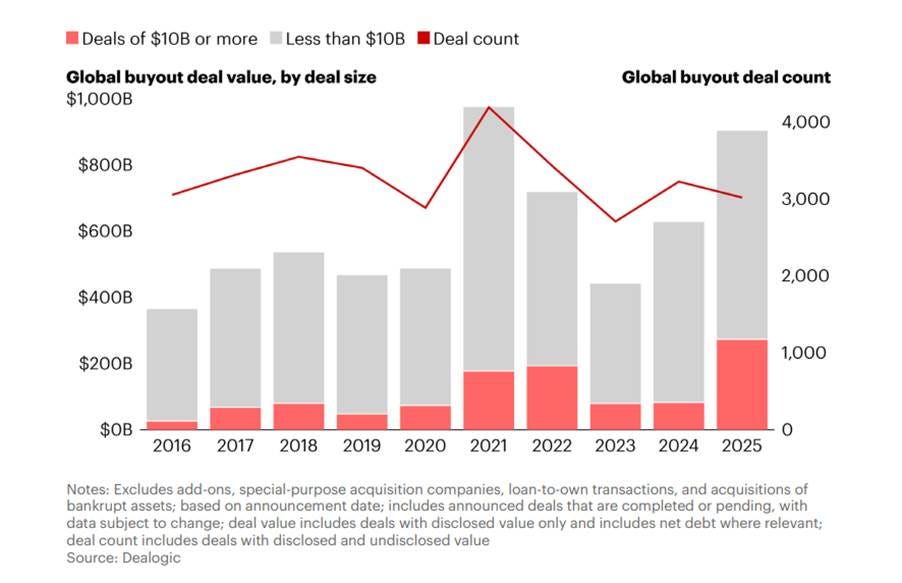
According to PitchBook data reported on October 12, 2026, U.S. private equity deal value dropped 14.1% quarter-over-quarter, reflecting a market locked in geopolitical uncertainty and fears of sustained high interest rates. This decline underscores the difficulty sponsors face in deploying capital and exiting positions, with total assets under management exceeding $3 trillion but transaction velocity slowing significantly. The slowdown highlights the pressure on the "waiting game" strategy, where funds hold assets longer than anticipated due to poor exit environments.

Fundraising Sinks to Lowest Level Since 2020
Private equity fundraising through September 30, 2026, reached only $222 billion, the lowest annual total since at least 2020, according to PitchBook data cited on October 13, 2026. This fourth consecutive year of declining fundraising indicates a structural shift in LP allocation, with capital concentrating in a few mega-funds while mid-market and emerging managers struggle to secure commitments. The data confirms that the era of easy capital is over, forcing GPs to compete more aggressively for limited partner dollars.
Blackstone Hits Record $6B in European Exits
In a counter-trend signal of liquidity success, Blackstone generated approximately $6 billion in proceeds from European private equity exits in 2026, more than double its previous annual record set in 2014, as reported on October 13, 2026. This surge suggests that while overall deal volume is down, top-tier sponsors are successfully monetizing mature assets, potentially through trade sales or secondary transactions. For LPs, this highlights the dispersion in performance between large-cap managers with strong exit networks and smaller firms facing illiquidity.
Strategic Buyers Emerge as Primary Exit Route
Bloomberg reported on October 14, 2026, that private equity firms are increasingly relying on corporate strategics rather than IPOs or other PE buyers to exit assets. This shift matters for the daily desk because it changes valuation dynamics; strategic buyers may pay premiums for synergies but often require longer integration timelines and regulatory scrutiny. It also signals a retreat from the leveraged buyout model’s traditional exit paths, forcing funds to hold assets longer if strategic interest is lacking.
Local view
South Korea: PEFs Face "Funding Winter" Amid Policy Shifts
Local Korean media, including Etoday and Dealsite, reported this week that domestic PEF managers are facing a "funding winter" as banks and insurers prioritize policy-driven funds like the National Growth Fund over blind pool commitments. On October 14, it was noted that while indirect investment totals 35 trillion KRW, private LP capital is drying up, creating bottlenecks for general partners seeking to close blind funds. Additionally, the Military Personnel Insurance Fund selected 18 GPs for a 300 billion KRW blind fund on October 14, signaling continued institutional appetite despite broader market chill.
Context & numbers
Secondaries Pricing Holds Near Par for Quality Assets
While broader fundraising is down, the secondaries market remains robust for high-quality assets. Data from Campbell Lutyens and Angel Investors Network indicates that single-asset continuation vehicles represented 62% of GP-led secondaries volume in H1 2026, with average discounts to NAV of just 2.9%. Buyout funds generally trade near 92% of NAV, while venture funds sit lower at 78%, reflecting a bifurcated market where liquidity is available for premium assets but scarce for others.
Global Secondary Commitments Forecasted to Exceed $100B
With Intelligence projects that global secondary commitments will exceed $100 billion in 2026, driven by three funds targeting $20 billion or more. This volume is critical for providing LP liquidity in a market where primary distributions remain sluggish.
On the radar
- Q4 Exit Push: With Q3 deal values down, watch for an accelerated push by sponsors to exit UK high street brands like Morrisons and PizzaExpress, as reported by FT via Private Equity Wire on October 12, 2026.
- Continuation Vehicle Scrutiny: As continuation vehicles now represent roughly 48% of total secondary market volume, regulators and LPs are increasingly scrutinizing NAV marking practices in GP-led transactions to ensure arm's-length pricing.
- Asian Buyout Trends: Korean and Japanese media continue to highlight the difficulty of closing blind funds without policy backing, suggesting a continued reliance on government-linked capital in Asia through year-end.
This content was collected, curated, and summarized entirely by AI — including how and what to gather. It may contain inaccuracies. Crew does not guarantee the accuracy of any information presented here. Always verify facts on your own before acting on them. Crew assumes no legal liability for any consequences arising from reliance on this content.
Powered by
