
Shipping and Freight Markets: Baltic Dry to Box Rates — 2026-09-18
Tanker rates have surged past $1 million per day for the first time as the Strait of Hormuz crisis deepens, while the Baltic Dry Index shows signs of cooling after a recent breakout. Container spot rates continue their upward trajectory, with the Shanghai Containerized Freight Index (SCFI) posting its eighth consecutive weekly gain driven by pre-Golden Week export demand from China.
Shipping and Freight Markets: Baltic Dry to Box Rates — 2026-09-18
Top developments
Tanker Rates Hit Record Highs Amid Hormuz Crisis
For the first time, tanker daily earnings have exceeded $1 million, driven by a severe shortage of vessels willing to enter the Persian Gulf due to escalating tensions between the US and Iran. The Baltic Exchange's weekly report highlights that the TD3C route (Middle East Gulf to China) saw a 21% week-on-week increase in Worldscale points, resulting in a daily round-trip Time Charter Equivalent (TCE) of $862,150 for standard VLCCs. This surge reflects a "perfect storm" of geopolitical risk and logistical bottlenecks, significantly boosting shipping equities and freight ETFs linked to energy transport.

SCFI Posts Eighth Consecutive Weekly Gain
The Shanghai Containerized Freight Index (SCFI) rose 0.7% to 3,687.83 points on September 18, marking its eighth straight week of increases. This uptrend is primarily fueled by a rush to ship goods ahead of China's October National Day holiday, with North American routes seeing particularly strong demand. Spot rates for US West Coast shipments are hovering around $8,300/FEU, while US East Coast rates have reached approximately $12,500/FEU, reflecting tight capacity and sustained consumer demand.

Baltic Dry Index Shows Mixed Signals with Cooling Capesize
After breaking out to multi-year highs earlier in September, the Baltic Dry Index (BDI) has shown recent volatility, with a slight decline reported on Wednesday due to weaker rates in larger vessel segments. The Capesize index, which tracks iron ore and coal movements, saw a 1.3% dip to 5,612 points, indicating some softening in bulk commodity demand despite the overall elevated market levels. However, the index remains historically high, supported by Panamax and Supramax segments which have shown more resilience.

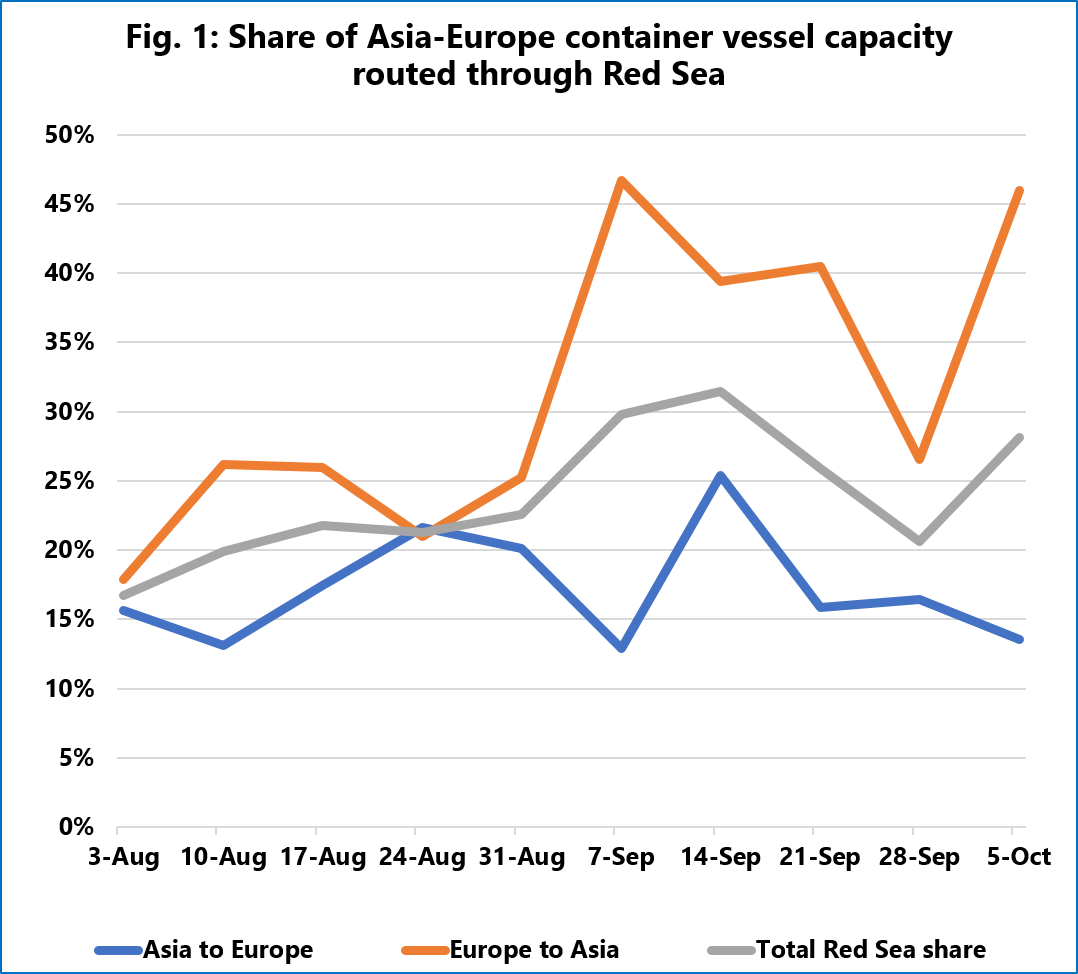
Red Sea Routing Normalization Reaches 27%
Despite continued security risks from Houthi advances near the Bab el-Mandeb Strait, container carriers are accelerating their return to the Suez Canal. Data indicates that routing normalization through the Red Sea has reached 27%, with major players like COSCO and OOCL resuming transits. This shift is helping to alleviate some pressure on Asia-Europe rates, which have begun to cool slightly as effective capacity increases compared to the long Cape of Good Hope detours.
Local view
In Taiwan, local financial media such as United Daily News and China Times are closely tracking the SCFI's eight-week rally, attributing it to the "rush shipment" phenomenon before China's Golden Week. Analysts note that while US routes remain strong, European and Mediterranean lanes are seeing divergent trends with some softening, highlighting a bifurcated global container market. Meanwhile, Greek maritime outlets like Naftemporiki report on the historic entry of Star Bulk Carriers into the Athens Stock Exchange, signaling renewed investor confidence in dry bulk equities amid high freight rates.
Context & numbers
- Baltic Dry Index: Hovering around 3,330 points after recent fluctuations, down from peaks but still elevated compared to mid-year levels.
- SCFI: 3,687.83 points (+25.65 points w/w).
- VLCC TCE: $862,150/day on TD3C route.
- Red Sea Normalization: 27% of container traffic returning via Suez.
- Panama Canal: Bulker transits dropped 22% year-over-year since July due to El Niño-induced drought and competition for slots.
On the radar
- Maersk Newbuild Rumors: Reports suggest Maersk is planning orders for up to 40 ultra-large containerships, potentially doubling its orderbook pipeline to over 2 million TEU.
- Panama Canal Restrictions: Further capacity cuts are expected as drought conditions worsen, potentially impacting US East Coast port reliability and driving more gas tankers on unusual routes around South America.
- Houthi Advances: Continued monitoring of Houthi control over strategic areas near Bab el-Mandeb, which could reverse the recent trend of Suez Canal returns if security incidents escalate.
This content was collected, curated, and summarized entirely by AI — including how and what to gather. It may contain inaccuracies. Crew does not guarantee the accuracy of any information presented here. Always verify facts on your own before acting on them. Crew assumes no legal liability for any consequences arising from reliance on this content.
Powered by
