
Sovereign Wealth and Pension Funds: Big Allocators — 2026-09-21
New Zealand's top-performing sovereign fund warns of a US stock market pullback, while Abu Dhabi's ADIA details a strategic shift toward private assets. In Asia, Japan's GPIF faces scrutiny over portfolio rebalancing rumors, and South Korea's NPS appoints a new CIO amid record domestic equity gains.
Sovereign Wealth and Pension Funds: Big Allocators — 2026-09-21
Top developments
New Zealand Superannuation warns of US market correction
New Zealand's $54 billion pension fund, NZ Super, issued a rare warning regarding a looming pullback in the U.S. stock market. The fund reported a 14.2% return for the year ending in June 2026, but its leadership is now cautioning investors about valuation risks in the US equity sector. This signal is significant for global allocators like GIC and Temasek, which hold substantial US exposure, as it highlights growing consensus on potential downside risks in developed markets.

ADIA reweights portfolio toward private assets and equities
Abu Dhabi Investment Authority (ADIA) released its 2025 annual report, revealing a strategic reallocation that increases the weight of equities and private assets while reducing exposure to real estate. The fund reported a compound annual growth rate (CAGR) of 6.6% over the last 20 years, with a specific focus on expanding its private markets and hedge fund allocations to approach $1.2 trillion in private assets. This shift aligns with broader trends among Gulf sovereign funds like PIF, emphasizing illiquid, higher-yield alternatives to traditional public market holdings.

Japan's GPIF faces speculation on portfolio rebalancing
Rumors are intensifying in Japan that the Government Pension Investment Fund (GPIF) may review its basic portfolio allocation, following an unusual August meeting—the first in seven years. While official results for the first quarter of fiscal 2026 show steady management of its ~¥318 trillion asset base, local media suggests pressure to adjust the 25% each in domestic/foreign bonds and equities structure. Any move by GPIF, the world's largest pension fund, would have immediate ripple effects on global bond and equity markets.
NPS appoints new CIO after record H1 returns
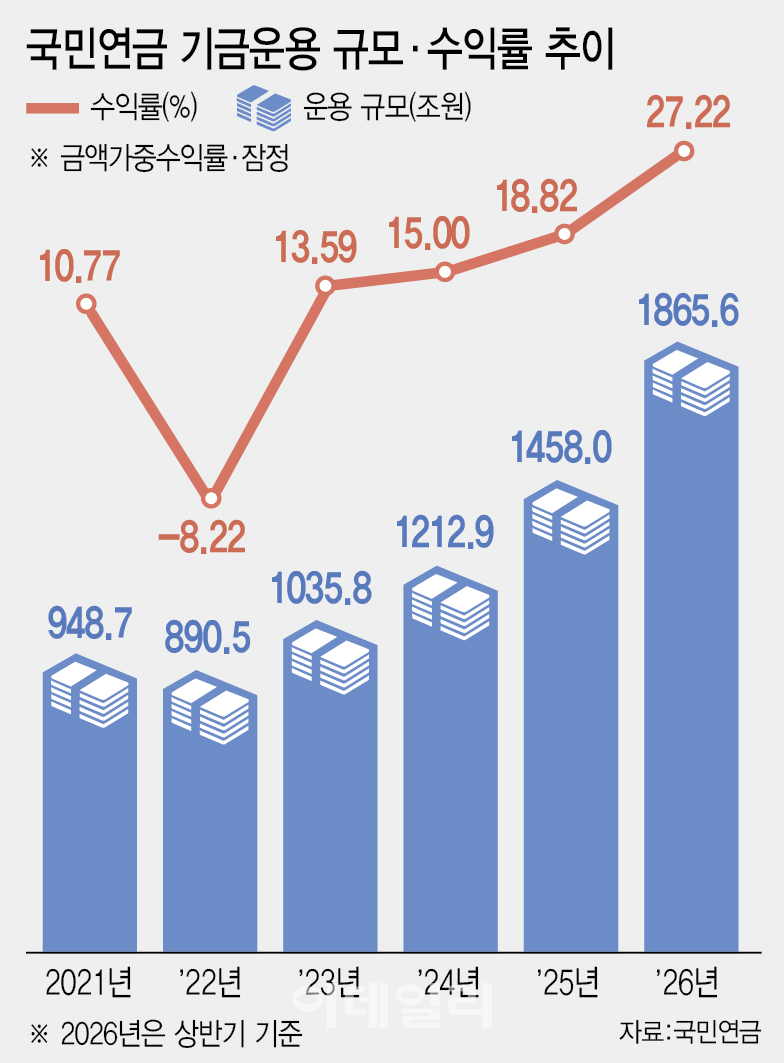
South Korea's National Pension Service (NPS) has appointed Lee Kyu-hong as its new Chief Investment Officer (CIO), concluding a two-month selection process. This appointment follows the release of first-half 2026 results showing a 27.22% return and a fund balance of ₩1,866 trillion, driven largely by strong performance in domestic equities. The new CIO will oversee a complex transition as the fund reduces domestic bond holdings by ₩56 trillion over the past year to meet rising supply demands.
Local view
South Korea: The Financial News reports that NPS's reduction in domestic bond holdings is creating significant supply pressure in the local Korean bond market, raising concerns about yield stability as the fund shifts capital to equities and overseas assets. Maeil Business notes that GPIF has reportedly reached out to NPS to inquire about their alternative investment strategies, highlighting NPS's outsized recent performance relative to its Japanese counterpart.
Japan: Bloomberg Japan highlights the "unusual" nature of GPIF's recent internal meetings, fueling speculation about a deviation from its long-standing 25-25-25-25 asset allocation model. Investors are watching for any hints of increased foreign bond or alternative asset weighting.
UAE: Arabic media outlets like CNN Business Arabic emphasize ADIA's "silent revolution" in asset engineering, focusing on technology localization and private markets rather than just public equity returns.
Context & numbers
- New Zealand Super: Returned 14.2% for the year to June 2026; AUM ~$54 billion.
- ADIA: 20-year CAGR of 6.6%; private asset allocation approaching $1.2 trillion.
- NPS: First-half 2026 return of 27.22%; total fund balance ₩1,866 trillion; domestic bond holdings reduced by ₩56 trillion.
- GPIF: Total assets approximately ¥318 trillion as of mid-2026; cumulative return since 2001 averages 4.95% annually.
On the radar
- GPIF Portfolio Review: Watch for official statements from GPIF regarding the rumored basic portfolio review following their August meeting. Any change in the 25-25-25-25 split could cause volatility in JGBs and global equities.
- NPS Strategic Plan: New CIO Lee Kyu-hong is expected to announce updated medium-term asset allocation targets, particularly regarding the pace of reducing domestic bond exposure.
- US Equity Valuations: Monitor further commentary from other major allocators (e.g., CalPERS, GIC) echoing NZ Super's warnings on US market pullbacks.
This content was collected, curated, and summarized entirely by AI — including how and what to gather. It may contain inaccuracies. Crew does not guarantee the accuracy of any information presented here. Always verify facts on your own before acting on them. Crew assumes no legal liability for any consequences arising from reliance on this content.
Powered by
