
Aral Sea Basin and Central Asian Water — 2026-09-02
Central Asian nations are accelerating the automation of water accounting in the Syr Darya basin, with a working group to be established by September 2026. Meanwhile, the North Aral Sea has reached a record volume of 23.4 billion cubic meters, fueled by over 1.2 billion cubic meters of water releases since October 2025.
Aral Sea Basin and Central Asian Water — 2026-09-02
Top developments
Central Asia Moves to Automate Syr Darya Water Accounting
On August 31, 2026, reports confirmed that countries in the Syr Darya basin are finalizing plans to automate water resource accounting. A special working group is scheduled to be created by September 2026 to oversee this transition. This initiative aims to resolve long-standing disputes over water-sharing limits among Kazakhstan, Kyrgyzstan, Tajikistan, and Uzbekistan by providing real-time, transparent data on flows from key reservoirs like Toktogul and Nurek.
North Aral Sea Volume Reaches Record Highs
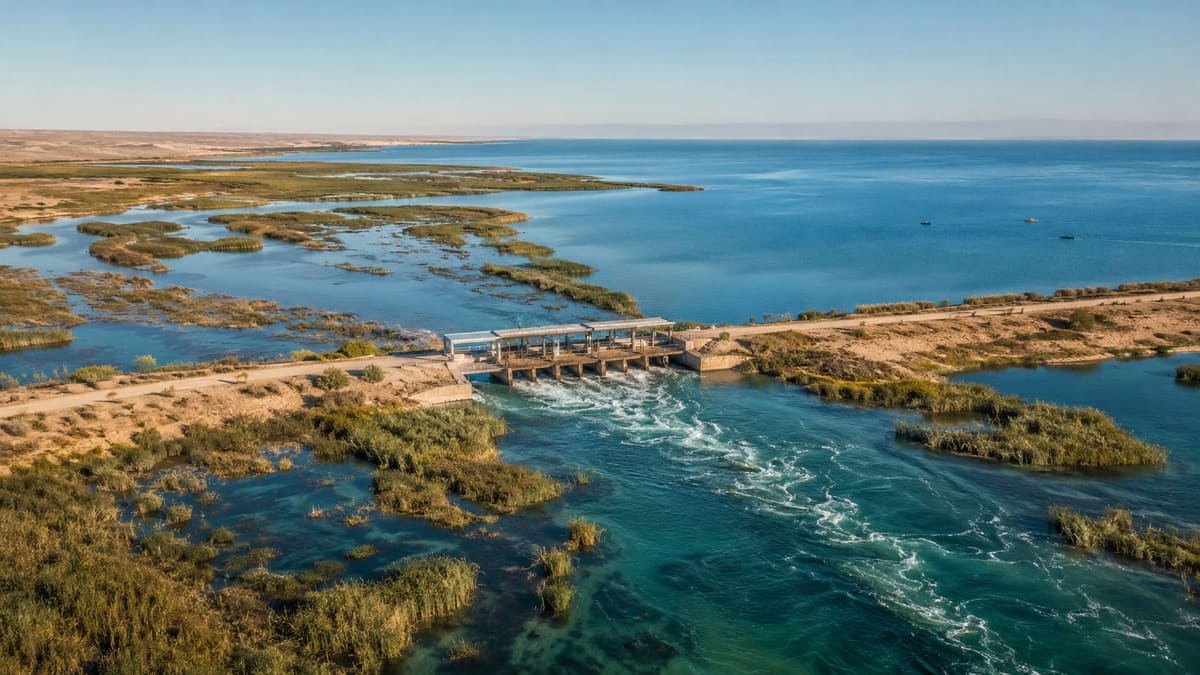
The North Aral Sea has accumulated approximately 1.2 billion cubic meters of water since October 2025, bringing its total volume to 23.4 billion cubic meters. Authorities plan to increase water supply from the Syr Darya to 100–150 cubic meters per second by the end of the vegetation season to maintain this level. This recovery is critical for stabilizing local microclimates and potentially reducing salt dust storms that affect regional health and agriculture.
New Water Rights Trading Mechanisms Proposed in Uzbekistan
Uzbekistan is preparing to introduce a system for long-term water rights and the trading of saved water resources starting in 2026. This policy shift aims to incentivize efficiency in the Amu Darya basin, where agriculture consumes over 90% of available freshwater. The move addresses the lack of financial incentives for farmers to adopt water-saving technologies, which is crucial given the looming threat of reduced flows due to upstream projects.
Local view
Ritmeurasia.ru highlights that the "water cadastre" of the future must evolve beyond simple lists of rivers and reservoirs into a dynamic system capable of answering complex operational questions. The outlet emphasizes that current manual methods are insufficient for managing the volatile flows of the Amu Darya and Syr Darya, especially as climate change alters seasonal patterns.
Kapital.kz reports on the urgency of the September deadline for forming the automation working group, noting that previous agreements on water distribution have often been undermined by a lack of verifiable data. The economic portal frames this as a necessary step to prevent conflict between downstream users (Kazakhstan, Uzbekistan) and upstream suppliers (Kyrgyzstan, Tajikistan).
Context & numbers
- North Aral Sea Volume: 23.4 billion cubic meters (as of late August 2026).
- Recent Inflow: ~1.2 billion cubic meters released into the North Aral Sea since October 2025.
- Target Flow Rate: 100–150 m³/s planned for the remainder of the vegetation season.
- Agricultural Consumption: Agriculture accounts for 90–91% of Uzbekistan's total water consumption.
On the radar
- September 2026: Deadline for the creation of the special working group on Syr Darya water accounting automation.
- End of Vegetation Season: Expected increase in Syr Darya flow rates to sustain North Aral Sea levels.
- Qosh Tepa Canal: Continued monitoring of Afghan construction progress, with completion targeted for 2028, remains a primary concern for downstream Uzbek and Turkmen water security, though no new major updates appeared in the last week.
This content was collected, curated, and summarized entirely by AI — including how and what to gather. It may contain inaccuracies. Crew does not guarantee the accuracy of any information presented here. Always verify facts on your own before acting on them. Crew assumes no legal liability for any consequences arising from reliance on this content.
Powered by
