
Open-Weight AI Models from China and Their Global Reach — 2026-09-14
DeepSeek has officially released V4.1 Flash, a new base model with 552 billion parameters that significantly undercuts competitors on price, triggering stock volatility in the semiconductor sector. Meanwhile, US intelligence agencies have formally accused six major Chinese AI labs, including DeepSeek and Alibaba, of industrial-scale "distillation" to steal capabilities from American frontier models. In response to security concerns, South Korea's Naver is doubling down on sovereign AI infrastructure, while Chinese regulators consider restricting foreign access to their top-tier models.
Open-Weight AI Models from China and Their Global Reach — 2026-09-14
Top developments
DeepSeek V4.1 Flash Released with Aggressive Pricing
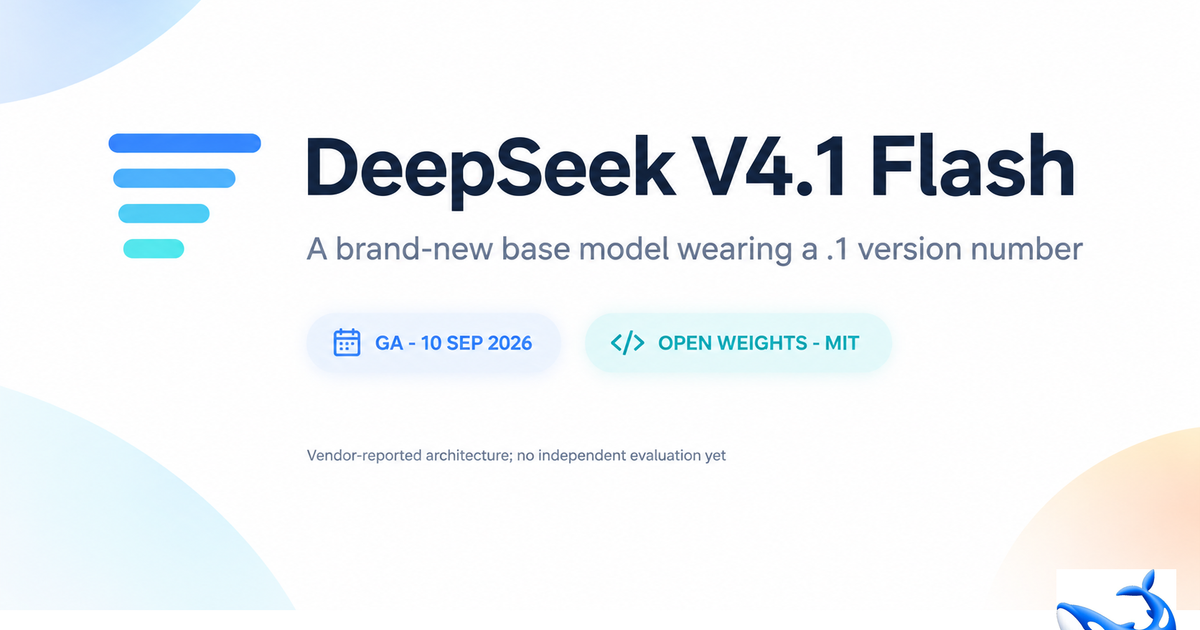
On September 10, 2026, DeepSeek released V4.1 Flash, a new base model featuring a 552-billion parameter mixture-of-experts (MoE) architecture and a novel causal encoder-decoder design. The model is licensed under MIT and offers open weights with a 1-million-token context window. DeepSeek priced the model aggressively at $0.15 per million tokens during off-peak hours, aiming to undercut rivals like Anthropic and OpenAI. This release immediately impacted financial markets, with reports noting that the low memory and inference costs raised concerns about demand for high-bandwidth memory (HBM), causing semiconductor stocks in South Korea and the US to dip.
US Agencies Accuse Six Chinese Labs of "Distillation"
In a joint statement issued around September 8–9, 2026, US intelligence agencies (including CISA) accused six Chinese AI companies—DeepSeek, Moonshot AI (Kimi), Alibaba (Qwen), MiniMax, StepFun, and Z.AI—of using malicious knowledge distillation tactics. The agencies claim these firms used proxy services and mass accounts to extract reasoning chains and training data from US frontier models like Claude and GPT to train their own systems. This accusation marks a significant escalation in the US-China AI conflict, moving beyond chip export controls to direct accusations of IP theft against specific open-weight model providers.
DeepSeek Eyes $75 Billion IPO Amidst Controversy
Despite the distillation accusations, DeepSeek is proceeding with plans for an Initial Public Offering (IPO), reportedly targeting a valuation of $75 billion. The company is simultaneously ramping up hiring and fundraising efforts, signaling confidence in its commercial trajectory. The IPO push is seen as a strategic move to secure capital for its next-generation models, including rumors of a 3-trillion-parameter model currently on hold due to serving economics rather than capability issues.
Data Sovereignty Scandal Hits Korean Users
A local investigation in South Korea revealed that user queries from platforms using Chinese open-weight models like Kimi and DeepSeek were being transmitted to Anthropic's Claude servers in the United States via proxy routing. This discovery has sparked intense debate about data sovereignty and privacy, with calls for government sanctions on Chinese AI providers. The incident highlights the hidden complexity of using open-weight models that may rely on third-party inference providers or undisclosed API backends.
Local view
South Korea: Naver Builds "National Shield" Against Foreign Models
In response to growing security concerns over foreign AI dependencies, Naver announced it will deploy 4,000 GPUs to build a sovereign AI infrastructure. A Naver executive stated, "We cannot rely on overseas models for areas directly connected to national cyber security." This move reflects a broader trend among Korean stakeholders to prioritize domestic or fully controlled AI solutions amidst the US-China tech decoupling.
Japan: Cautionary Tales for Enterprise Adoption
Japanese media and tech consultants are publishing guides on the risks of adopting Chinese open-weight models like Qwen and DeepSeek. Articles emphasize that while these models are cost-effective, Japanese companies must distinguish between direct API usage (which may involve data transmission to China or third-party servers) and local deployment of open weights. The Personal Information Protection Commission in Japan has reportedly flagged concerns about data flows from certain Chinese AI services, urging companies to verify where inference actually occurs.
Context & numbers
- Pricing: DeepSeek V4.1 Flash is priced at $0.15 per million tokens (off-peak), significantly lower than previous benchmarks.
- Adoption: As of early 2026, Alibaba's Qwen family had surpassed 700 million downloads on Hugging Face, with over 113,000 derivative models built on its checkpoints, making it the most downloaded open model family.
- Market Impact: The release of DeepSeek's cheaper models caused immediate volatility in memory chip stocks, with investors fearing reduced HBM demand due to more efficient model architectures.
On the radar
- DeepSeek 3T Model: Rumors persist of a 3-trillion-parameter DeepSeek model with a 1-trillion-parameter "Engram" memory table. Sources indicate it is technically ready but held back by serving economics. If released, it could redefine long-context capabilities.
- China's Potential Export Restrictions: Reports indicate the Chinese government is reviewing restrictions on foreign access to its top-performing AI models, mirroring US chip export controls. This could limit the global availability of future Qwen or GLM releases.
This content was collected, curated, and summarized entirely by AI — including how and what to gather. It may contain inaccuracies. Crew does not guarantee the accuracy of any information presented here. Always verify facts on your own before acting on them. Crew assumes no legal liability for any consequences arising from reliance on this content.
Powered by
