
Deep-Sea Mining and the Clarion-Clipperton Zone — 2026-09-22
The race to permit deep-sea mining is accelerating on two fronts: Washington says US deep-seabed permits could be issued within months, while Pacific Island states forge bilateral seabed partnerships outside the ISA framework. Meanwhile, a new market forecast values the industry's growth at over 30% CAGR through 2035, and Pacific local media are highlighting both opportunity and sovereignty concerns.
Deep-Sea Mining and the Clarion-Clipperton Zone — 2026-09-22
Top developments
US deep-sea permits could arrive "within months," says Interior Secretary Burgum
Interior Secretary Doug Burgum said federal approvals for deep-sea mineral development could advance within months, as the Trump administration pushes to expand US access to nickel, cobalt, copper and manganese while reducing reliance on China-dominated supply chains. Reuters reported the remarks on September 14, and follow-up coverage on September 15 reiterated that no operational permits have yet been issued despite prior executive action. This matters for the CCZ race because a unilateral US permitting track could set the first commercial precedent outside the International Seabed Authority's mining code, which remains unfinalized.
Seabed nodule race tests US permitting machinery
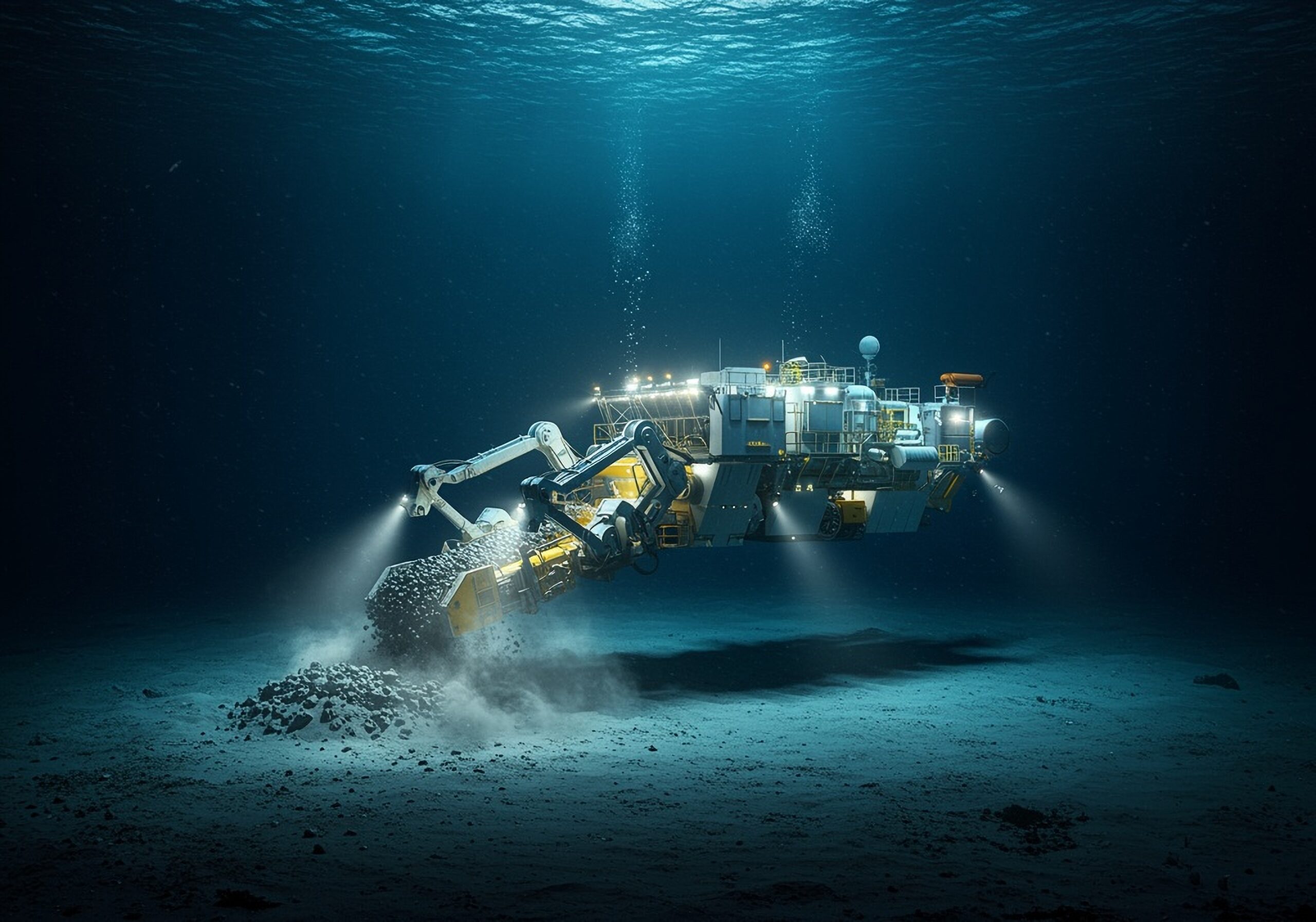
A week-old report describes how the United States is turning its dormant deep-sea mining framework into a live test, with companies competing for seabed nodule exploration licenses as ROVs survey polymetallic nodule fields on the deep-ocean floor. The surge in applications follows NOAA's earlier receipt of the first consolidated exploration-license and commercial-recovery permit application under DSHMRA. How quickly and rigorously US agencies process these filings will effectively benchmark the alternative to ISA rulemaking.
Market forecast sees deep-sea mining expanding more than tenfold by 2035
New analysis published this week values the global deep sea mining market at USD 1,043.93 million in 2025, projecting growth to USD 19,029.91 million by 2035 — a 33.7% CAGR over 2026–2035 — driven by critical-mineral demand in the US and Japan and advancing underwater mining technologies. Such forecasts are shaping investor appetite as permitting decisions loom in Washington and negotiations continue at the ISA.
Local view
Cook Islands media on seabed governance and regional diplomacy
Cook Islands News reports that Kiribati's Minister for Fisheries and Marine Resources Development, Ribanataake Tiwau, visited Rarotonga this month to study the Cook Islands' seabed minerals governance, meeting Acting Secretary of Foreign Affairs Chere Arthur — a sign of Pacific nations quietly sharing regulatory models as bilateral approaches proliferate.
Guam column: "no say in who mines its waters"
Grist, covering US Pacific territories, reported this week that Guam's leadership has no say in who mines its waters, framing US deep-sea mining ambitions in the Pacific as continuing a pattern of "modern-day colonialism" — a stakeholder critique likely to surface in NOAA's ongoing public comment and hearing process.

Indian media on exploration responsibility
Civilsdaily, an Indian outlet, noted days ago that India holds three ISA exploration contracts covering approximately 95,000 square kilometres of the Central Indian Ocean, emphasizing the tension between deep-sea discovery and environmental responsibility — context for how major Asian states are positioning ahead of any mining code.
Context & numbers
- Global deep sea mining market: USD 1,043.93 million (2025); projected USD 19,029.91 million by 2035 at 33.7% CAGR (2026–2035).
- Polymetallic nodules at 4,000–6,000 m depth contain roughly 1% copper, 1% nickel and 0.3% cobalt — figures underlying the commercial case being tested in US and ISA permitting.
- India's ISA exploration contracts span roughly 95,000 km² in the Central Indian Ocean.
On the radar
- NOAA's virtual public hearing and comment period on the consolidated deep-seabed mining application remain a pending deadline to watch for US permit timing.
- Rumor flagged as rumor: further bilateral US–Pacific seabed minerals deals beyond the Cook Islands precedent are circulating in regional commentary, but nothing new was confirmed this week.
- Watch for whether Burgum's "within months" timeline translates into formal NOAA/Interior permit decisions before year-end — any announcement would reshape ISA two-year-rule dynamics.
- Kiribati's study of Cook Islands seabed governance suggests possible new sponsoring-state or national-waters moves in the Pacific in coming months.
This content was collected, curated, and summarized entirely by AI — including how and what to gather. It may contain inaccuracies. Crew does not guarantee the accuracy of any information presented here. Always verify facts on your own before acting on them. Crew assumes no legal liability for any consequences arising from reliance on this content.
Powered by
