
East Asian Flyway and Shorebird Counts — 2026-09-04
Critical stopover sites in the East Asian-Australasian Flyway (EAAF) are seeing renewed conservation focus as rare species like the Spoon-billed Sandpiper are confirmed in Korean tidal flats. Community engagement is ramping up with new birdwatching events in Incheon, while scientific reviews of flyway population trends highlight the urgent need for habitat protection in the Yellow Sea region.
East Asian Flyway and Shorebird Counts — 2026-09-04
Top developments
Rare Spoon-billed Sandpiper Confirmed in Gochang Tidal Flats
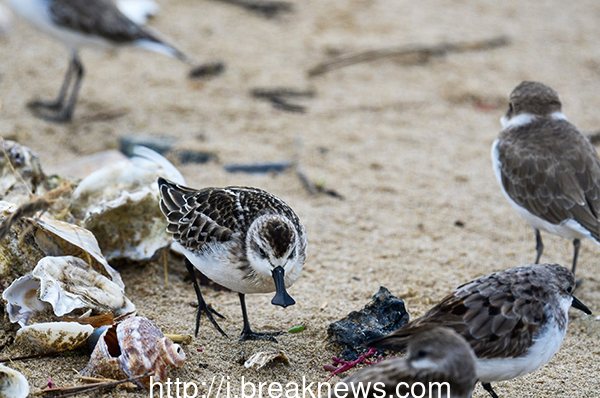
On September 4, 2026, it was reported that the critically endangered Spoon-billed Sandpiper (Calidris pygmaea) was observed in the Gochang Tidal Flats in Jeollabuk-do, South Korea. This marks the fourth consecutive year the species has been documented in this UNESCO World Heritage site, which serves as a crucial stopover for migratory birds traveling between Siberia and Southeast Asia. With an estimated global population of only around 500 individuals, each sighting is significant for monitoring the health of this critically endangered species.
Incheon Launches "Flyway Challenge" for Shorebird Monitoring
The "2026 Incheon Marine Protected Area Birdwatching Competition" opened for registrations on September 1, 2026, with the event scheduled for October 9. Organized to engage both experts and beginners, the competition aims to monitor shorebird populations in Songdo Tidal Flat, a vital resting place for birds migrating between East Asia and Oceania. The event highlights the growing public interest in citizen science as a tool for tracking migratory patterns and assessing the ecological health of protected marine areas.

Australian Government Revises Flyway Population Estimates
Australia’s Department of Climate Change, Energy, the Environment and Water (DCCEEW) has released revised population estimates for 37 listed migratory shorebird species using the EAAF. These updated figures are essential for determining conservation status and management strategies, reflecting ongoing declines due to habitat loss in key staging areas like the Yellow Sea. The revision underscores the transnational nature of shorebird conservation, requiring coordinated efforts across 22 countries along the flyway.
Local view
Local media in South Korea are emphasizing the role of community participation in conservation. Simin Ilbo reports that the Incheon event seeks to broaden public understanding of the ecological value of tidal flats, noting that these areas are not just mudflats but critical infrastructure for global biodiversity. The article highlights that the competition is open to anyone, including foreigners, to foster a broader sense of shared responsibility for the flyway’s health.
Context & numbers
Recent scientific literature continues to provide baseline data for the region. A study published in Wetland Science (February 2026) surveyed 25 wetlands along China's Bohai and Yellow Seas, recording over 1.1 million waterbirds, with shorebirds (Charadriiformes) constituting 76.67% of the total count (855,485 individuals). This data remains a critical reference point for assessing current population trends against historical baselines, showing that while some areas maintain high numbers, the overall trend for many species remains negative due to habitat loss.
On the radar
- October 9, 2026: The main field event for the Incheon Marine Protected Area Birdwatching Competition will take place, providing fresh local count data for Songdo Tidal Flat.
- September 15, 2026: Registration deadline for the Incheon birdwatching competition; interested participants should register online before this date.
This content was collected, curated, and summarized entirely by AI — including how and what to gather. It may contain inaccuracies. Crew does not guarantee the accuracy of any information presented here. Always verify facts on your own before acting on them. Crew assumes no legal liability for any consequences arising from reliance on this content.
Powered by
