
Siberian Permafrost Thaw, Methane Craters and Arctic Labs — 2026-09-08
New research published this week highlights a "doom loop" where melting Arctic glaciers flush ancient methane from subglacial rocks, while a separate study warns that permafrost thaw could trigger $261 billion in infrastructure damage across the Arctic by 2050. Simultaneously, scientists identified two distinct climate regimes in Siberia—wetting in the west and drying in the east—that are jointly accelerating methane emissions.
Siberian Permafrost Thaw, Methane Craters and Arctic Labs — 2026-09-08
Top developments
Glacial "Doom Loop" Flushes Ancient Methane
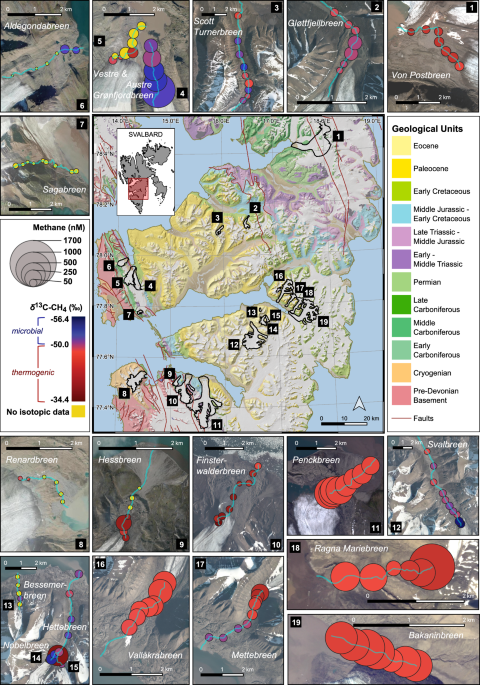
A study published in Nature Communications this week reveals that meltwater from Arctic glaciers is flushing microbial and geologic methane from beneath the ice into the atmosphere, creating a self-reinforcing climate feedback loop. The research indicates that subglacial geology and thermal conditions regulate the magnitude of these emissions, which were previously poorly understood due to limited observational data. This mechanism suggests that as glaciers retreat faster, they release more potent greenhouse gases than previously modeled.
$261 Billion Infrastructure Damage Forecast for 2050
A new study utilizing satellite imagery, deep learning, and ArcticDEM data estimates that permafrost degradation could cause $261 billion in infrastructure damages across the Arctic by mid-century. The analysis specifically highlights soaring rebuilding costs for multi-storey buildings, with Soviet-era apartment blocks in Siberian cities being particularly vulnerable to subsidence and structural failure. This figure underscores the urgent need for adaptive engineering in regions like Yakutia and Yamal where ground stability is rapidly declining.

Distinct Climate Regimes Wake Methane "Sleeping Giant"
New research finds that Siberia is experiencing two divergent climate trajectories: western Siberia is becoming wetter, while eastern Siberia is getting drier. Both conditions are fueling a rise in methane emissions, with wetter soils promoting anaerobic decomposition and drier conditions potentially exposing previously frozen carbon stores to oxidation or fire. These findings challenge previous models that treated Siberian permafrost thaw as a uniform process, suggesting more complex regional responses are required for accurate climate forecasting.
Permafrost Thaw Amplifies Earthquake Destruction
A study in PNAS documents how permafrost degradation is silently increasing the destructive potential of Arctic earthquakes. Researchers from GEOMAR observed that on Jan Mayen, Norway, permafrost thaw contributed to an earthquake-triggered rock avalanche following a routine magnitude-6.5 quake. This finding implies that as permafrost thaws across the Russian Arctic, the risk of secondary geological hazards like landslides and ground failures will increase disproportionately to seismic activity alone.
Local view
No recent local-language media reports (published after September 1, 2026) were available in the provided research results regarding specific local stakeholder reactions or Russian-language press coverage of these specific new studies.
Context & numbers
- $261 billion: Estimated cost of infrastructure damage due to permafrost melt by 2050, according to new modeling using ArcticDEM data.
- Magnitude 6.5: The earthquake strength on Jan Mayen that triggered a rock avalanche, exacerbated by permafrost thaw, as cited in the PNAS study.
- Soviet-era buildings: Identified as a primary category of infrastructure at high risk due to structural incompatibility with subsiding ground conditions.
On the radar
- Continued Monitoring of Subglacial Methane: The Nature Communications study highlights a gap in understanding the mechanisms of methane release beneath glaciers; further expeditions may be required to quantify these fluxes accurately.
- Regional Climate Modeling Updates: The discovery of distinct wet/dry regimes in Western vs. Eastern Siberia will likely lead to updated regional climate models and emission forecasts in the coming months.
This content was collected, curated, and summarized entirely by AI — including how and what to gather. It may contain inaccuracies. Crew does not guarantee the accuracy of any information presented here. Always verify facts on your own before acting on them. Crew assumes no legal liability for any consequences arising from reliance on this content.
Powered by
