
Sri Lanka Tea Auctions and Estate Labour — 2026-10-21
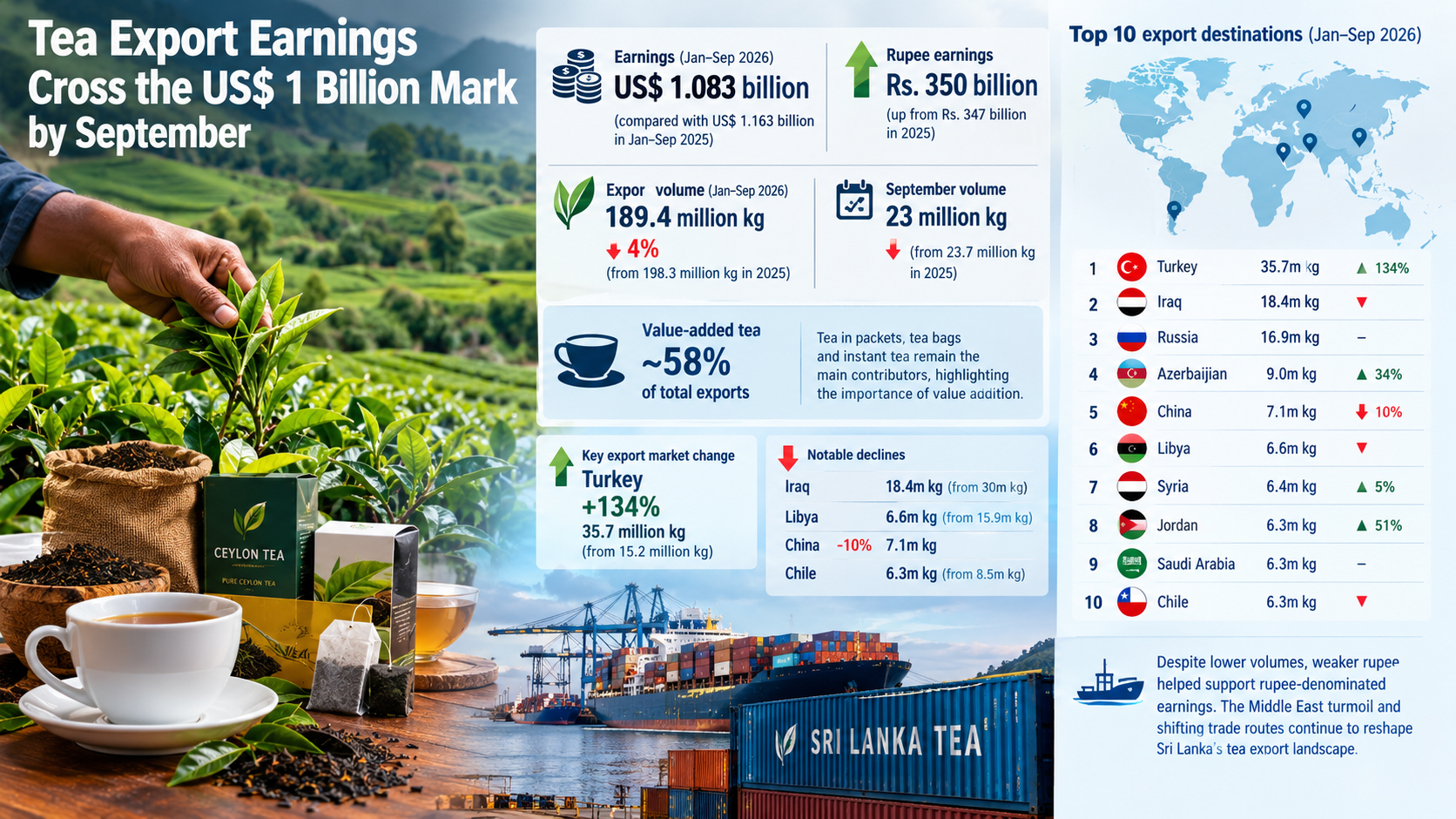
Sri Lanka's tea export revenues surpassed $1 billion in the first nine months of 2026, though this represents a decline from the previous year as global demand fragments. Meanwhile, the plantation sector is accelerating its adoption of technology to mitigate persistent labour shortages, marking a significant structural shift in estate operations.
Sri Lanka Tea Auctions and Estate Labour — 2026-10-21
Top developments
Export revenues cross $1 billion mark but show year-on-year decline
According to analysis of customs data by Siyaka Research, Sri Lanka’s tea export revenues amounted to approximately $1.083 billion during the first nine months of 2026. While this figure crosses the $1 billion milestone, it marks a decrease from the $1.163 billion recorded in the corresponding period of the previous year. This decline highlights the pressure on traditional export markets and the need for diversification in buyer portfolios.
Plantation sector pivots to technology amid labour shortages
In a significant operational shift, Sri Lanka’s plantation sector is increasingly embracing technology to address persistent labour shortages. Estate managers and plantation companies are rethinking traditional manual processes, driven by the inability to secure sufficient daily wage workers. This transformation is critical for maintaining productivity levels as the Rs. 1,750 daily wage, effective from January 2026, continues to impact operational costs.

Global tea market projected to reach $123 billion by 2034
The global tea market is on a strong growth trajectory, projected to reach US$123.22 billion at a 6.61% CAGR between 2026 and 2034. The growth is driven by rising demand for premium and Ready-to-Drink (RTD) tea products. For Sri Lanka, this global trend presents an opportunity to capture higher value in the premium segment, although competition from other origins remains fierce.
Local view
Fragmentation of global markets poses risks
Local industry analysis suggests that the traditional formula of relying on Middle Eastern demand and established shipping routes is becoming unreliable. The "perfect storm" facing Ceylon tea is not just about price fluctuations but the structural fragmentation of global markets. Buyers are becoming more fragmented, requiring exporters to adapt to smaller, more specific orders rather than bulk consignments.

India’s export drop offers potential opportunity
India’s tea exports plunged by 15.12% to 155.33 million kg in January–August 2026, despite higher prices. This drop is attributed to West Asia-related shipping disruptions. For Sri Lanka, this disruption in a key competitor’s supply chain may offer short-term opportunities to capture market share in affected regions, provided logistics remain stable.

Context & numbers
Turkish tea exports provide competitor benchmark
Turkey’s tea exports reached $25,021,548 in the first nine months of 2026, with sales to 119 countries. While significantly smaller in value than Sri Lanka’s exports, Turkey’s ability to distribute to such a wide array of markets highlights the importance of market diversification strategies for Ceylon tea.
On the radar
- Labour Dynamics: The International Labour Organization (ILO) recently held a workshop in Sri Lanka to examine priorities for decent work in the platform economy, which may eventually influence broader labour standards in the estate sector.
- Wage Enforcement: With the Rs. 1,750 daily wage now active, continued monitoring of compliance by Regional Plantation Companies (RPCs) remains a key stakeholder concern, especially as the Planters’ Association has previously expressed objections to wage hikes without corresponding productivity guarantees.
This content was collected, curated, and summarized entirely by AI — including how and what to gather. It may contain inaccuracies. Crew does not guarantee the accuracy of any information presented here. Always verify facts on your own before acting on them. Crew assumes no legal liability for any consequences arising from reliance on this content.
Powered by
