
Japan Property: Tokyo Condos, Akiya, Foreign Buyers — 2026-09-08
Tokyo’s new condominium market recorded its highest-ever average price for the first half of 2026, crossing the ¥100 million threshold, while existing condo prices in the 23 wards hit record highs for family-sized units. Amidst this surge, the Japanese government announced new financial support for converting vacant homes (akiya) into rentals, and public discourse intensified regarding foreign real estate acquisition and national security.
Japan Property: Tokyo Condos, Akiya, Foreign Buyers — 2026-09-08
New Condo Prices Cross ¥100 Million Barrier
The Real Estate Economic Institute reported that the average price of new condominiums in the Greater Tokyo Area for the first half of 2026 (January–June) reached ¥101.35 million, marking the first time the average has exceeded ¥100 million. This represents a significant jump from previous years, driven by high land costs and construction material prices. The number of units released was 7,989, a slight decrease of 0.8% year-on-year, but the average price per square meter rose to ¥1.514 million.

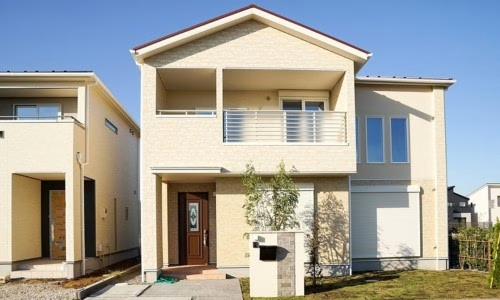
Existing Condo Prices in Tokyo 23 Wards Hit Records
According to LIFULL, the average listed price for used family-type condominiums in Tokyo's 23 wards reached ¥120 million, while single-person units averaged ¥72.92 million, both setting new historical records. The data, released on September 8, 2026, indicates that price growth is no longer confined to ultra-luxury segments but is spreading across standard housing categories. This trend is squeezing affordability for domestic buyers and altering rental market dynamics as more owners choose to sell rather than rent out properties due to high capital gains potential.
Government Launches Funding Support for Akiya Conversion
On September 8, 2026, the Ministry of Land, Infrastructure, Transport and Tourism (MLIT) announced a new initiative to support operators financially when converting vacant homes (akiya) into rental properties. This policy aims to address the growing number of vacant houses by incentivizing their re-entry into the housing market. The support is designed to lower barriers for companies and individuals willing to renovate and manage these properties, potentially stabilizing local communities and increasing housing supply in non-central areas.
Debate Over Foreign Ownership and "Bakugai" Tours Intensifies
A new book published on September 6, 2026, highlights concerns about foreign investors and wealthy individuals conducting "bakugai" (bulk buying) tours in Japan, particularly targeting vacant homes and resort properties. The author argues that Japan is too defenseless regarding foreign real estate transactions and warns of impacts on national security and social structure. While the government has previously postponed specific regulations on foreign condo purchases, this renewed media focus may accelerate discussions on stricter disclosure rules or restrictions on overseas buyers.
Local view
Nikkei reports that sales velocity for new condos in Tokyo's 23 wards has slowed due to rising interest rates and prohibitive prices. Despite record averages, developers are facing challenges in moving inventory, with initial contract rates dipping slightly to 64.8% in H1 2026.
Yahoo! News Japan features commentary from economist Keisuke Nakahara, noting that the average price of new condos in Tokyo's 23 wards has tripled since 2001. He attributes this to Abenomics-era monetary policies and structural supply constraints, warning that the "100-million-yen condo" era reflects deepening wealth inequality.
Context & numbers
- Average New Condo Price (Greater Tokyo, H1 2026): ¥101.35 million (First time exceeding ¥100M).
- Average Used Family Condo Price (Tokyo 23 Wards): ¥120 million (Record high).
- Initial Contract Rate (H1 2026): 64.8% (Down 1.8 points YoY).
- Vacant Homes (Akiya) Policy: MLIT launched financial support for rental conversion on Sept 8, 2026.
On the radar
- Autumn Diet Session: The government plans to submit a bill to tighten regulations on land acquisitions near national security sites (defense facilities, airports, etc.) during the extraordinary Diet session this autumn. This follows earlier postponements of broader foreign ownership bans.
- Osaka Development Boom: International attention is shifting to Osaka, where large-scale resort and urban renewal projects are driving a surge in foreign investment and tourism, potentially diverting capital from Tokyo's saturated market.
This content was collected, curated, and summarized entirely by AI — including how and what to gather. It may contain inaccuracies. Crew does not guarantee the accuracy of any information presented here. Always verify facts on your own before acting on them. Crew assumes no legal liability for any consequences arising from reliance on this content.
Powered by
