
Offices and Commercial Property Distress — 2026-09-04
CMBS office delinquency rates remain elevated, with specific metro areas driving a disproportionate share of lender losses, while new loan forbearances and foreclosures highlight the ongoing distress in secondary assets. Meanwhile, New York City is accelerating office-to-residential conversions to address housing shortages, and Boston’s vacancy rates are showing signs of stabilization as demolitions outpace new construction. <!-- /headline --> **NYC Conversions Surge as CMBS Office Distress Peaks** <!-- /headline -->
Offices and Commercial Property Distress — 2026-09-04
CMBS office delinquency rates remain elevated, with specific metro areas driving a disproportionate share of lender losses, while new loan forbearances and foreclosures highlight the ongoing distress in secondary assets. Meanwhile, New York City is accelerating office-to-residential conversions to address housing shortages, and Boston’s vacancy rates are showing signs of stabilization as demolitions outpace new construction.
<!-- /headline -->NYC Conversions Surge as CMBS Office Distress Peaks
<!-- /headline -->Top developments
CMBS Delinquency Volume Stabilizes at High Levels
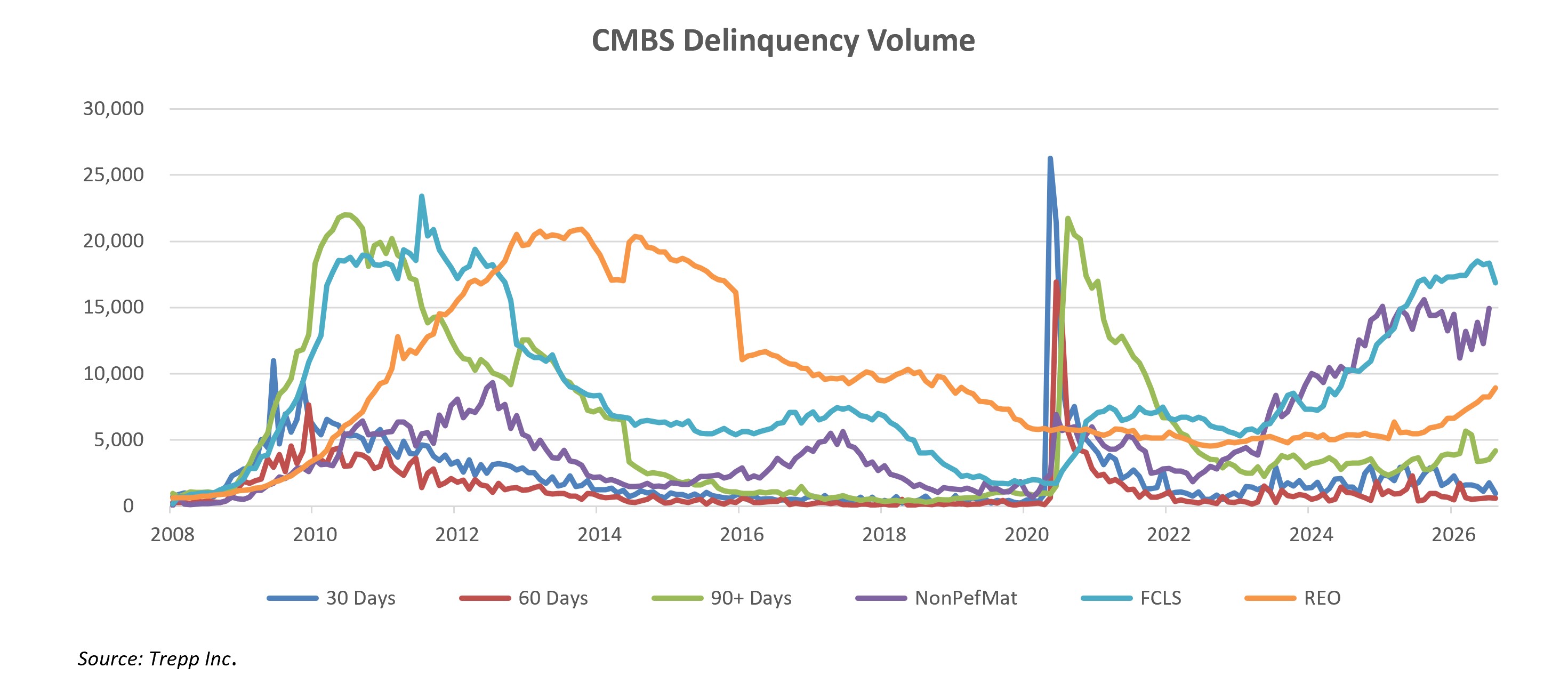
As of September 2026, the volume of CMBS loans more than 30 days delinquent remained relatively flat at $47.42 billion, declining only by $72 million from the previous month. This stability suggests that while the wave of new defaults may have peaked, the existing distress is persistent and deeply embedded in the portfolio. The overall CMBS delinquency rate has hovered near historic highs, with office-specific delinquencies previously hitting an all-time high of 12.34% earlier in the year.
Five Metro Areas Drive One-Third of Office Delinquencies
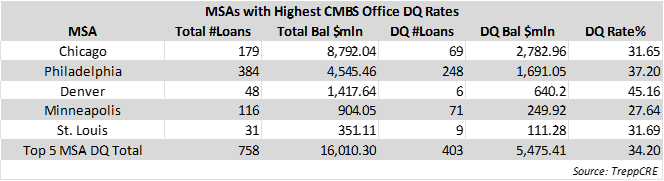
Data released in late August 2026 indicates that just five metropolitan statistical areas account for more than one-third of all CMBS office delinquencies. This geographic concentration highlights that the office distress is not uniformly distributed across the U.S. but is heavily clustered in specific markets where remote work adoption was highest and building quality is lower. Lenders are facing significant losses in these specific hubs, forcing aggressive restructuring and discounted sales.
NYC Accelerates Office-to-Housing Conversions
A New York Times analysis published on August 30, 2026, reveals that the pace of office-to-residential conversions in New York City has quickened sharply. This trend is driven by a combination of high vacancy rates in older office stock and a severe housing shortage. Projects like the conversion of the former Pfizer building are emblematic of this shift, though they face structural challenges, such as the buckling of steel columns noted in July. The city’s reliance on these conversions is becoming a critical pillar of its housing strategy.

Boston Vacancy Rates Dip as Demolitions Outpace Construction
In Boston, office vacancy rates are beginning to fall as the demolition of obsolete buildings outpaces new construction starts. This supply-side correction is providing relief to landlords and lenders who have been burdened by high carrying costs on non-prime assets. The shift suggests a market maturation where "demolition" becomes a viable exit strategy for distressed owners, helping to rebalance supply and demand in the long term.
Local view
German Media Focus on "Zwischenquartiere" (Interim Housing) German media, including the Frankfurter Allgemeine Zeitung (FAZ), are reporting on the use of empty offices as temporary housing modules ("Zwischenquartiere") to alleviate immediate housing pressure. These interim solutions are gaining traction in cities like Frankfurt and Munich, where political pressure to convert vacant office space into permanent housing is mounting. The Süddeutsche Zeitung notes that Munich has established a dedicated "Umbauagentur" (conversion agency) to coordinate these efforts, signaling a systematic approach to repurposing commercial real estate.
Context & numbers
- CMBS Loan Forbearance: A $180 million CMBS loan against the office building at 261 Fifth Ave. in Manhattan entered a forbearance agreement with its special servicer in early August 2026.
- Foreclosure Action: A CMBS trust filed for foreclosure on a New Jersey office park due to an unpaid $130 million loan that matured on January 1, 2026.
- New Financing: Despite distress, some assets are refinancing; the owner of 101 Arch St. in Boston secured a $92 million loan in September 2026, reflecting continued lender appetite for stabilized or value-add opportunities in prime locations.
- Vacancy Rates: National office vacancy rates are holding steady around 14%, with some markets seeing dips while others continue to climb, indicating a fragmented recovery.
On the radar
- Frankfurt Real Estate Report: The official Frankfurt real estate market report for the first half of 2026 was published in mid-August, offering detailed local vacancy and pricing data for German market analysts.
- Return-to-Office Mandates: Recent data suggests that return-to-office mandates are influencing leasing demand, with on-site roles comprising 87% of job postings in certain sectors, potentially stabilizing occupancy in key business districts.
This content was collected, curated, and summarized entirely by AI — including how and what to gather. It may contain inaccuracies. Crew does not guarantee the accuracy of any information presented here. Always verify facts on your own before acting on them. Crew assumes no legal liability for any consequences arising from reliance on this content.
Powered by
