
Climate Science: Attribution, Tipping Points and IPCC — 2026-09-04
UNEP's new "Limiting Overshoot" report, published on September 2, 2026, projects a best-case peak warming of 1.8°C, signaling that the 1.5°C threshold will be crossed. Concurrently, fresh research highlights that the Atlantic Meridional Overturning Circulation (AMOC) is vulnerable to the *rate* of warming rather than just the absolute temperature, complicating traditional tipping-point models.
Climate Science: Attribution, Tipping Points and IPCC — 2026-09-04
Top developments
UNEP Report Confirms 1.5°C Threshold Will Be Crossed
On September 2, 2026, the United Nations Environment Programme (UNEP) released its "Limiting Overshoot" report, which states that global temperatures are on a trajectory to exceed the Paris Agreement's 1.5°C limit. The report identifies 1.8°C as the best-case scenario for peak warming before stabilization efforts can take effect. This finding significantly impacts the IPCC's upcoming Seventh Assessment Report (AR7) cycle, as it shifts the policy focus from prevention to managing the consequences of temporary overshoot and the necessity of large-scale carbon removal to return to safer levels.

AMOC Stability Dependent on Rate of CO2 Change, Not Just Threshold
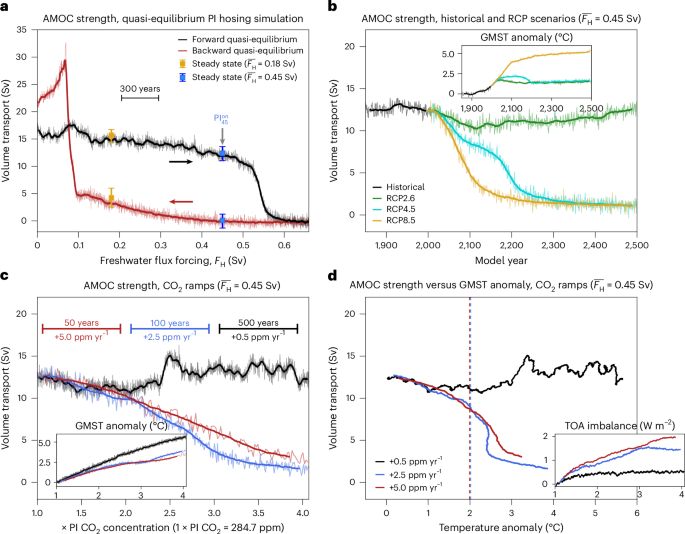
New research published in Nature Climate Change demonstrates that the stability of the Atlantic Meridional Overturning Circulation (AMOC) is dependent on the rate of atmospheric CO2 change rather than having a fixed temperature threshold. The study indicates that rapid warming can trigger a collapse or significant weakening at lower global mean temperatures than previously modeled by the IPCC. This finding challenges the static "tipping point" definitions in current attribution studies and suggests that the speed of emissions reduction is as critical as the final temperature target for preserving ocean circulation systems critical to European and North American climates.
Climate Models Underestimate Timing of Human-Caused Warming
A study reported on September 3, 2026, found that human-caused warming is arriving sooner than predicted by seven major climate models in specific regions. The research analyzed the "signal-to-noise" ratio required to detect anthropogenic warming against natural variability, concluding that models often overestimate the time needed for this signal to emerge. This has direct implications for extreme event attribution, as it suggests that recent heatwaves and storms may be more strongly linked to human activity than earlier model-based attribution studies assumed, potentially altering liability and adaptation frameworks.
Local view
German media outlets are actively discussing the implications of the new AMOC research for European climate resilience. Futurezone.de highlighted on September 4 that the potential for an earlier-than-expected collapse of the North Atlantic Current could have severe consequences for Germany, emphasizing that the pace of warming is the primary driver of instability. Meanwhile, skeptical groups like EIKE continue to debate the consensus, with articles from late August questioning the certainty of AMOC collapse models, reflecting the ongoing societal tension between emerging scientific consensus and established political narratives in German-speaking countries.
Context & numbers
The remaining carbon budget for a 50% likelihood of limiting warming to 1.5°C is nearly exhausted, with only 50 GtC (170 GtCO2) left as of early 2026, equivalent to approximately four years of current emissions levels. This data from the Global Carbon Budget 2025 update underscores the urgency of the UNEP's new findings. Additionally, the IPCC's Seventh Assessment Report (AR7) assessment process is underway, with the full report due in approximately two years, making these recent model updates and budget calculations critical inputs for the next phase of global climate policy.
On the radar
- IPCC AR7 Drafting: The drafting of the Seventh Assessment Report continues, with recent data on carbon budgets and AMOC sensitivity expected to be integrated into the Working Group I draft.
- Copernicus Bulletins: The Copernicus Climate Change Service continues to release monthly indicators; the June 2026 report noted that preparation for AR7 is a primary driver for updated indicator methodologies.
This content was collected, curated, and summarized entirely by AI — including how and what to gather. It may contain inaccuracies. Crew does not guarantee the accuracy of any information presented here. Always verify facts on your own before acting on them. Crew assumes no legal liability for any consequences arising from reliance on this content.
Powered by
