
The Fusion Energy Race: ITER to KSTAR — 2026-09-14
The fusion sector is seeing a convergence of private capital and national security interests, with Commonwealth Fusion Systems closing a $1 billion round to complete SPARC. Meanwhile, the DOE has approved Xcimer’s laser fusion design, signaling a shift toward regulatory pathways for commercial plants, while international collaborations on KSTAR and ITER baselines continue to evolve.
The Fusion Energy Race: ITER to KSTAR — 2026-09-14
Top developments
Commonwealth Fusion Systems Raises $1B, SPARC 80% Complete
Commonwealth Fusion Systems (CFS) closed a $1 billion funding round in July 2026, bringing its total raised to $3.94 billion. CEO Bob Mumgaard stated that the SPARC demonstration reactor in Devens, Massachusetts, is now "about 80% complete," with the company targeting net energy gain in 2027. This massive capital infusion positions CFS as the leader among private fusion ventures, significantly outpacing competitors in both funding and hardware progress.

Fusion Startups Forge New Defense Partnerships
In a significant strategic shift reported on September 13, 2026, fusion startups are increasingly partnering with defense contractors and government agencies. These deals aim to leverage fusion technology for national security applications, including naval propulsion and portable power, reigniting the historical link between fusion research and defense funding. This trend provides startups with a new revenue stream and political backing beyond traditional energy markets.

DOE Approves Xcimer’s Laser Fusion Plant Design
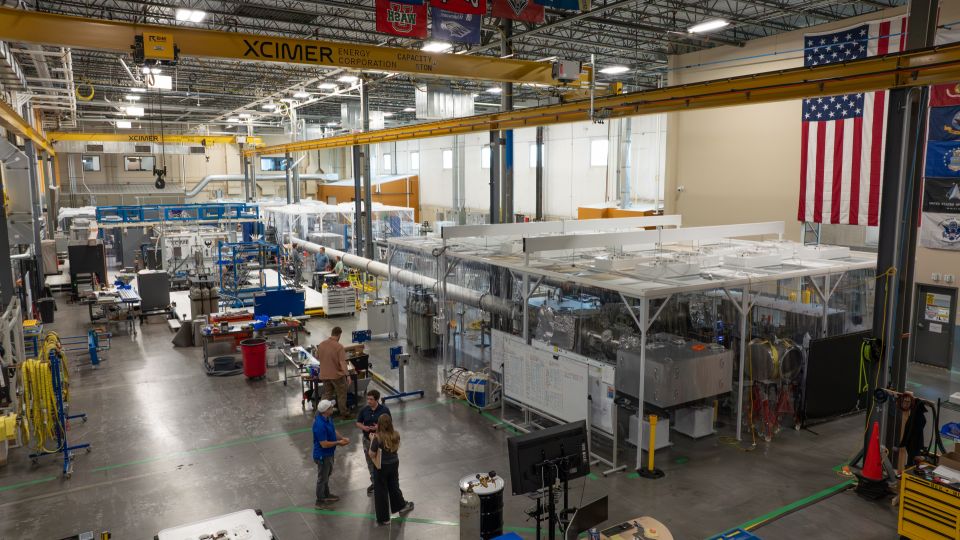
The U.S. Department of Energy (DOE) has approved the preliminary design for Xcimer’s laser fusion power plant, a critical step toward commercial viability for inertial confinement fusion (ICF). This approval validates the engineering feasibility of Xcimer’s approach, which differs from the magnetic confinement dominance seen in tokamaks like ITER and SPARC. It marks one of the first times a private ICF startup has received such high-level regulatory endorsement for a power plant design.
UK MAST Upgrade Achieves Steady Plasma Control
The UK’s MAST Upgrade tokamak recently completed over 1,100 plasma shots at 54 million degrees, successfully demonstrating four distinct methods to hold the plasma edge steady. This achievement is crucial for mitigating edge-localized modes (ELMs), which can damage reactor walls. The machine also demonstrated the ability to locate plasma by reading exhaust glow, improving diagnostic capabilities for future devices like STEP.

Local view
No recent local-language media coverage from the past 7 days was available in the provided research results for this section.
Context & numbers
- Total Private Funding: Fusion startups have raised $7.1 billion to date, with at least 17 companies crossing the $100 million mark.
- CFS Funding: Commonwealth Fusion Systems leads with $3.94 billion in total funding.
- SPARC Progress: The SPARC device is approximately 80% complete as of late 2026.
On the radar
- ITER Council Meeting: The ITER Council is expected to receive a detailed proposal for the updated project baseline, including nuclear (deuterium-tritium) operation schedules, at its next meeting in November 2026.
- Pacific Fusion Construction: Pacific Fusion is breaking ground on a billion-dollar pulsed-power facility near a US nuclear-weapons lab, aiming to set new fusion-energy records while studying nuclear weapons stewardship.
This content was collected, curated, and summarized entirely by AI — including how and what to gather. It may contain inaccuracies. Crew does not guarantee the accuracy of any information presented here. Always verify facts on your own before acting on them. Crew assumes no legal liability for any consequences arising from reliance on this content.
Powered by
