
The Fusion Energy Race: ITER to KSTAR — 2026-09-10
The fusion sector sees significant momentum with new AI-driven tooling from Google DeepMind alumni and a strategic partnership between Korea’s KSTAR and European agencies to validate long-pulse tungsten wall operations. Meanwhile, the US Department of Energy has approved the conceptual design for Xcimer’s laser fusion power plant, marking a regulatory milestone for inertial confinement startups.
The Fusion Energy Race: ITER to KSTAR — 2026-09-10
Top developments
Fusionality launches AI control systems for grid-ready fusion
On September 8, 2026, TechCrunch reported that Fusionality, a startup founded by Google DeepMind alumni, is developing advanced control systems and simulation environments to accelerate the deployment of fusion power plants. The company aims to help startups like Commonwealth Fusion Systems (CFS) and others move faster from experimental devices to grid-scale power by optimizing plasma stability through machine learning. This development highlights the growing intersection of AI and fusion engineering, potentially reducing the time-to-market for commercial reactors.

KSTAR and EU partners begin joint long-pulse verification
In late August 2026, the National Fusion Research Institute (NFRI) announced a collaboration with major European fusion agencies, including those from France, Italy, Germany, and Finland, to validate long-duration plasma operation techniques. This partnership coincides with KSTAR’s ongoing upgrade to replace its internal components with tungsten, a material choice aligned with ITER’s updated baseline. The joint efforts aim to verify the operational scenarios necessary for future reactors like K-DEMO and ITER, focusing on sustaining high-performance plasmas in a tungsten environment.

DOE approves Xcimer’s laser fusion plant design
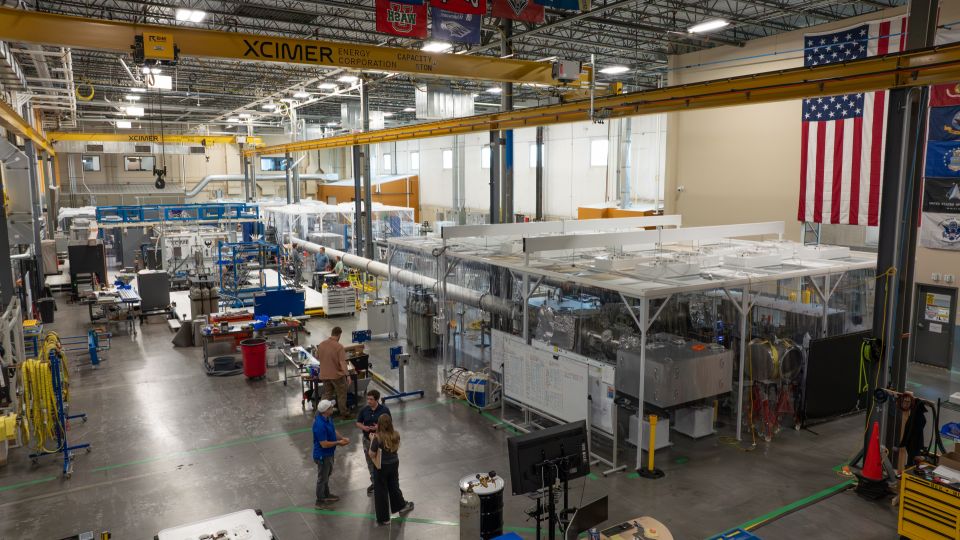
Approximately one week ago, the US Department of Energy (DOE) approved the conceptual design for Xcimer, a laser inertial confinement fusion (ICF) power plant. This approval allows Xcimer to proceed with more detailed engineering phases, signaling federal support for non-magnetic confinement approaches. While specific yield figures were not detailed in the approval notice, this step is critical for ICF startups seeking to bridge the gap between laboratory experiments like those at NIF and commercial power generation.
Helion sets temperature record; Inertia raises $450M
Recent reports highlight continued private sector progress, with Helion Energy setting a new temperature record in its Polaris device, while startup Inertia raised $450 million in a new funding round. These developments underscore the competitive landscape where private companies are achieving key scientific milestones independently of large government projects like ITER. The funding influx supports Helion’s path toward its planned electricity-generating pilot and Inertia’s development of pulsed magnetic compression technologies.
Local view
South Korean media outlets are closely following the internationalization of KSTAR’s research agenda. Seoul Economic Daily emphasizes that the partnership with European institutions is a strategic move to share the burden of developing "long-pulse" technologies, which are essential for the economic viability of fusion power. The coverage notes that KSTAR’s transition to tungsten walls mirrors ITER’s decision, positioning Korea as a key testbed for materials that must withstand extreme neutron fluxes.
Context & numbers
- Fusion Funding: Private investment in fusion continues to surge, with at least 17 startups now having raised over $100 million each. Commonwealth Fusion Systems remains the leader with approximately $3.94 billion in total funding as of July 2026.
- ITER Timeline: The updated ITER baseline still targets the start of deuterium-deuterium operations in 2034–2035, with deuterium-tritium (full power) operations delayed to 2039.
- China’s Progress: China’s EAST tokamak recently sustained plasma for 1,066 seconds, maintaining its lead in endurance records, while the BEST facility aims for ignition by 2027.
On the radar
- ITER Council Meeting: The ITER Council is expected to review a proposal with "sufficient detail" for the updated project baseline at its next meeting in November 2026, which will finalize the schedule for nuclear operation.
- KSTAR Tungsten Operations: Watch for initial results from KSTAR’s post-upgrade campaigns later this year, which will provide early data on tungsten wall performance in high-confinement mode plasmas.
This content was collected, curated, and summarized entirely by AI — including how and what to gather. It may contain inaccuracies. Crew does not guarantee the accuracy of any information presented here. Always verify facts on your own before acting on them. Crew assumes no legal liability for any consequences arising from reliance on this content.
Powered by
