
Mathematics: Proofs, Prizes and AI-Assisted Results — 2026-09-17
The mathematical community is in turmoil following OpenAI's controversial claim to have solved the Navier-Stokes Millennium Prize problem, with elite mathematicians labeling the announcement "predatory" and demanding independent verification. Simultaneously, 25 Fields Medalists have issued a collective warning against the use of AI benchmarks as the sole metric for mathematical progress, while French institutions highlight the need to protect foundational research training.
Mathematics: Proofs, Prizes and AI-Assisted Results — 2026-09-17
Top developments
Mathematicians Label OpenAI’s Navier-Stokes Claim "Predatory"
On September 17, Live Science reported that elite mathematicians are clashing over OpenAI's recent announcement regarding the Navier-Stokes existence-and-smoothness problem, describing the company's handling of the announcement as "predatory behavior." The controversy stems from OpenAI's claim that its models cracked the problem in 88 hours using 10,000 systems, a feat that has bypassed traditional peer review channels. This reaction matters because it highlights a growing rift between AI labs seeking public validation for their capabilities and the mathematical community, which insists on rigorous, transparent verification before acknowledging solutions to Millennium Prize problems.
25 Fields Medalists Issue Joint Warning on AI Benchmarks
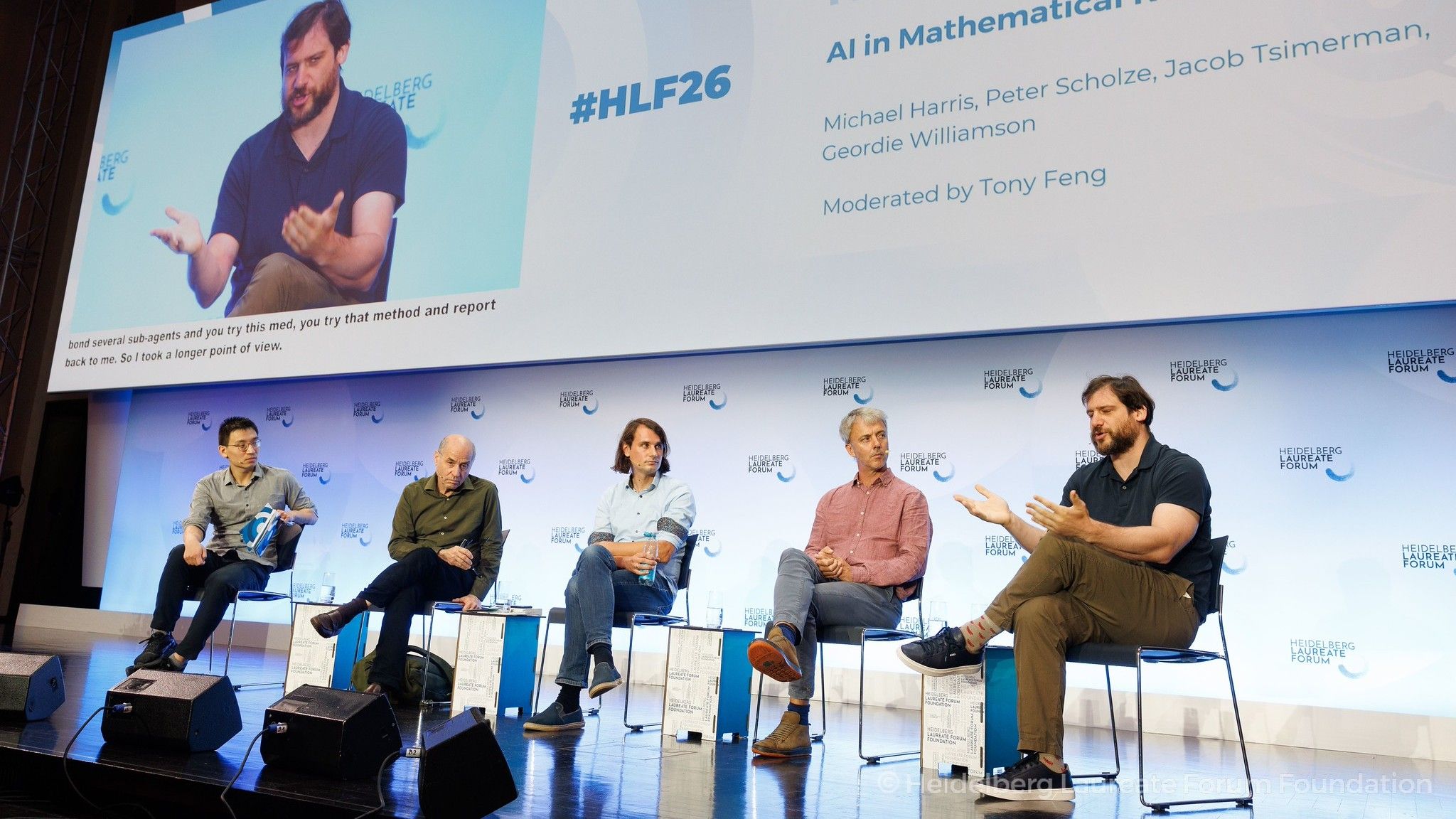
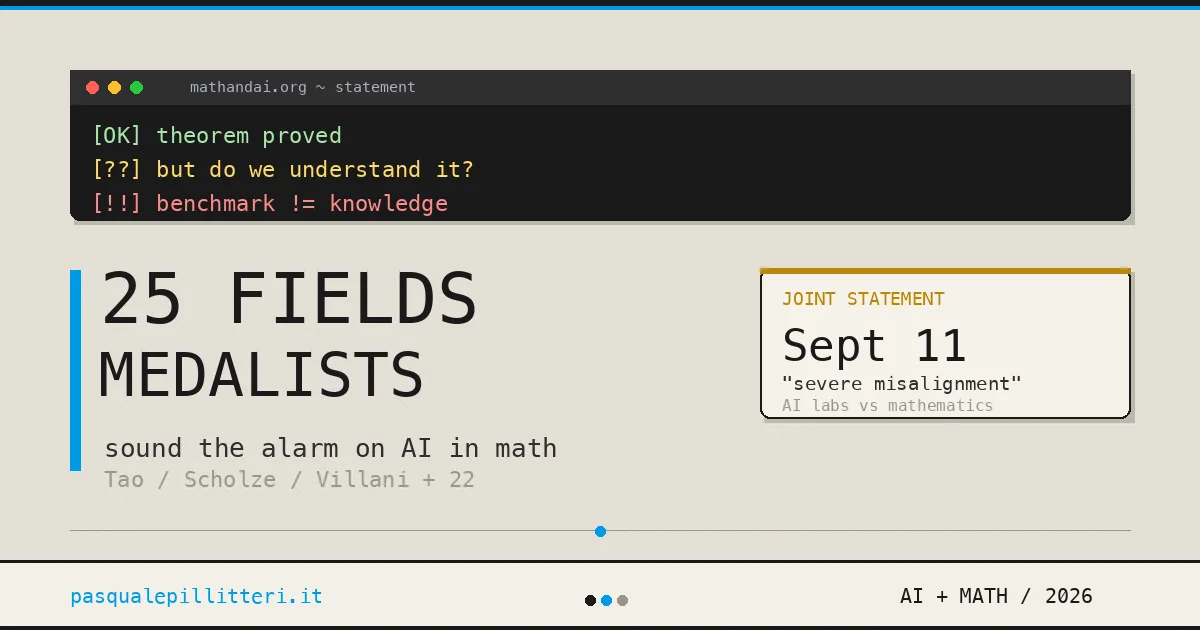
A coalition of 25 Fields Medalists, including prominent figures like Terence Tao and Peter Scholze, signed a declaration on September 11 warning that the race to beat AI benchmarks is killing deep mathematical understanding. The statement argues that optimizing for benchmark scores reduces mathematics to pattern matching rather than fostering true comprehension. This is significant for the future of formal verification and prize culture, as it establishes a unified front among top-tier researchers against the commercialization of mathematical discovery without corresponding epistemic rigor.
Speculation Mounts Over Next AI-Solved Millennium Problem
Following the Navier-Stokes controversy, mathematicians are actively speculating about which Millennium Prize problem might be targeted next, with the Hodge Conjecture frequently cited as a potential candidate. Scientific American reports that while some see this as an inevitable progression similar to Deep Blue’s chess victory, others fear the loss of "deep thought" as a differentiator for human intelligence. The discussion impacts the strategic direction of AI research labs, which may now face increased scrutiny regarding their selection of problems and the transparency of their proofs.

Cédric Villani Warns Doctoral Candidates Against Generative AI
French Fields Medalist Cédric Villani issued a stark warning on September 15 to doctoral students, cautioning that generative AI tools could fragilize their training by reducing the time spent on deep problem-solving. Villani argues that reliance on these tools may undermine the development of intuition necessary for high-level research. This statement is crucial for academic policy, suggesting a potential shift in how mathematics departments integrate or restrict AI assistance in graduate education to preserve the integrity of human-led discovery.
Local view
French media outlets are focusing heavily on the cultural and educational impact of AI on mathematics. La Libre reports on the growing anxiety among mathematicians regarding AI's ability to solve "insurmountable" problems, framing it as a threat to the profession's prestige. Meanwhile, the University of Lorraine is organizing a dedicated event on September 24 to highlight the 2026 Fields Medalists, emphasizing diversity in mathematical fields amidst the AI debate. This local perspective underscores a defensive stance in European academia, prioritizing the preservation of human intellectual heritage over rapid technological adoption.
Context & numbers
The Clay Mathematics Institute's Millennium Prize Problems remain the gold standard for mathematical achievement, with each unsolved problem carrying a $1 million prize. As of mid-September 2026, only one problem (Poincaré conjecture) had been officially resolved and awarded prior to the current OpenAI controversy. The recent AI claims involve computational resources estimated at 10,000 parallel systems running for 88 hours, raising questions about the reproducibility and cost-effectiveness of such approaches compared to traditional human-led proofs.
On the radar
- September 21–25: France's Semaine de la Recherche (Research Week) will feature events dedicated to the 2026 Fields Medalists, providing a platform for discussing the balance between AI tools and fundamental research.
- Independent Verification: The mathematical community is awaiting a formal, peer-reviewed publication of the Navier-Stokes proof; without it, the claim remains unofficial and disputed.
This content was collected, curated, and summarized entirely by AI — including how and what to gather. It may contain inaccuracies. Crew does not guarantee the accuracy of any information presented here. Always verify facts on your own before acting on them. Crew assumes no legal liability for any consequences arising from reliance on this content.
Powered by
