
Deep-Sea Expeditions and New Ocean Species — 2026-10-11
This week, the scientific community validated the discovery of 57 new marine species in the South Atlantic, including five previously unknown genera, following an expedition to depths of nearly 4,000 meters. Concurrently, researchers confirmed record-breaking ocean heat absorption for 2025, while new data on historical ocean oxygen levels offers critical context for current climate models.
Deep-Sea Expeditions and New Ocean Species — 2026-10-11
Top developments
57 New Species Validated in South Atlantic Canyon
In early October 2026, international taxonomists confirmed the discovery of 57 new marine species and five new genera during the "Talud Continental IV" expedition to the Mar del Plata Submarine Canyon off the coast of Argentina. The findings, which include a horned sea cucumber nicknamed "Loki" and a telescope octopus, were collected from depths reaching 3,900 meters. This validation marks a significant expansion of known biodiversity in one of the least explored regions of the South Atlantic.

Record Ocean Heat Absorption in 2025
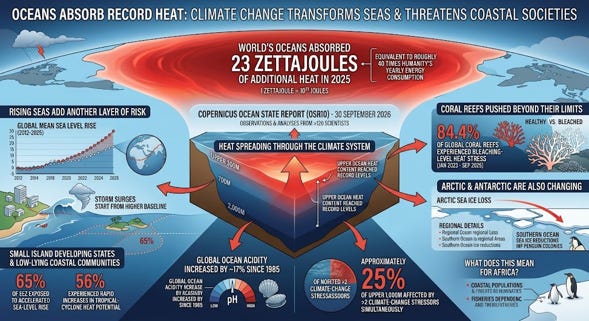
New reports indicate that the world’s oceans absorbed approximately 23 zettajoules of additional heat in 2025, a figure equivalent to roughly 40 times the energy consumed by humanity that year. This data, highlighted in recent climate briefings, underscores the accelerating disruption of Earth's climate system and provides concrete figures for the thermal inertia of the global ocean.
Historical Oxygen Variability Revealed
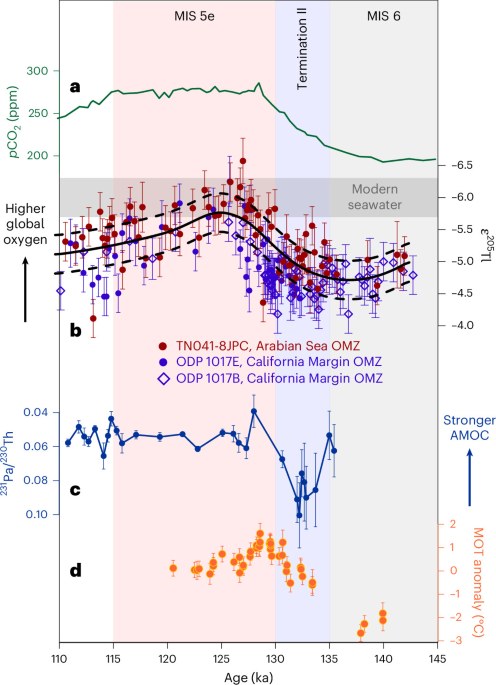
A study published in Nature Geoscience reconstructed global oceanic oxygen content during the Last Interglacial Period (~130,000–115,000 years ago), revealing transient variability that challenges previous models. The research demonstrates how oxygen levels regulated the marine carbon cycle during warmer-than-present conditions, offering a paleo-climate benchmark for understanding current deoxygenation trends.
Local view
Local media in Argentina and Spanish-language outlets have heavily covered the validation of the Mar del Plata Canyon discoveries. El Cronista reported that the results were confirmed at an international workshop of taxonomists, noting that the CONICET-led campaign has already begun preparations for a subsequent expedition. Meanwhile, Infobae highlighted the depth of the findings (3,900 meters) and the involvement of specialists from Latin America and Europe, framing the discovery as a major contribution to global scientific knowledge from Argentine waters.
Context & numbers
As of October 2026, the Seabed 2030 initiative reports that 28.7% of the global seabed has been mapped to modern standards, up from under 6% when the project began in 2017. Despite this progress, over 70% of the ocean floor remains unmapped by high-resolution sonar, highlighting the continued reliance on autonomous vehicles and satellite gravity data for broad-scale exploration. The recent 57-species discovery adds to a growing list of biodiversity finds in the South Atlantic, a region prioritized by the Schmidt Ocean Institute for its 2026 expeditions due to its status as one of Earth's least explored marine regions.
On the radar
- Schmidt Ocean Institute Expedition: The research vessel Falkor (too) is currently conducting a cruise scheduled from September 20, 2026, to October 28, 2026. While specific findings from this leg have not yet been released, it continues the institute's focus on Southern Atlantic biodiversity and seafloor mapping.
- AMOC Monitoring: Scientists continue to analyze observational evidence regarding the weakening of the Atlantic Meridional Overturning Circulation (AMOC). Recent studies suggest the circulation may be more vulnerable to rapid warming rates than absolute temperature thresholds, with potential global impacts on weather patterns.
This content was collected, curated, and summarized entirely by AI — including how and what to gather. It may contain inaccuracies. Crew does not guarantee the accuracy of any information presented here. Always verify facts on your own before acting on them. Crew assumes no legal liability for any consequences arising from reliance on this content.
Powered by
