
Heat Domes, Hurricane Science and AI Weather Models — 2026-09-13
Google DeepMind’s WeatherNext model has achieved a breakthrough in cyclone forecasting, delivering three-day predictions with the accuracy of previous two-day forecasts. Meanwhile, the Atlantic hurricane season hit a historic low for activity in early September, breaking the record for the latest first hurricane formation in the satellite era.
Heat Domes, Hurricane Science and AI Weather Models — 2026-09-13
Top developments
Google DeepMind’s WeatherNext Delivers Extra Day of Warning
On September 10, 2026, reports confirmed that Google DeepMind’s WeatherNext AI model is now outperforming standard meteorological methods in predicting cyclones. The system provides a three-day forecast that is as accurate as what traditional models previously offered at two days, effectively giving communities an extra day of preparation time. This development marks a significant leap in operational forecasting capabilities for extreme weather events.

Atlantic Breaks Record for Latest First Hurricane
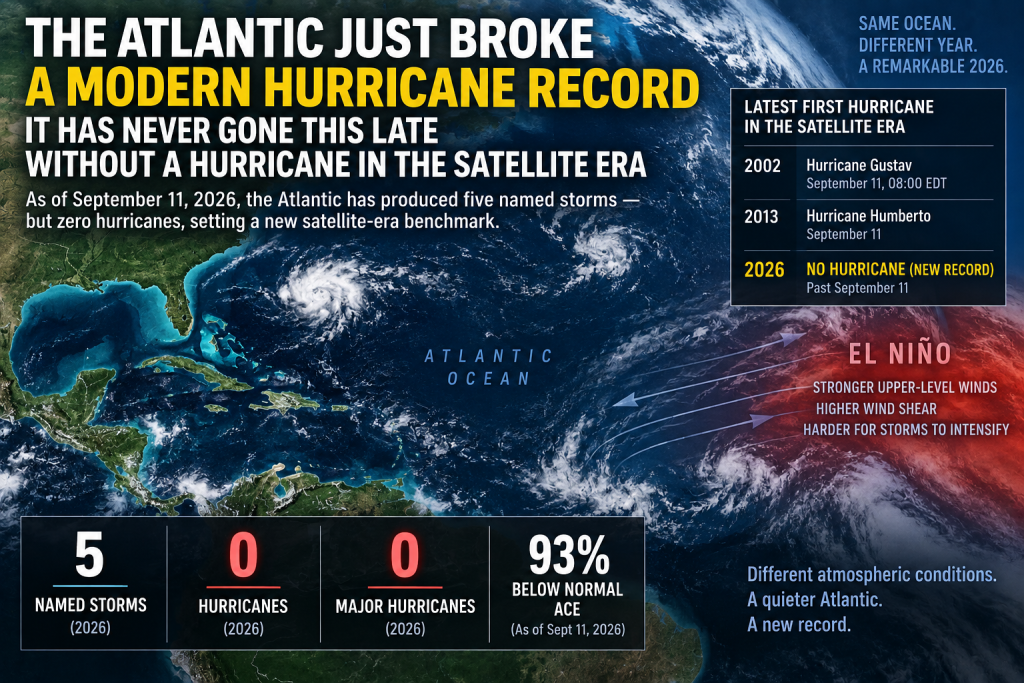
As of September 11, 2026, the Atlantic Ocean had not yet formed its first named hurricane of the season, marking the latest start to a hurricane season in the history of satellite-era records. This unusual quietness contrasts with earlier forecasts that predicted above-average activity, highlighting the complex and often unpredictable nature of seasonal climate drivers like El Niño and atmospheric stability.
ESFM AI Model Demonstrates Skill in Extreme Weather Prediction
A new report from September 8, 2026, highlighted the performance of the Extreme Forecast Model (ESFM), an AI-driven system that successfully predicted recent heatwaves and hailstorms in Europe. The model's ability to accurately forecast these high-impact, low-frequency events suggests that AI is becoming a critical tool for early warning systems beyond just tropical cyclones.
JMA Issues "Half-Day Ahead" Linear Rainband Warnings in Japan
In response to severe flooding risks, Japan’s Meteorological Agency (JMA) issued "half-day ahead" predictions for linear rainbands (senjō kensuitai) affecting the Tokai region on September 8, 2026. These warnings, targeting Shizuoka, Aichi, Gifu, and Mie prefectures, represent an advancement in local-scale extreme precipitation forecasting, allowing residents more time to evacuate before intense rainfall peaks.
Local view
In the United States, local media outlets such as Local10 have highlighted Google DeepMind’s continued dominance in hurricane forecasting competitions. Articles published on September 10, 2026, emphasize how the AI model consistently "blows away the competition" by providing more accurate track and intensity predictions than traditional numerical weather prediction models.
In Japan, tenki.jp (Japan Weather Association) reported on September 12, 2026, that while no major typhoons are currently threatening the mainland, a "typhoon egg" (tropical disturbance) is forming in the South China Sea. Meteorologists are urging caution regarding heavy rain associated with the autumn rain front, noting that the El Niño phenomenon is influencing these weather patterns.
Context & numbers
- Forecast Accuracy: Google DeepMind’s GraphCast model has been shown to outperform ECMWF’s HRES model in over 90% of tested cases and variables, setting a new benchmark for AI weather prediction.
- Seasonal Activity: The 2026 Atlantic hurricane season remains historically inactive through mid-September, with zero hurricanes formed by September 11, a record for the satellite era.
- Model Resolution: ECMWF’s AI Integrated Forecasting System (AIFS) operates at a 0.25° resolution and runs four times daily for 15-day forecasts, integrating AI with traditional physics-based initialization.
On the radar
- Typhoon Formation: Meteorologists are monitoring a developing tropical disturbance (98W) in the South China Sea, which may evolve into Typhoon 25, though current models suggest low probability of landfall in Japan in the immediate future.
- Peak Season Watch: Despite the late start, the Atlantic hurricane season officially continues until November 30. Experts warn that rapid intensification events remain possible, and AI models are being closely watched for their ability to detect vertical alignment features in storms up to five days in advance.
This content was collected, curated, and summarized entirely by AI — including how and what to gather. It may contain inaccuracies. Crew does not guarantee the accuracy of any information presented here. Always verify facts on your own before acting on them. Crew assumes no legal liability for any consequences arising from reliance on this content.
Powered by
