
Asteroids and Planetary Defence: Bennu, Apophis, Hera — 2026-09-13
Asteroid 2026 RW1, a city-bus-sized space rock, impacted Earth's atmosphere over the Indian Ocean on September 6, becoming the 13th known object detected before impact. Simultaneously, new analyses of Hayabusa2 samples reveal that asteroid Ryugu is a remnant of the solar system's earliest formation period, offering critical insights into the origins of life's ingredients.
Asteroids and Planetary Defence: Bennu, Apophis, Hera — 2026-09-13
Top developments
Asteroid 2026 RW1 Impacts After Six-Hour Warning
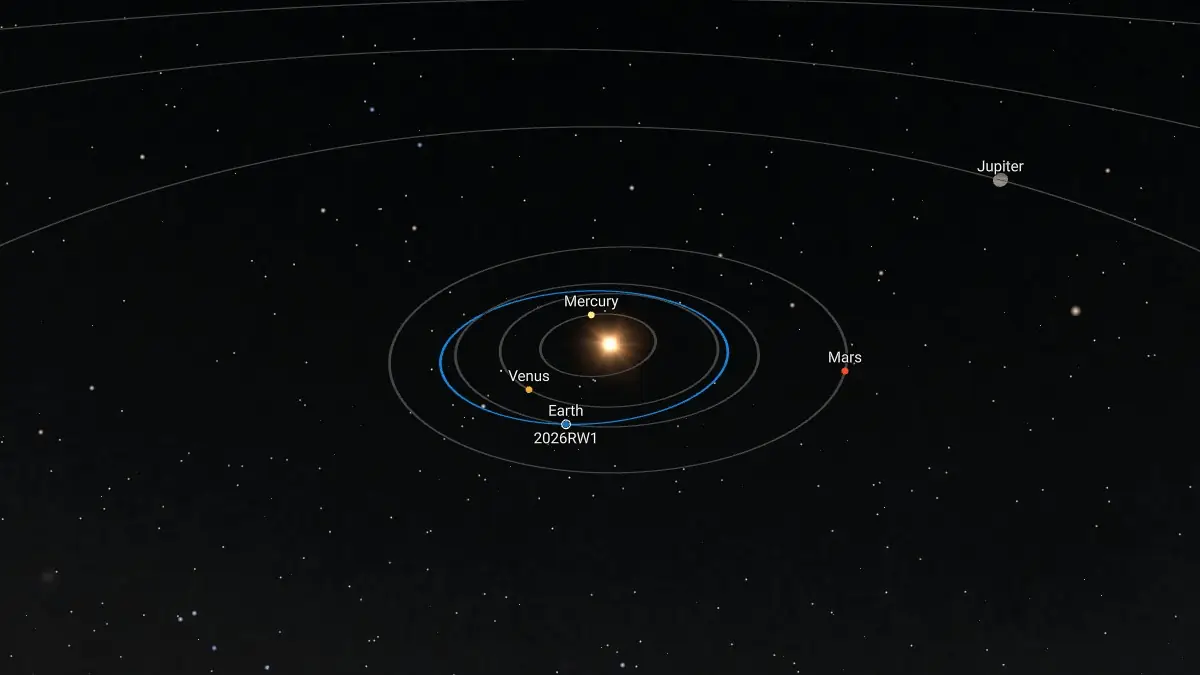
On September 6, 2026, asteroid 2026 RW1 entered Earth’s atmosphere over the Indian Ocean northwest of Australia at 16:07 UTC, approximately seven hours after its discovery by the Catalina Sky Survey. Measuring roughly 0.8 meters in diameter, this event marks only the 13th time in history that an asteroid was detected before impacting Earth. The successful detection and tracking provided a rare live test for planetary defense networks, demonstrating the capability of systems like the Mount Lemmon Observatory to identify small, fast-moving threats with limited lead time.
Ryugu Identified as Remnant of Early Solar System Planetesimals
Researchers from Hokkaido University and other institutions published findings in Science on September 10, 2026, indicating that asteroid Ryugu is a remnant of a planetesimal formed within two million years of the solar system's birth. Analysis of samples returned by JAXA’s Hayabusa2 mission suggests that carbonaceous asteroids like Ryugu contain organic matter that may have contributed to Earth's early chemical inventory. This discovery refines our understanding of how early solar system bodies evolved and provides a timeline for the delivery of prebiotic materials to terrestrial planets.

Hayabusa2 Prepares for Torifune Flyby
JAXA confirmed that the extended mission of Hayabusa2 is on track for its flyby of asteroid 1998 KY26 (renamed Torifune), scheduled for July 5, 2026. Recent updates from ISAS/JAXA highlight that the spacecraft successfully captured images of the target from 7 million kilometers away. This mission phase leverages the remaining fuel from the Ryugu sample return campaign, allowing scientists to observe a different class of asteroid—a small, rapidly rotating body—to compare with the larger, C-type Ryugu and B-type Bennu.
Local view
Japanese media outlets, including Mainichi Shimbun and Yahoo! News Japan, have focused heavily on the scientific implications of the Ryugu sample analysis. Mainichi Shimbun highlighted the collaborative nature of the research involving Hokkaido University and international partners, emphasizing the global impact of Japan's sample return missions. Coverage notes that these findings reinforce Japan's leadership in asteroid exploration following the success of both Hayabusa and Hayabusa2.
Context & numbers
The detection of 2026 RW1 occurred just six hours before impact, a timeframe considered "short notice" but sufficient for global monitoring networks to track its trajectory. It was the first known impactor on an orbit entirely inside Earth's own orbit, a dynamic that makes such objects particularly difficult to detect until they are very close. As of mid-September 2026, there are no known asteroids with a significant probability of impacting Earth in the next century, according to ESA's NEOCC and NASA's Sentry systems.
On the radar
- Apophis 2029 Flyby: NASA’s OSIRIS-APEX mission remains on course to intercept asteroid Apophis during its close approach in April 2029. The asteroid will pass within 32,112 km of Earth, closer than geostationary satellites.
- ESA Hera Mission: ESA continues preparations for the Hera mission to the binary asteroid Didymos/Dimorphos, which will provide follow-up observations of NASA's DART impact site.
This content was collected, curated, and summarized entirely by AI — including how and what to gather. It may contain inaccuracies. Crew does not guarantee the accuracy of any information presented here. Always verify facts on your own before acting on them. Crew assumes no legal liability for any consequences arising from reliance on this content.
Powered by
