
China’s Space Programme: Tiangong, Chang’e, Long March — 2026-09-21
China’s Shenzhou-23 crew has surpassed four months in orbit, conducting advanced biological experiments and critical station maintenance. Simultaneously, state media confirmed that lunar spacesuit development and ground-based physiological research are progressing to support the 2030 crewed moon landing goal, while commercial launchers face scrutiny over satellite deployment gaps.
China’s Space Programme: Tiangong, Chang’e, Long March — 2026-09-21
Top developments

Shenzhou-23 crew completes four months in orbit with ongoing biological research
As of September 20–21, 2026, the Shenzhou-23 crew—astronauts Zhu Yangzhu, Zhang Zhiyuan, and Li Jiaying—have been in orbit for nearly four months. The China Manned Space Agency (CMSA) reported that the team is actively conducting space science experiments, specifically focusing on the interaction between viruses and immune metabolism in microgravity. This research is crucial for understanding long-duration human adaptability, a key prerequisite for the planned year-long missions and the eventual lunar expedition.
Lunar spacesuit and bed rest studies advance for 2030 moon landing
State media Xinhua reported on September 19 and 20 that China is accelerating the development of its next-generation lunar spacesuits and conducting "bed rest" studies to simulate the physiological effects of long-duration spaceflight and lunar gravity. These efforts are directly tied to the technical verification flights of the Long March-10 rocket and the Mengzhou spacecraft, which are targeted to debut in 2026 to support the first crewed lunar landing by 2030.
Long March-2D launches PIESAT satellites; Wenchang LC-301 nears completion
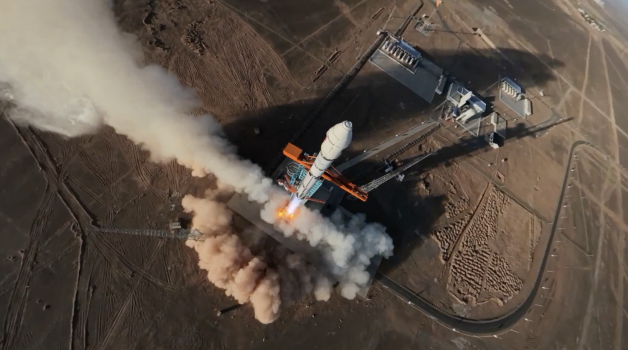
On September 19, 2026, a Long March-2D rocket successfully launched the PIESAT-2 13-16 satellite group from the Taiyuan Satellite Launch Center. Concurrently, NASASpaceFlight.com noted that construction at Wenchang Space Launch Site’s new Complex 301 is nearing completion, with shutter doors installed on assembly buildings. This facility will house the Long March-10 vehicles intended for the Mengzhou lunar capsule launches, marking a tangible step toward the 2030 lunar mission infrastructure.
Local view
Media highlight "romantic" milestones amid commercial reality checks
Local outlets like Sohu and Huxiu have focused heavily on the narrative of China’s reusable rocket breakthroughs, framing recent successes (such as the Zhuque-3 land recovery in August) as a shift from "flying out" to "flying back." However, Huxiu also published a critical analysis on September 20 noting a significant gap between the number of satellites currently in orbit (approx. 256 for commercial constellations like Qianfan) and the contracted delivery targets, suggesting a "78-fold deficit" that commercial launch providers must address to meet future demands.
Context & numbers
- Shenzhou-23 Mission Duration: As of Sept 21, the crew has been in orbit for ~4 months. One astronaut, Li Jiaying, is scheduled for a one-year stay, setting a new Chinese record for single-mission duration.
- Recent Launch: PIESAT-2 13-16 satellites launched on Sept 19, 2026, via Long March-2D from Taiyuan.
- Lunar Infrastructure: Construction of LC-301 at Wenchang, designated for Long March-10/Mengzhou lunar missions, is in its final stages as of late September 2026.
On the radar
- Mengzhou-1 and Long March-10A Debut: Both vehicles are officially scheduled for their maiden flights in 2026. With LC-301 nearing completion, watch for static fire tests or pad preparations at Wenchang in Q4 2026.
- Commercial IPO Activity: Orienspace is preparing for an IPO coaching process to fund its reusable Gravity-2 rocket, signaling continued financial momentum in the private sector despite operational challenges.
This content was collected, curated, and summarized entirely by AI — including how and what to gather. It may contain inaccuracies. Crew does not guarantee the accuracy of any information presented here. Always verify facts on your own before acting on them. Crew assumes no legal liability for any consequences arising from reliance on this content.
Powered by
