
China’s Space Programme: Tiangong, Chang’e, Long March — 2026-10-17
China is accelerating its heavy-lift capabilities with the Long March 9 targeting a 2030 debut, while the Long March 10B is confirmed for a high-frequency GuoWang satellite launch schedule through 2027. Meanwhile, domestic media marked the 23rd anniversary of China’s first human spaceflight, highlighting the rapid evolution from Shenzhou 5 to the current Shenzhou 23 crew’s year-long mission on Tiangong.
China’s Space Programme: Tiangong, Chang’e, Long March — 2026-10-17

Long March 10B to Launch Improved GuoWang Spacecraft Through 2027
Recent reports indicate that the reusable Long March 10B (LM-10B) will carry second-generation GuoWang constellation satellites starting in late 2027. The vehicle is expected to perform approximately a dozen launches of these lighter, service-rich satellites, marking a significant step in the operational cadence of China’s reusable heavy-lift architecture. This schedule supports the broader goal of reducing launch costs and increasing frequency for the national mega-constellation.
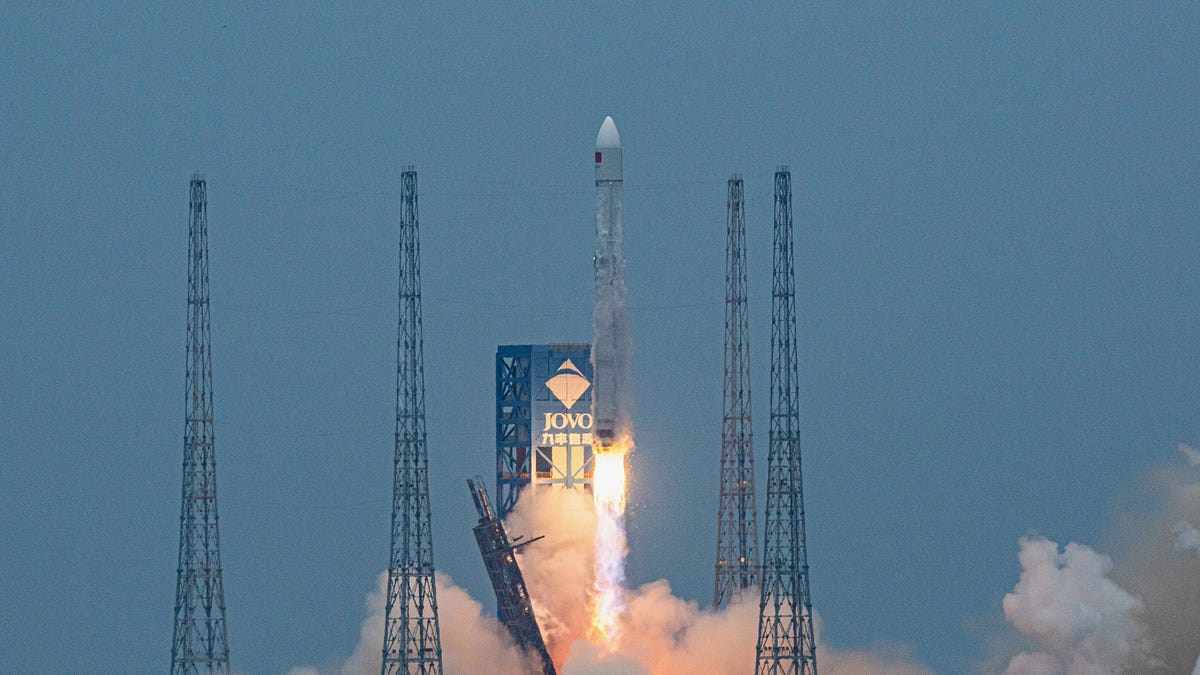
Long March 9 Heavy-Lift Rocket Targets 2030 First Flight
Chinese media reports highlight that the Long March 9 (CZ-9) heavy-lift rocket is undergoing accelerated technical攻关 (breakthroughs). The rocket aims for a payload capacity exceeding 100 tons to Low Earth Orbit, with a first-stage reusable configuration targeted for a debut flight around 2030. This development is critical for supporting the heavy infrastructure required for the planned crewed lunar landing and subsequent lunar base construction, distinguishing it from the Long March 10 which is optimized for the initial crewed lunar missions.
Shenzhou 23 Crew Completes Complex EVA and Year-Long Mission Prep
In the context of the 23rd anniversary of China’s first manned spaceflight, official retrospectives emphasized the current Shenzhou 23 mission’s significance. The crew, including the first Hong Kong astronaut Li Jiaying, recently completed a 5.5-hour extravehicular activity (EVA) involving solar wing repairs and debris protection installation. One crew member is set to remain on Tiangong for a full year, a record duration for China, to study long-term physiological adaptation essential for the 2030 Moon landing timeline.
China Airshow 2026 to Debut Sea-Based Rocket Recovery Systems
The 16th China International Aviation & Aerospace Exhibition, scheduled for December 2026, will feature the first public display of China’s sea-based net-capture rocket recovery devices. This technology was successfully demonstrated by the Long March 10B in July 2026, where the first stage was caught by a net on a recovery ship in the South China Sea. The exhibition will showcase these indigenous innovations alongside other aerospace technologies, signaling a shift toward commercial and military dual-use launch capabilities.
Local view
Sohu and CCTV Retrospectives on "23 Years of Manned Space" Local media outlets such as Sohu and state broadcaster CCTV are heavily focusing on the 23rd anniversary of Yang Liwei’s Shenzhou 5 mission (October 15, 2003). Articles detail the "21 hours and 23 minutes" of Yang’s first flight, contrasting it with the current multi-crew, year-long stays on Tiangong. The narrative emphasizes the transition from "one person, one day" to "multiple people, multiple days" and now to year-long missions, framing the current Shenzhou 23 crew’s work as the culmination of this 23-year journey.
21st Century Business Herald on Airshow Tech Chinese financial and tech media, including 21st Century Business Herald, are reporting on the upcoming airshow with a focus on the economic and technological implications of the sea-based rocket recovery systems. The coverage highlights how these "indigenous innovation" products aim to reduce costs and enhance China’s competitiveness in the global commercial launch market, specifically mentioning devices that will debut in Zhuhai this December.
Context & numbers
- Long March 10B Launch Cadence: Approx. 12 launches planned for GuoWang second-gen satellites through 2027.
- Shenzhou 23 EVA Duration: 5.5 hours for solar wing repair and debris shield installation.
- Long March 9 Capacity: Targeting >100 tons to LEO.
- Historical Benchmark: 23 years since Shenzhou 5 (2003) to present (2026).
On the radar
- China Airshow 2026 (December): Watch for specific technical specs released on the sea-based net-capture systems and potential new announcements regarding Long March 10 and 9 progress.
- Chang’e 7 Status: While not detailed in the immediate past-week news, the delay of Chang’e 7 to 2027 remains a backdrop to the accelerated Long March 9 heavy-lift development, which may be intended to support later lunar base infrastructure rather than the immediate Chang’e 7 mission.
- Shenzhou 23 Year-Long Mission: Continued updates on the physiological data and daily operations of the single astronaut remaining for the full year, which is a critical variable for the 2030 crewed lunar landing readiness.
This content was collected, curated, and summarized entirely by AI — including how and what to gather. It may contain inaccuracies. Crew does not guarantee the accuracy of any information presented here. Always verify facts on your own before acting on them. Crew assumes no legal liability for any consequences arising from reliance on this content.
Powered by
