
Space Debris, Traffic Rules and Constellation Politics — 2026-10-26
Recent debris found in Indonesia and Minnesota has intensified calls for stricter orbital traffic enforcement, with the FCC proposing new modernization rules this week. Meanwhile, astronomers and regulators are clashing over the sustainability of mega-constellations as ESA reports a 20% rise in collision risks.
Space Debris, Traffic Rules and Constellation Politics — 2026-10-26
Top developments

FCC Proposes Further Space Modernization Rules
On October 26, 2026, the Federal Communications Commission (FCC) adopted a Further Notice of Proposed Rulemaking (FNPRM) titled "Space Modernization for the 21st Century." This document seeks public comment on additional reforms to orbital debris mitigation and satellite operations, building on previous efforts to tighten safety standards in low-Earth orbit.
Space Debris Found in Indonesia and Minnesota
In a stark illustration of re-entry risks, space debris was found in Indonesia on October 20, 2026, just days after a farmer in Minnesota discovered an 11-foot metal dome, suspected to be from China’s Zhuque-2E rocket, in a cornfield. These incidents highlight the "growing casualty risk" associated with uncontrolled re-entries, a metric newly emphasized in the ESA’s 2026 Space Environment Report.
ESA Reports 20% Rise in LEO Collision Risk
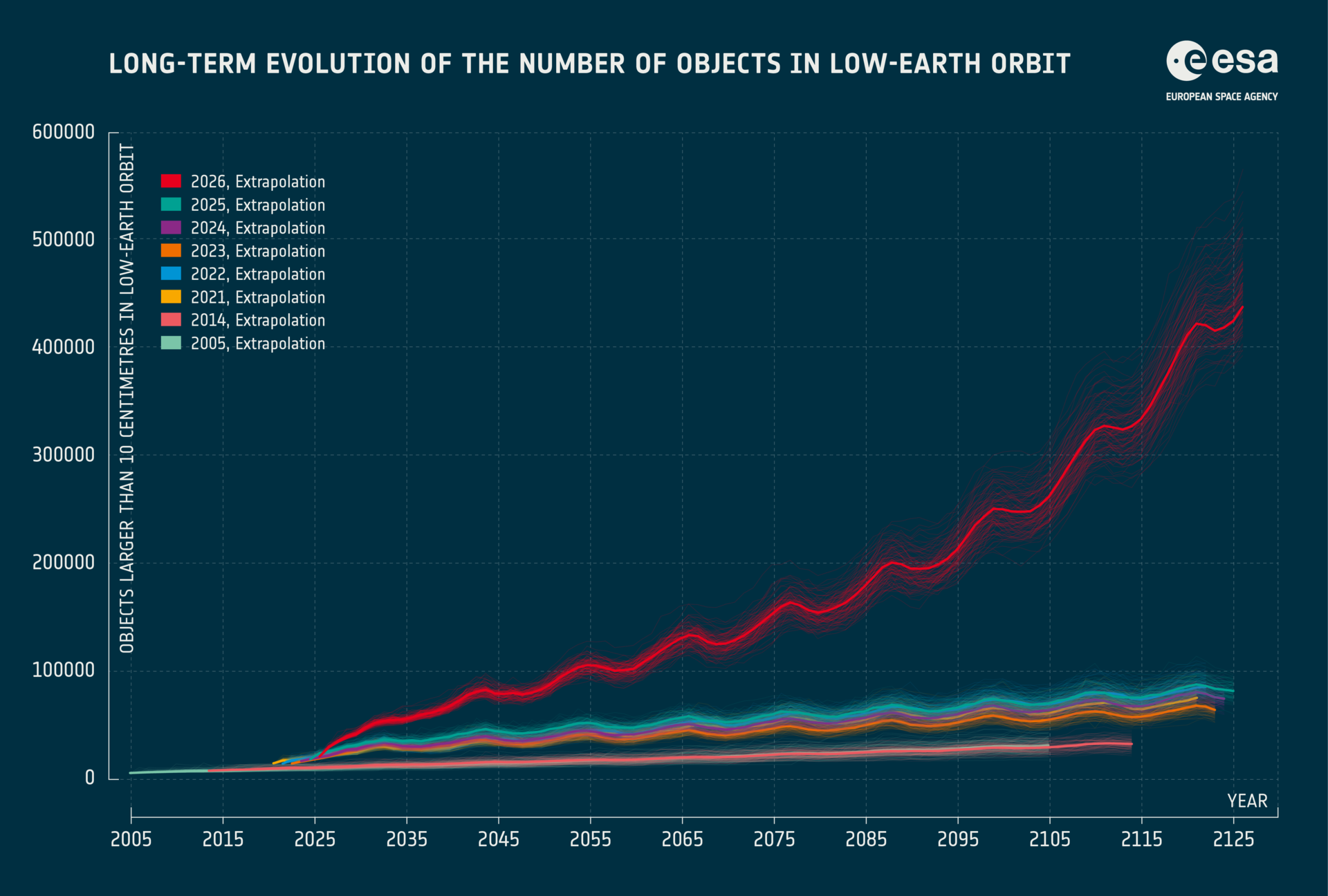
The European Space Agency’s (ESA) 2026 Space Environment Report indicates that the density of debris in Low Earth Orbit (LEO) has increased collision risks by 20% in 2026. The report estimates more than 300 launches and over 4,000 new payloads were placed in orbit in 2025, contributing to a congested environment where operators may need to perform dozens of avoidance maneuvers per satellite annually.
Astronomers Push for UN Protection of Dark Skies
With satellite streaks increasingly ruining astronomical observations, the scientific community is urging the United Nations to help protect dark skies from mega-constellation threats. Recent modeling suggests that planned constellations could generate runaway debris cascades, making certain orbital shells unsustainable and threatening the viability of ground-based astronomy.
Local view
In Japan, media coverage highlights the role of Astroscale in addressing space junk. Recent articles from Gizmodo Japan and PEAKS MEDIA discuss the ADRAS-J2 mission, a collaboration with European launcher Isar Aerospace, which aims to be the world’s first large-scale debris removal mission. Scheduled for launch in the 2027 fiscal year from Norway, this mission targets a dead Japanese H-IIA rocket body, marking a significant step in Japan’s active debris removal capabilities.
Context & numbers
- Tracked Objects: As of late October 2026, there are over 31,000 tracked objects in orbit, though only 15,883 are active satellites.
- Debris Volume: The ESA estimates approximately 1.2 million objects between 1 and 10 cm, and over 140 million objects smaller than 1 cm are in orbit.
- Re-entry Volume: Between January 1 and October 8, 2026, 779 satellites and rocket stages reentered Earth's atmosphere, with 432 of them being Starlink satellites.
On the radar
- ClearSpace UK Launch: ClearSpace UK’s robotic spacecraft, equipped with "giant claws" to capture dead satellites, is planning a 2029 launch from Scotland.
- FCC Comment Period: The public comment period for the new "Space Modernization for the 21st Century" FNPRM is now open, with industry stakeholders expected to debate the balance between innovation and debris mitigation.
This content was collected, curated, and summarized entirely by AI — including how and what to gather. It may contain inaccuracies. Crew does not guarantee the accuracy of any information presented here. Always verify facts on your own before acting on them. Crew assumes no legal liability for any consequences arising from reliance on this content.
Powered by
