
JWST and the New Astronomy: Exoplanets, Early Galaxies — 2026-10-17
This week, the James Webb Space Telescope (JWST) delivered groundbreaking data on exoplanet atmospheres and early universe structures, revealing unexpected dark matter concentrations and mapping the true shape of a distant world for the first time. Simultaneously, astronomers are grappling with a mysterious infrared signal detected in the Hubble Ultra Deep Field that defies current physical models. <!-- /headline --> **JWST Reveals Hidden Dark Matter and Maps Alien Worlds** <!-- /headline -->
JWST and the New Astronomy: Exoplanets, Early Galaxies — 2026-10-17
This week, the James Webb Space Telescope (JWST) delivered groundbreaking data on exoplanet atmospheres and early universe structures, revealing unexpected dark matter concentrations and mapping the true shape of a distant world for the first time. Simultaneously, astronomers are grappling with a mysterious infrared signal detected in the Hubble Ultra Deep Field that defies current physical models.
<!-- /headline -->JWST Reveals Hidden Dark Matter and Maps Alien Worlds
<!-- /headline -->Top developments
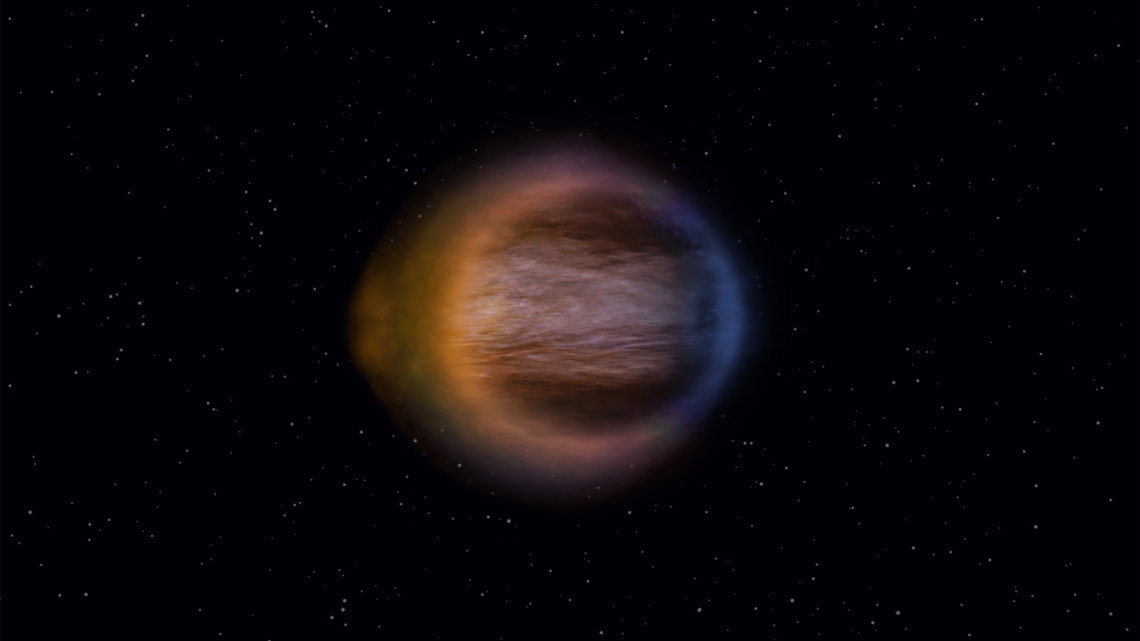
First True Shape of an Exoplanet Mapped
For the first time in astronomy, scientists have successfully mapped the true three-dimensional shape of a distant exoplanet located 1,000 light-years away. The breakthrough relies on JWST data combined with new analytical techniques, allowing researchers to move beyond simple transit measurements to understand the planet's physical geometry. This development marks a significant leap in exoplanet characterization, providing concrete figures on planetary deformation that challenge previous assumptions about gas giant stability.
Ancient Galaxy Cluster Challenges Cosmic Models
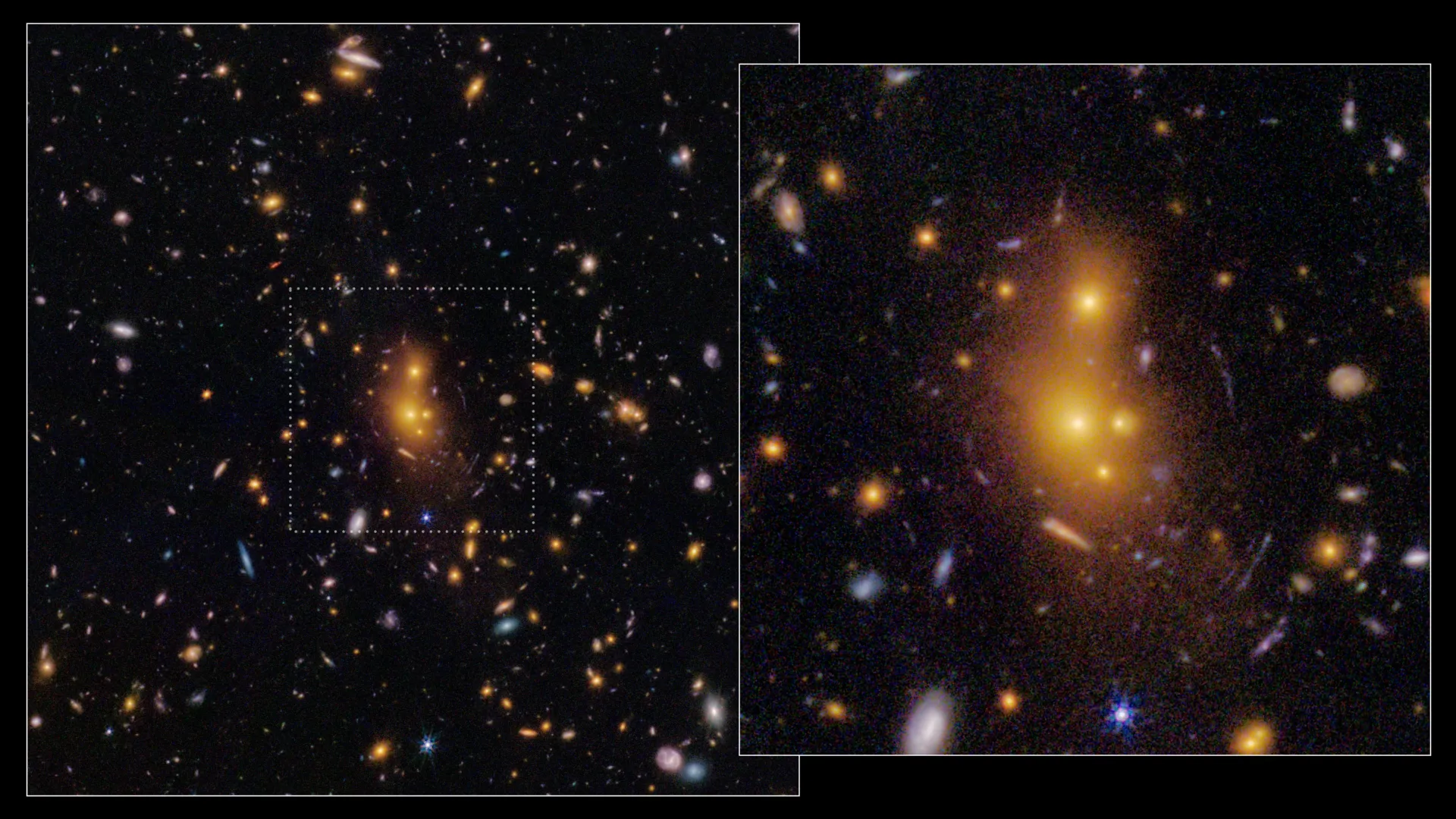
JWST has revealed an ancient galaxy cluster, XLSSC-122, with an unexpectedly dense concentration of dark matter, challenging standard theories about how the universe developed. The discovery uncovered a surprising connection between scattered starlight and invisible dark matter, suggesting that structure formation may have occurred more rapidly than previously believed. This finding adds weight to ongoing debates regarding the Hubble tension and the nature of dark matter in the early universe.
Mysterious Signal Detected in Hubble Ultra Deep Field
Astronomers are currently puzzled by a mysterious infrared emission line detected by JWST within the Hubble Ultra Deep Field in the constellation Fornax. Despite the region being one of the most well-documented areas of the sky, four common explanatory models have failed to account for the signal, leading some to describe it as coming from "nothing." This anomaly highlights the continued capacity of JWST to uncover phenomena that defy current astrophysical frameworks.

Early Universe Explosion Defies Expectations
Webb has detected a mysterious explosion from the early universe that defies current expectations regarding massive star death. The event, identified as AT 2026abck, appeared as a sudden light point in a distant galaxy just days after its explosion, potentially offering a rare glimpse into how massive stars died when the universe was young. This observation provides critical data for understanding stellar evolution in the first few hundred million years after the Big Bang.
Local view
German-language media outlets, including heise online and futurezone.at, are actively covering the "mystery signal" detected by JWST, emphasizing the confusion among astronomers as standard models fail to explain the infrared emission. The reporting highlights the significance of the Hubble Ultra Deep Field, noting that such an anomaly in a well-studied region is particularly striking.
Context & numbers
The Nancy Grace Roman Space Telescope is currently in orbit following its launch on August 30, 2026. It is positioned at the Sun-Earth L2 orbit, similar to JWST, and is scheduled to begin its primary survey missions soon. The Roman Telescope's vast surveys are expected to provide independent evidence to test the Hubble tension through supernovae and gravitational time delays.
On the radar
- Roman Space Telescope Commissioning: With the Roman Space Telescope launched in late August 2026, the coming weeks will focus on instrument calibration and the first engineering data releases.
- Follow-up on Fornax Signal: Astronomers are expected to publish further analysis on the unexplained infrared signal in the coming weeks, potentially proposing new physical models.
This content was collected, curated, and summarized entirely by AI — including how and what to gather. It may contain inaccuracies. Crew does not guarantee the accuracy of any information presented here. Always verify facts on your own before acting on them. Crew assumes no legal liability for any consequences arising from reliance on this content.
Powered by
