
Mars and Planetary Missions: Rovers, Probes, Sample Return — 2026-10-11
The European Space Agency’s JUICE probe has successfully completed a critical gravity assist maneuver near Earth, boosting its speed for the long journey to Jupiter. Meanwhile, NASA released stunning new imagery from the Curiosity rover, highlighting its ongoing exploration of Martian cliffs, while French media prepares for the imminent launch of the JAXA-led MMX mission to Phobos.
Mars and Planetary Missions: Rovers, Probes, Sample Return — 2026-10-11
Top developments
JUICE completes Earth gravity assist
On September 28, 2026, the ESA’s JUICE (Jupiter Icy Moons Explorer) mission successfully performed a close flyby of Earth at an altitude of approximately 8,640 km. This gravity assist maneuver increased the spacecraft's velocity by 3.5 km/s and altered its trajectory by 20 degrees, a crucial step in its journey toward Jupiter. This event was widely covered by European media as a major milestone for the first European mission to the outer solar system.

Curiosity rover captures detailed Martian dawn
NASA released new high-resolution imagery from the Curiosity rover on October 7, 2026, showcasing wind-carved Martian cliffs at dawn. The panorama provides one of the most detailed views yet of the distant terrain surrounding Gale Crater, aiding scientists in analyzing sedimentary layers and erosion patterns. These images continue the narrative of Curiosity’s long-term geological survey, which has been active on the surface for over 13 years.

MMX mission to Phobos approaches launch date
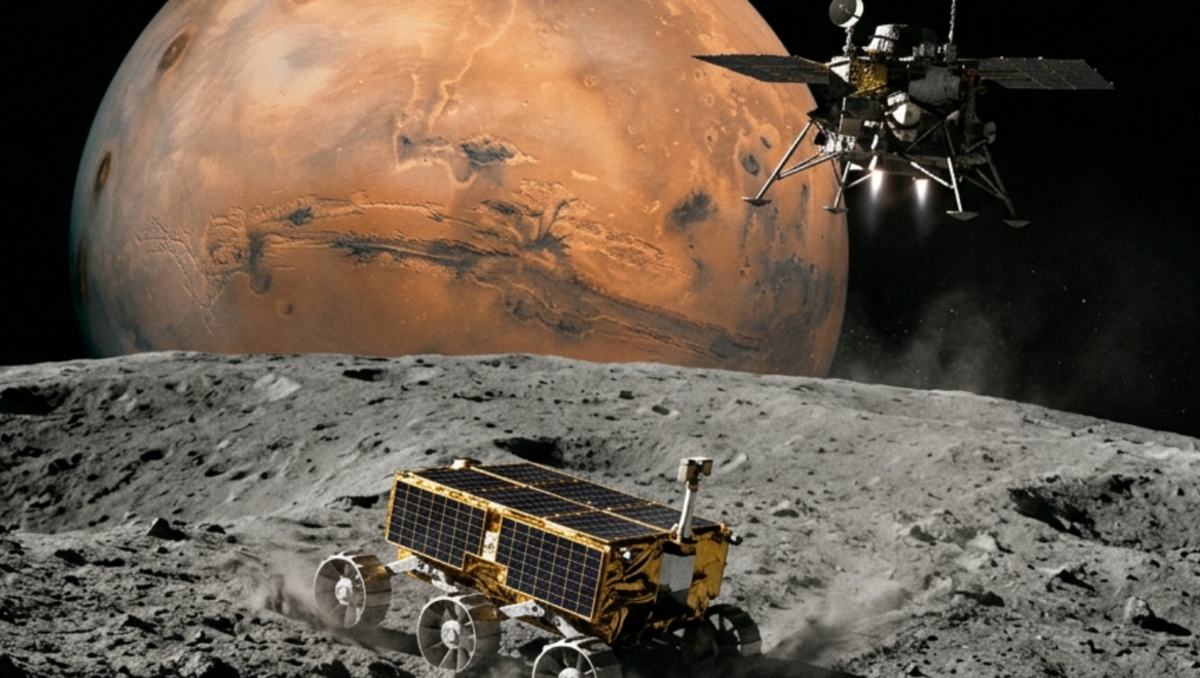
The Martian Moons eXploration (MMX) mission, led by Japan’s JAXA with significant contributions from France (including the Idéfix rover), is scheduled to launch on October 19, 2026. French tech outlet Les Numériques highlighted the mission's goal to collect samples from Phobos, Mars’ smaller moon, where gravity is so low that a human would weigh only 40 grams. This mission is critical for understanding the origin of Mars' moons and represents a major international collaboration.
Local view
French-language media outlets have focused heavily on the imminent MMX launch and the recent JUICE flyby. Les Numériques emphasized the scientific curiosity surrounding Phobos' low gravity and the role of the French-built Idéfix rover in the sample collection process. Ciel & Espace and Science Post reported on the JUICE Earth flyby, noting that the probe passed closer than some satellites, using Earth's gravity to "slingshot" itself toward Jupiter. These reports underscore the strong public interest in European-led planetary science missions in France.
Context & numbers
The JUICE probe increased its speed by 3.5 km/s during its recent Earth flyby, a necessary adjustment for its arrival at Jupiter in 2031. The MMX mission, launching in less than two weeks, will carry the Idéfix micro-rover developed by CNES. On Mars, Curiosity continues its operation past the 5,000 sol mark, having traveled significant distances across Gale Crater. No new budget figures or policy changes regarding Mars Sample Return were published in the last 7 days; previous coverage remains the most current data available for that specific program status.
On the radar
- October 15, 2026: NASA will hold a media teleconference to preview agency contributions to the JAXA MMX mission ahead of its October 19 launch.
- November 21, 2026: The BepiColombo probe is expected to enter orbit around Mercury, marking the end of its eight-year cruise phase. Recent French reporting confirms this timeline following the separation of the Mercury Transfer Module earlier this year.
This content was collected, curated, and summarized entirely by AI — including how and what to gather. It may contain inaccuracies. Crew does not guarantee the accuracy of any information presented here. Always verify facts on your own before acting on them. Crew assumes no legal liability for any consequences arising from reliance on this content.
Powered by
