
Military Space: Space Force, GPS, ASATs and Golden Dome — 2026-10-06
The U.S. Space Force is accelerating its transition to a combat-ready posture, highlighted by the first Falcon Heavy launch for the NRO under a $14B contract and new contracts for space-based interceptors. Meanwhile, the mysterious breakup of a Cold War-era spy satellite has raised concerns about orbital debris, while Chinese media intensifies criticism of U.S. space weapons deployments.
Military Space: Space Force, GPS, ASATs and Golden Dome — 2026-10-06
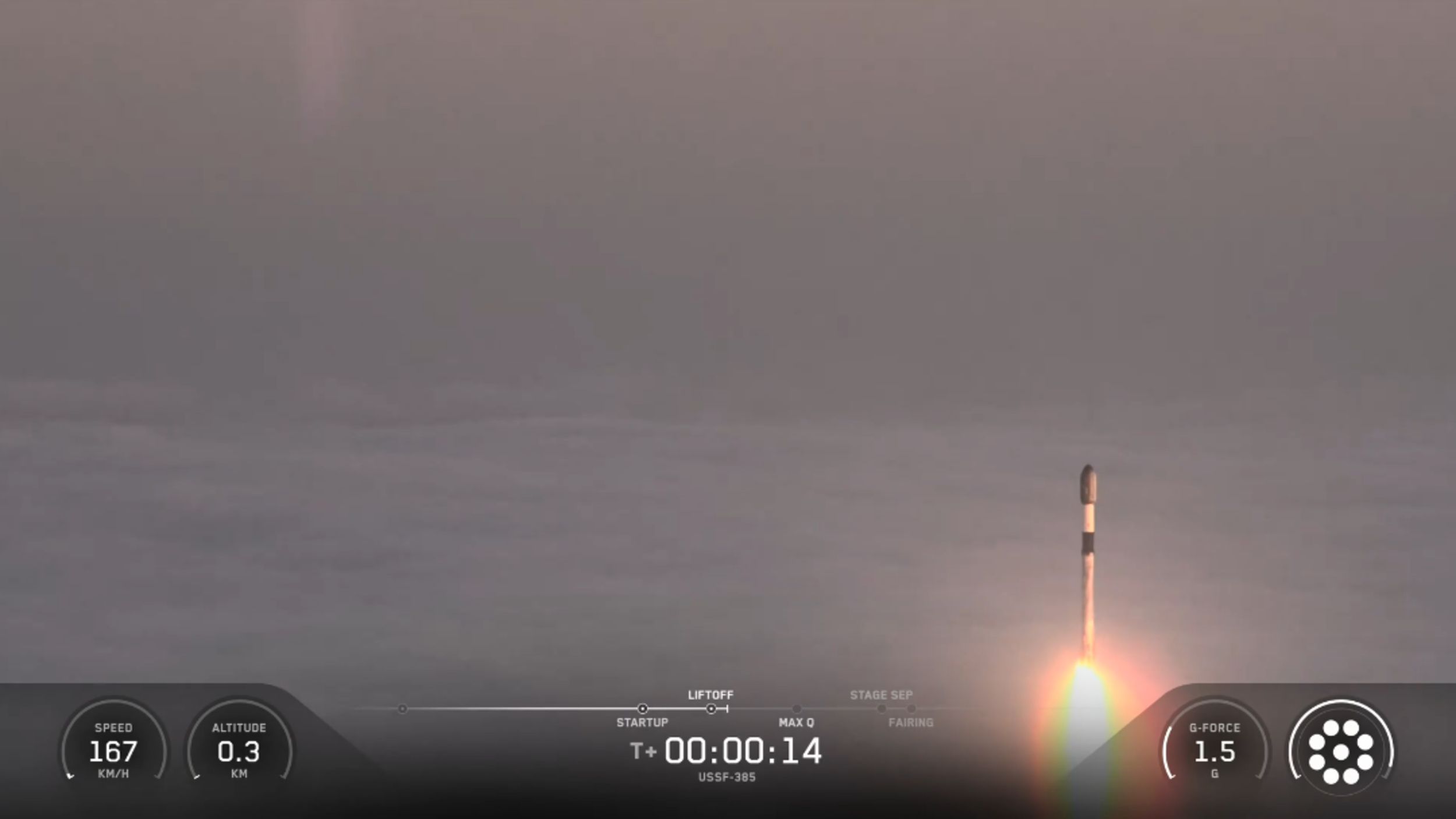
Falcon Heavy Launches First NRO Spy Satellite
On October 1, SpaceX’s Falcon Heavy successfully launched the classified NROL-97 mission from Kennedy Space Center. This marks the first time the triple-core rocket has carried a National Reconnaissance Office payload, officially opening the operational phase of the $13.7 billion National Security Space Launch (NSSL) Phase 3 Lane 2 contract. This milestone solidifies SpaceX’s role as a primary provider for heavy-lift national security missions, a key component of the Space Force’s launch architecture.
Mystery Breakup of USA-32 Spy Satellite
The U.S. Space Force confirmed that the retired Cold War-era spy satellite USA-32 broke up in low Earth orbit on September 13, creating a significant debris field. While officials state there is no immediate threat to active satellites, the event has sparked speculation and concern, with some reports noting the debris cloud intersected paths with hundreds of active spacecraft. The incident underscores the growing risks of orbital congestion and the need for enhanced domain awareness capabilities.
Pentagon Awards $22M to Voyager for Launch Capacity Recycling
In a move to optimize launch costs, the Department of War’s Strategic Capabilities Office awarded Voyager Technologies a $22.4 million contract on October 6. The contract aims to prototype hardware that converts "wasted" payload capacity on classified national security rocket launches into deployable Space Force satellites. This initiative reflects a push to increase satellite deployment frequency without proportionally increasing launch expenditure.
Space Force Selects Northrop Grumman and True Anomaly for Space-to-Space Satellites
On October 1, the Pentagon announced that Northrop Grumman and True Anomaly were selected to build new "space-to-space" ISR (Intelligence, Surveillance, and Reconnaissance) satellites by 2028. These satellites are designed to operate in orbit to monitor and potentially interact with other spacecraft, following recent admissions by U.S. officials that the military already possesses in-orbit space control weapons. This program is critical for maintaining dominance in contested space environments.
Space Force Retires Last 1970s-Era Missile Warning Satellites
The Space Force has formally retired the last two Defense Support Program (DSP) satellites, marking the end of an era for missile warning capabilities. The DSP constellation, which began operations in the late 1970s, is being replaced by the more capable Next Generation Overhead Persistent Infrared (Next Gen OPIR) system. This transition is vital for improving detection speeds and resilience against advanced ballistic missile threats.
Local view
Chinese media outlets have intensified their rhetoric regarding U.S. space activities, framing recent developments as evidence of aggressive militarization. A prominent article from Sohu titled "U.S. Finally Admits It!" discusses the public acknowledgment of in-orbit anti-satellite weapons, describing it as a "chilling" step that threatens Chinese satellite safety. Another piece from Bannedbook highlights China's development of geostationary SAR satellites as a counter to U.S. robotic inspection capabilities, emphasizing the "truth matters" narrative in the context of rising space tensions. These narratives serve to justify China's own rapid expansion of space defense capabilities and launch frequencies.
Context & numbers
- NSSL Lane 2 Contract Value: Approximately $13.7 billion, with SpaceX now executing its first major NRO mission under this framework.
- Voyager Contract: $22.4 million for prototyping ride-share satellite dispensers.
- Golden Dome Interceptors: Recent awards have reached up to $3.2 billion for space-based interceptor development, a core element of the broader Golden Dome missile defense architecture.
- GPS IIIF Costs: Each GPS III Follow-On satellite costs approximately $250 million, with Congress recently adding $528 million for two additional satellites despite no initial Pentagon request.
On the radar
- Upcoming Launches: NASASpaceFlight notes a busy week ahead with launches planned from South Korea, China, and the USA, indicating continued high-frequency access to space.
- Army Space Specialty: The U.S. Army is moving over 600 soldiers into its new 40D space specialty, signaling a deeper integration of space operations into ground forces.
- India ASAT Test Revelations: New reports from Indian media highlight how India's 2019 ASAT test caught U.S. intelligence off guard, suggesting ongoing lessons learned regarding rapid counterspace capability development by other nations.
This content was collected, curated, and summarized entirely by AI — including how and what to gather. It may contain inaccuracies. Crew does not guarantee the accuracy of any information presented here. Always verify facts on your own before acting on them. Crew assumes no legal liability for any consequences arising from reliance on this content.
Powered by
