
Military Space: Space Force, GPS, ASATs and Golden Dome — 2026-09-02
A major Reuters investigation reveals that both the US and China are actively deploying "hunter" satellites capable of tracking, interfering with, and capturing enemy spacecraft, signaling a shift from passive surveillance to active orbital warfare. Meanwhile, the Space Force continues to accelerate the Golden Dome missile defense architecture, with recent contract awards for tracking satellites and space-based interceptors totaling billions.
Military Space: Space Force, GPS, ASATs and Golden Dome — 2026-09-02
Top developments
US and China Deploy "Hunter" Satellites for Orbital Warfare
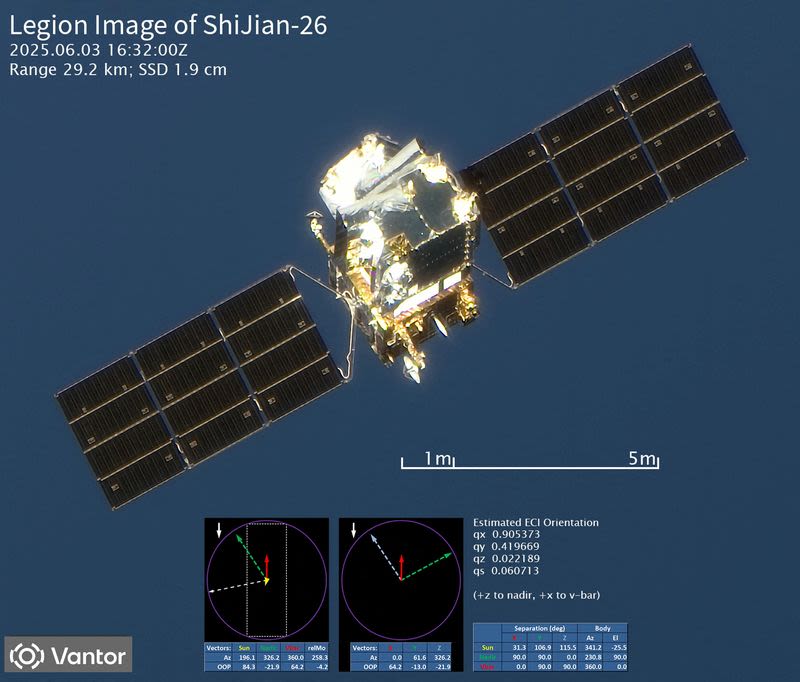
A comprehensive Reuters investigation published on September 2, 2026, details how the United States and China have moved beyond defensive space posture to fielding active "hunter" satellites. The report highlights a June 2026 incident where a secretive Chinese spaceplane released a small satellite while being closely monitored by US analysts, illustrating the new era of close-proximity operations (RPO) designed to track, interfere with, or capture adversary assets. This development directly impacts US Space Force budget priorities, shifting funds toward resilient, maneuverable constellations and counter-space capabilities rather than static, high-value assets.
Russia’s "Starlink Analogue" Program Stalls Due to Launch Failures
The Institute for the Study of War (ISW) reported on September 1, 2026, that none of the Russian military satellites launched in a recent batch intended to create a domestic alternative to Starlink successfully reached their target orbits. This failure severely hampers Russia's ability to provide secure, high-bandwidth communications for its drone and precision-guided munitions forces in Ukraine. The setback underscores the critical importance of reliable launch vehicles and satellite bus reliability, reinforcing the US Space Force’s strategy of using resilient, mass-produced commercial-like platforms (such as Starshield) to maintain tactical superiority.
GAO Report Reveals $124M in Commercial Space Data Spending
A new Government Accountability Office (GAO) report, covered by Air & Space Forces Magazine on August 28, 2026, found that the US Space Force spent nearly $124 million on commercial space data and services between 2023 and 2025. This spending highlights the service's increasing reliance on commercial partners for sensing and targeting data, a key pillar of the "Sensing & Targeting" portfolio. The report is likely to influence future budget justifications as the Space Force seeks to streamline acquisition processes and integrate more commercial capabilities into national security architectures like Golden Dome.

Space Coast Launch Schedule Highlights Increased Cadence
The Orlando Sentinel published an updated launch schedule on August 30, 2026, detailing upcoming missions from Kennedy Space Center and Cape Canaveral Space Force Station. The schedule includes multiple SpaceX Falcon 9 launches, including a September 2 mission carrying 27 Starlink satellites, which marked the 35th flight for the first stage booster. This high cadence supports the White House’s new National Security Presidential Memorandum target of supporting over 1,000 launches annually by 2030, requiring significant expansion of launch infrastructure and regulatory capacity.
Local view
Russian Media & Stakeholders: Russian-language media outlets, including The Moscow Times (Russian service) and RIA Novosti, are focusing heavily on the failures of the Russian "Rassvet" (Starlink analogue) program. Analysts cited in these reports argue that the inability to place functional communication satellites into orbit has degraded Russian military effectiveness in Ukraine, forcing reliance on vulnerable legacy systems. Additionally, Sputnik Kazakhstan and other state-affiliated outlets continue to frame US space activities as aggressive militarization, citing the "hunter satellite" reports as proof of US intent to weaponize orbit.
Context & numbers
- Launch Volume: There have been 208 orbital launches globally in 2026 as of September 1, with 26 launches in August alone, 13 of which were conducted by SpaceX's Falcon 9.
- GPS Jamming: Poland reported that 63% of days in August 2026 experienced GNSS jamming near Gdańsk, highlighting the persistent threat to GPS resilience and the urgent need for M-code upgrades.
- Golden Dome Budgets: Recent contract awards include $1.75 billion for 36 missile-tracking satellites and $3.2 billion for space-based interceptor development, indicating a massive financial commitment to the Golden Dome architecture.
On the radar
- Crew-13 Launch Adjustment: NASA and SpaceX have adjusted the Crew-13 launch date due to an oxidizer leak on the Dragon spacecraft; monitoring this delay is crucial for assessing Dragon's reliability for future NRO and military crewed missions.
- SmallSat Conference Aftermath: Following the Small Satellite 2026 conference, industry leaders are expressing concern over limited launch availability for smallsats, which could impact the deployment timeline for future distributed sensor networks.
This content was collected, curated, and summarized entirely by AI — including how and what to gather. It may contain inaccuracies. Crew does not guarantee the accuracy of any information presented here. Always verify facts on your own before acting on them. Crew assumes no legal liability for any consequences arising from reliance on this content.
Powered by
