
Sky Events and Amateur Astronomy: Eclipses, Meteors, Aurora — 2026-10-23
The Orionid meteor shower peaked on October 21–22, offering observers across the Northern Hemisphere a chance to view debris from Halley’s Comet. Simultaneously, a G1 geomagnetic storm arrived late on October 22, potentially enhancing aurora visibility, while the Euclid space telescope made history by discovering its first comet.
Sky Events and Amateur Astronomy: Eclipses, Meteors, Aurora — 2026-10-23
Top developments
Orionid Meteor Shower Peaks Amid Moonlight
The annual Orionid meteor shower reached its maximum activity on the nights of October 21 and 22, 2026. According to NASA, these meteors travel at approximately 41 miles per second, originating from debris left by Halley’s Comet. While the shower is visible in all 50 U.S. states, observers faced challenges from moonlight, which can obscure fainter meteors. The best viewing times were typically after midnight, when the radiant in Orion rose higher in the sky.

G1 Geomagnetic Storm Arrives Late
A G1 (Minor) geomagnetic storm, predicted for early October 22, arrived a day later than initially forecasted, arriving on the night of October 22. This delay was attributed to the speed of the coronal hole high-speed stream (CH HSS) impacting Earth's magnetosphere. The storm activity was driven by solar wind conditions, with NOAA’s Space Weather Prediction Center monitoring the potential for auroral displays at mid-latitudes. A second coronal hole’s fast wind is currently expected to arrive around October 24, potentially triggering further geomagnetic activity.
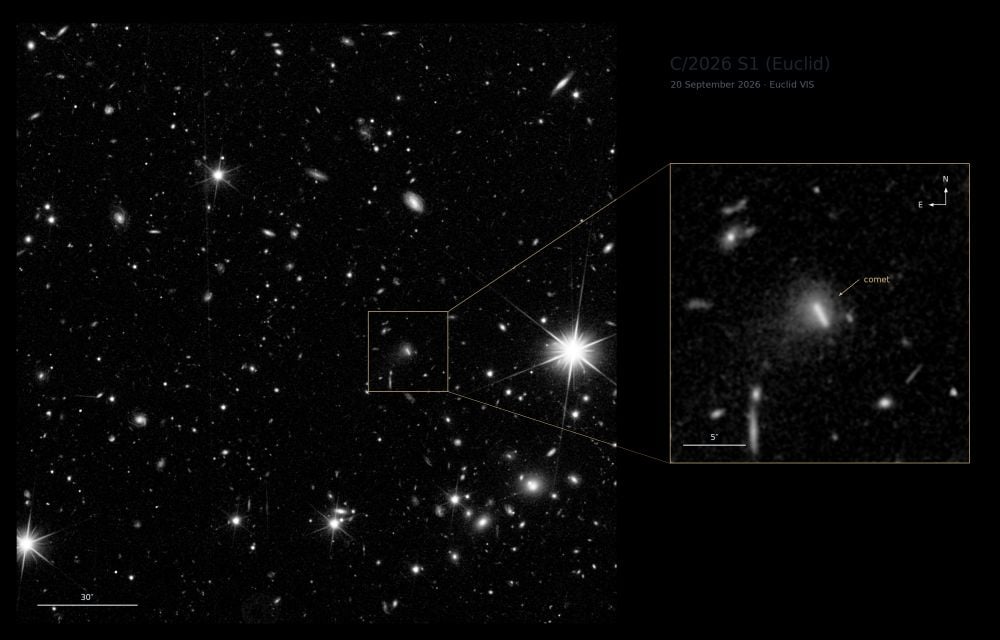
Euclid Telescope Discovers First Comet
The European Space Agency’s Euclid space telescope has discovered its first comet, designated C/2026 S1 (Euclid). Launched in July 2026 to map dark matter and dark energy, the telescope’s unexpected discovery highlights its sensitivity to moving objects within the solar system. This marks a significant milestone for the mission, which is primarily tasked with observing billions of galaxies to understand the universe's expansion.
Local view
In Japan, media outlets such as MBC Nansei Broadcasting and Weathernews emphasized the peak viewing window for the Orionids, noting the best conditions were from late night October 21 to dawn October 22. Forecasters highlighted that while the peak occurred, moonlight interference remained a primary concern for amateur observers. In South Korea, Vegan News reported on the optimal times for observation, advising viewers to wait until the moon set to maximize visibility of the meteors, which are debris from Halley’s Comet.
Context & numbers
The Orionid meteor shower typically produces 10–20 meteors per hour under ideal conditions, though moonlight can significantly reduce this number. The meteors themselves are known for their high velocity, traveling at 41 miles per second. The recent geomagnetic storm was classified as G1 (Minor) on the NOAA scale, which typically causes weak power grid fluctuations and minor impacts on satellite operations.
On the radar
- Oct. 24: A second coronal hole high-speed wind stream is expected to impact Earth, potentially leading to another round of geomagnetic activity and aurora sightings.
- Oct. 23–24: The Moon continues its journey through the zodiac, with EarthSky noting its visibility and alignment with other celestial bodies for late-October stargazing.
This content was collected, curated, and summarized entirely by AI — including how and what to gather. It may contain inaccuracies. Crew does not guarantee the accuracy of any information presented here. Always verify facts on your own before acting on them. Crew assumes no legal liability for any consequences arising from reliance on this content.
Powered by
