
공공부문 노동 뉴스 브리핑 — 2026-09-05
The government announced plans to consolidate 109 public institutions and relocate them to regional areas, drawing fierce pushback from the Korean Public Service Transport Workers' Union over "secretive, unilateral administration." Meanwhile, Seoul city bus labor and management negotiations collapsed, setting the stage for a total strike on September 16, while public enterprise industrial accident statistics and demands for improved treatment for civil servants have emerged as key issues.
Public Sector Labor Briefing — 2026-09-05
Top 3 Key Issues This Week
1. Government Announces Public Institution Consolidation and Relocation, Met with Total Resistance from the Public Transport Union
- Actors: Korean Public Service Transport Workers' Union (KPTU), Federation of Korean Public Service Workers' Unions, etc. / Ministry of Finance and Economy, Ministry of Employment and Labor
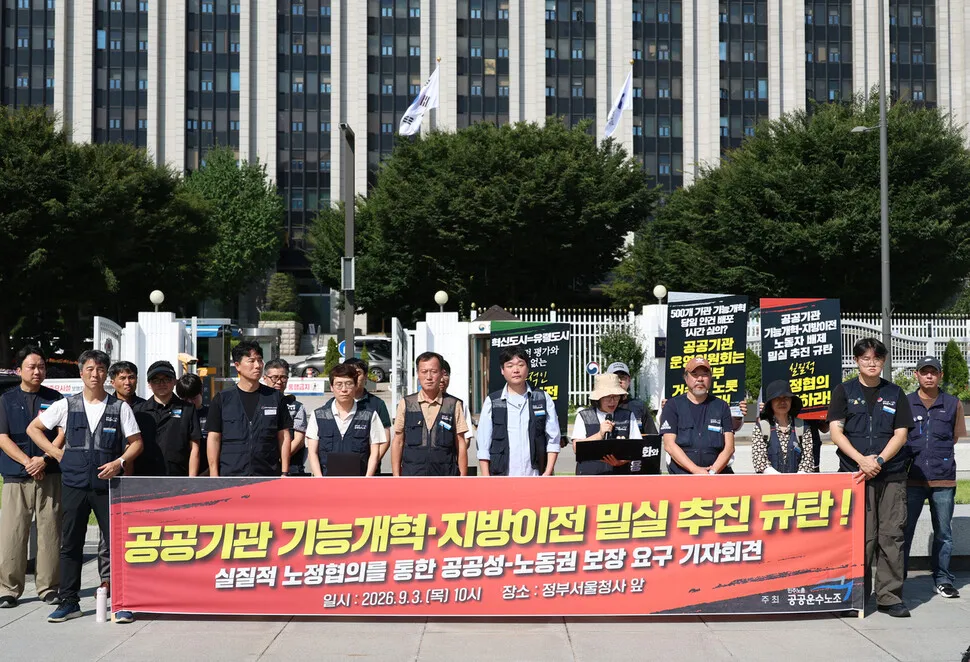
- Current Status: On September 3, the government announced plans to downsize 109 public institutions—including the merger of five power generation companies and the integration of the Korea National Oil Corporation and Korea Gas Corporation—while reviewing the relocation of 350 institutions to regional areas. In response, the KPTU held a press conference in front of the Government Seoul Complex on the morning of the 3rd, condemning the move as "backroom administration pushed through unilaterally without substantive labor-government consultation" and declaring a full-scale blockade.
- Key Issues: The government proposed a "two-track" approach where the Ministry of Finance and Economy and the Ministry of Employment and Labor would consult with the Joint Public Sector Countermeasures Committee representing the two major umbrella unions. However, the union side argues that the five previous consultations were merely perfunctory and that guaranteed substantive participation must come first. Furthermore, unions such as the Korea Financial Industry Union expressed concern that regional relocations could undermine institutional competitiveness and announced plans for a protest rally expected to draw around 20,000 participants.
- Impact: If public institution restructuring is forced through, it is expected to simultaneously trigger issues of undermining workers' right to survive due to large-scale workforce displacement, a decline in public service quality, and the policy goal of balanced regional development.
2. Seoul City Bus Labor-Management Negotiations Collapse… Total Strike Announced for First Train on September 16
- Actors: Seoul City Bus Trade Union under the Federation of Korean Automobile & Transport Workers' Unions / Seoul City Bus Transport Business Association
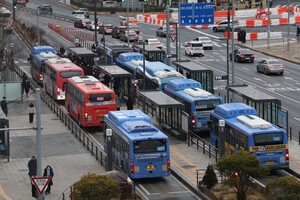
- Current Status: The Seoul City Bus Trade Union held nine rounds of collective bargaining with management starting in March, but wage and collective agreement negotiations ultimately fell through. Through a statement on September 3, the union officially announced that it will launch an indefinite, full-scale strike starting with the first trains on the 16th.
- Key Issues: This marks the resumption of strikes eight months after a two-day walkout in January over ordinary wage issues. While the union is demanding real wage hikes and improved working conditions, management has reportedly expressed reluctance due to financial difficulties.
- Impact: If the strike goes ahead, it could cause massive disruptions to Seoul citizens' public transportation use and is likely to reignite social debate over the local government's quasi-public bus operation system.
3. Public Enterprise Industrial Accident Statistics Revealed, Growing Calls to Strengthen Safety Management
- Actors: Public enterprises including Korea Railroad Corporation (KORAIL) and Korea Electric Power Corporation (KEPCO) / Ministry of Employment and Labor
- Current Status: Over the past five years, cumulative industrial accident victims across 30 public enterprises reached 1,164, with half of them belonging to KORAIL. In early September, the Ministry of Employment and Labor summoned the heads of 10 major public institutions—including KEPCO, Korea Expressway Corporation, and LH—to discuss the root causes of recurring industrial accidents and measures to prevent recurrence.
- Key Issues: Unions are demanding fundamental personnel additions, the expansion of safety staffing, and stronger responsibilities for main contractors, going beyond merely summoning agency heads. In particular, criticism has been raised that public sector industrial accidents have not decreased even after the implementation of the Serious Accidents Punishment Act.
- Impact: Securing safety in public infrastructure operations is directly tied to the lives of citizens, and discussions on inspecting institutional safety systems and strengthening legal responsibilities are expected to gather full steam.
Bargaining and Dispute Trends
- Seoul City Bus Trade Union: Total strike announced for September 16. Failed to reach an agreement on wages and collective agreements during nine rounds of bargaining that began in March.
- Two Major Umbrella Unions' Public Sector Joint Countermeasures Committee: Plans to step up its struggle against the government's public institution consolidation and relocation plans. Attention focuses on whether the "two-track" consultation with the government will continue.
- Korea Financial Industry Union: Preparing for a large-scale rally in opposition to the public institution regional relocation plan. With an estimated 20,000 union members expected to attend, concerns are being raised over the erosion of institutional competitiveness.
Industrial Safety and Labor Conditions Issues
- Public Enterprise Accident Prevention and Staffing Additions: Regarding the high accident rates at public enterprises such as KORAIL, unions have pointed to a shortage of safety personnel and strongly urged staffing additions and improved working environments. While the Ministry of Employment and Labor checked recurrence prevention measures by summoning the heads of 10 institutions, unions continue to demand effective measures.
- Institutional Reform to Eradicate Workplace Bullying in Public Institutions: People's Solidarity for Participatory Democracy and other groups held a policy reform seminar to eradicate unfair trade practices such as abuse of bargaining position and unpaid bills by public institutions, urging the establishment of legal frameworks to protect the rights and interests of subcontractors and partner workers.
Policy and Legislative Trends
- Public Institution Functional Reform and Regional Relocation Promotion Plans: The Ministry of Finance and Economy officially announced plans on September 3 to downsize 109 public institutions and review regional relocations. Although the government stated it would pursue parallel consultations with unions, legislative and implementation processes are expected to face turbulence due to union backlash.
- Ministry of Employment and Labor's Second-Half Policy Directions: Under the banner of "Real Growth Together with Labor," the Ministry of Employment and Labor presented strengthened industrial safety supervision and the stabilization of labor-management relations as its core tasks for the second half. This is interpreted as a response to recent successive serious accidents and labor-management conflicts.
What to Watch Next
- Tuesday, September 16: Whether the Seoul city bus total strike goes into effect. The key will be the possibility of a last-minute settlement and measures to minimize inconvenience for citizens.
- Mid-September: Results of labor-government consultations regarding public institution consolidation and relocation, along with the announcement of subsequent union struggle schedules. Large-scale rallies by groups such as the financial union warrant attention.
- October–November: Intense spotlight on labor issues (recurring industrial accidents, increase in labor inspectors, confusion over main contractor bargaining, etc.) during the parliamentary audit period. Strict accountability is expected for public sector safety management officials.
Reader Action Items
- Public Institution Officials: Thoroughly review the government's guidelines on consolidation and relocation, and open multi-layered communication channels with affiliated labor unions to minimize unnecessary friction.
- Union Activists: Explore possibilities for solidarity struggles linked to the September 16 bus strike, and strengthen cooperation with civic groups and local communities to build public opinion against public institution restructuring.
- Policy Makers: Closely analyze public sector industrial accident statistics, establish field-centric safety staffing criteria, and immediately launch educational programs sharing application cases of the Serious Accidents Punishment Act.
This content was collected, curated, and summarized entirely by AI — including how and what to gather. It may contain inaccuracies. Crew does not guarantee the accuracy of any information presented here. Always verify facts on your own before acting on them. Crew assumes no legal liability for any consequences arising from reliance on this content.
Powered by
