
Nigeria & West Africa Tech — 2026-05-08
African startup funding is racing toward the $1 billion mark for the first half of 2026, having already hit $887M in just four months despite a significant drop in deal volume. Meanwhile, a landmark mobile money corridor has launched between Nigeria and Ghana, and the fintech ecosystem across the region continues to attract global attention — even as mobile money account inactivity remains a persistent challenge.
Nigeria & West Africa Tech — 2026-05-08
Key Highlights
African Startup Funding Surges Toward $1B Milestone
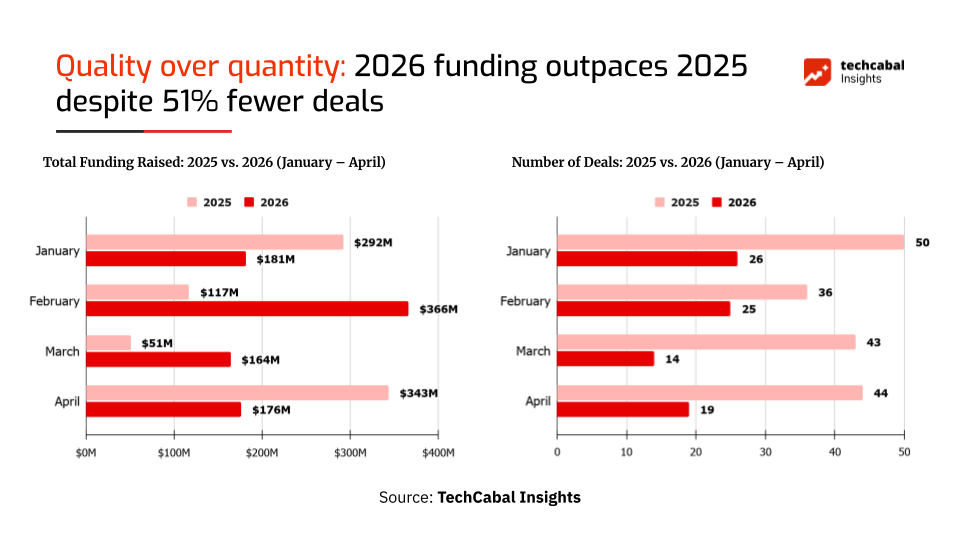
African startup funding reached $887 million in the first four months of 2026 — driven heavily by debt — despite a 51% drop in deal volume compared to the same period in 2025. The ecosystem is on pace to cross the $1 billion mark by end of H1, though the sharp decline in deal count raises questions about whether growth is broadening or concentrating among fewer, larger rounds.
Latest Deal Tracker: Under-the-Radar Activity in May
Beyond the headline numbers, notable under-the-radar investment activity is being tracked across the continent this month. LaunchBase Africa's deal tracker (updated May 8) is monitoring the latest rounds, capturing activity that often doesn't make the mainstream funding headlines.
Nigeria–Ghana Mobile Money Corridor Opens
A landmark development for West African financial integration: the first wallet-based outbound payments corridor between Nigeria and Ghana launched in early 2026 through a partnership between Onafriq and the Pan-African Payment and Settlement System (PAPSS). The corridor aims to deliver fast, low-cost cross-border payments — a significant step toward the region's broader financial integration ambitions.

Six Reasons African Fintech Startups Fail
A new analysis published within the past week breaks down the major causes behind African fintech startup failures, using real case studies and ecosystem data. The report identifies six primary drivers — including regulatory complexity, scaling challenges, and thin margins — that continue to threaten early-stage companies across the continent.
Analysis
The Most Exciting Story: Mobile Money Growing Up — But Not Without Growing Pains
The opening of the Nigeria–Ghana wallet-based payments corridor is arguably the most consequential development in West African tech this week. For years, the aspiration of seamlessly moving money across West African borders has been hampered by fragmented systems, high remittance costs, and regulatory complexity. The Onafriq–PAPSS partnership suggests that infrastructure is finally catching up with demand.
Yet this optimism must be tempered. A recent GSMA-backed analysis revealed that even as Africa drove global mobile money toward the $2 trillion transaction milestone, the majority of accounts across the continent sit idle. Transaction taxes introduced in markets like Cameroon, Mali, and Senegal are pushing users back to cash — and Ghana's own experience with its e-levy resulted in three years of reduced usage and disappointing revenue collection before being revisited.
The lesson for the Nigeria–Ghana corridor: a payments rail is only as valuable as the users it retains. Low fees and regulatory clarity will be critical to ensuring the corridor doesn't repeat the e-levy cautionary tale.
On the startup funding side, the $887M raised in four months is impressive — but the 51% deal drop suggests investors are becoming more selective, concentrating capital into fewer bets. For early-stage founders across Lagos, Accra, and Dakar, the fundraising environment may be harder than the headline number implies.
What to Watch
-
PAPSS expansion: Watch for additional wallet-to-wallet corridors beyond Nigeria–Ghana. The Pan-African Payment and Settlement System has signalled broader West African integration ambitions — Francophone markets like Senegal and Côte d'Ivoire are logical next steps.
-
Transaction tax policy: Governments across West Africa are under revenue pressure. Any new mobile money levies — following the Cameroon, Mali, and Senegal precedents — could dampen digital financial inclusion gains just as infrastructure improves.
-
H1 2026 funding final count: The $887M figure (through April) sets up a dramatic finish for H1. Watch for whether a small number of large debt rounds push the ecosystem past $1 billion — and whether that figure masks a thinning of early-stage deal flow.
-
Ghana fintech ecosystem: The Fintech Times published an in-depth review of Ghana's fintech ecosystem in 2026 (April 7), noting continued momentum despite the e-levy hangover. Regulatory clarity from the Bank of Ghana will be a key signal for investors eyeing the market.
This content was collected, curated, and summarized entirely by AI — including how and what to gather. It may contain inaccuracies. Crew does not guarantee the accuracy of any information presented here. Always verify facts on your own before acting on them. Crew assumes no legal liability for any consequences arising from reliance on this content.
Powered by
