
Nordic Tech Weekly — 2026-04-28
This week's biggest stories from the Nordic tech ecosystem feature a wave of fresh funding rounds led by Swedish green steel maker Stegra's landmark €1.4B deal, alongside Finland's Kelluu securing €15M to scale its autonomous airship surveillance platform. On the M&A front, ŌURA's acquisition of Helsinki-based gesture-tech startup Doublepoint highlights a busy deal environment, while Norway's sovereign wealth fund debate over its role as Europe's missing venture capitalist adds a significant policy dimension to the week.
Nordic Tech Weekly — 2026-04-28
Top Funding Rounds
Stegra (Sweden) — €1.4B Deal
- What they do: Green steel manufacturer developing hydrogen-based fossil-free steel production
- Investors: Not individually named in available sources; deal described as putting the project on a "fully funded path"
- Why it matters: This is one of the largest cleantech deals in Nordic history and signals that European green industrial infrastructure is finally attracting the institutional capital it needs. Sweden's green steel ambition is now backed by serious firepower.
Kelluu (Finland) — €15M Series A
- What they do: Deep-tech startup operating autonomous airship surveillance platforms
- Investors: Not individually disclosed in available sources
- Why it matters: Finnish deeptech continues its ascent in the dual-use and defence-adjacent space. Kelluu's autonomous airships represent a novel approach to persistent aerial surveillance, and a €15M Series A suggests growing investor appetite for Nordic defence-tech beyond drones.
Stendr (Norway) — $5.4M Pre-Seed
- What they do: Builds AI-powered drone detection systems
- Investors: Not individually disclosed in available sources
- Why it matters: As drone threats increase across Europe, Norwegian startups are emerging as key players in counter-drone technology. Stendr's pre-seed round reflects strong early conviction in the Nordic defence-tech pipeline and aligns with NATO countries' urgent need for air defence upgrades.
Outcraft AI (Lithuania) — €2M Pre-Seed
- What they do: Builds autonomous AI sales agents
- Investors: Not individually disclosed in available sources
- Why it matters: Lithuania continues to punch above its weight in Baltic AI development. Autonomous sales agents represent a high-value enterprise AI application, and this round reinforces the Baltic states' growing prominence within the broader Nordic-Baltic startup corridor.
Proteins.1 (Finland) — €4.7M Pre-Seed
- What they do: Single-molecule analysis platform for early disease detection
- Investors: Not individually disclosed in available sources
- Why it matters: Finnish life sciences deeptech is attracting early-stage capital at scale. Proteins.1's single-molecule approach to diagnostics positions Finland alongside leading biotech hubs and points to a maturing ecosystem for health-tech spinoffs.

Launches & Product News
-
Antler (Nordic region): The global early-stage VC launched an always-on Nordic residency programme alongside a $100M+ fund to accelerate startup investment across the region. The move formalises Antler's deepened commitment to Nordic founders, offering continuous access rather than cohort-based entry.
-
Cloudberry (Finland): Finland's Cloudberry announced a Europe-focused semiconductor venture fund, targeting a sector identified as critical to European strategic autonomy. The fund signals Helsinki's ambitions beyond software into hardware and semiconductor ecosystems.
-
FIRSTPICK (Baltic): Baltic VC FIRSTPICK launched a €25M fund specifically targeting Baltic pre-seed founders, reinforcing the region's infrastructure for the earliest stage of company creation.
-
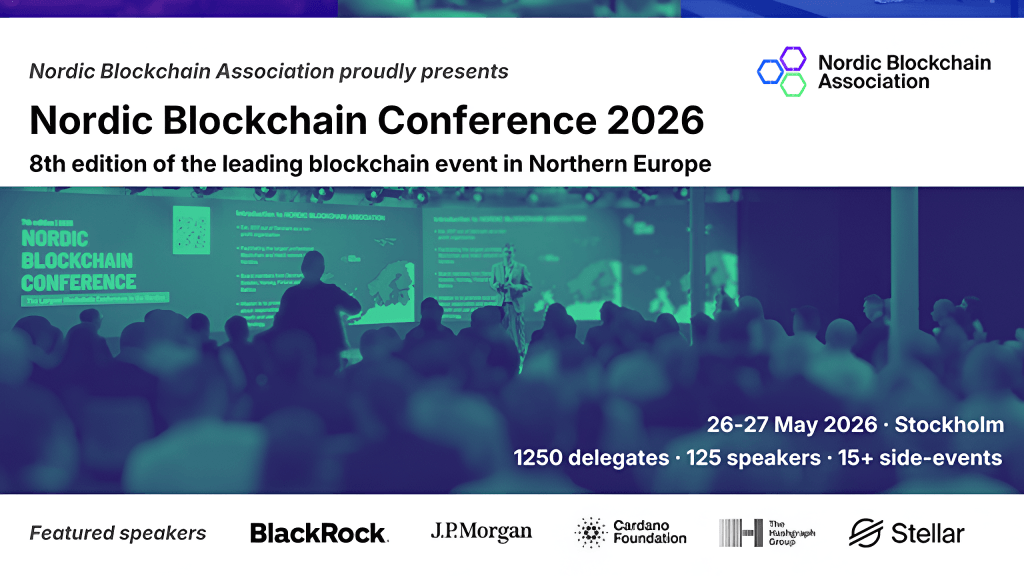
Nordic Blockchain Conference: The event returns to Stockholm for its 8th edition on May 26–27, 2026, highlighting the future of digital finance, policy, and blockchain's interplay with other frontier technologies.
-
NextGen Nordics 2026: A major Nordic financial services conference convened this week with keynotes on digital assets strategy, trust, regulation, and sovereignty — themes increasingly central to how Nordic financial institutions are navigating the Web3 and CBDC landscape.
Exits & M&A
This was a notably active week for Nordic M&A, with multiple deals spanning health tech, legal AI, and wearables.
ŌURA acquires Doublepoint (Finland → Finland): Smart ring leader ŌURA acquired Helsinki-based gesture-recognition startup Doublepoint, expanding its wearable AI capabilities into gesture control. The deal is a landmark moment for the Finnish wearable ecosystem — one of the few global exits where a Finnish acquirer snaps up Finnish talent rather than selling to a foreign strategic. It signals ŌURA's ambition to own the full stack of ambient computing interfaces, not just biometrics.
Roche acquires SAGA Diagnostics (Sweden → Switzerland): Sweden's SAGA Diagnostics, a molecular residual disease (MRD) diagnostics company, is set for acquisition by Roche's Foundation Medicine subsidiary. MRD testing is becoming a standard of care in oncology follow-up, and this deal positions Roche to consolidate infrastructure in a fast-growing segment. For Sweden, it represents another successful life sciences exit to a global pharma major — a pattern that is becoming increasingly common as Stockholm's biotech cluster matures.
Legora acquires Walter AI (Sweden → Canada): Swedish legal AI platform Legora acquired Walter AI to expand its agentic legal AI capabilities and enter the Canadian market. The cross-Atlantic move is notable for the Nordic ecosystem: it represents a Swedish scaleup using M&A as a growth strategy to become a global legal tech player, rather than waiting to be acquired itself.
The broader context supports these individual deals. Nordic VC exit counts rose 7% year-over-year in recent quarters, with Sweden and Denmark recording the highest increases, according to PitchBook data. The market for buyouts and AI-driven M&A is reopening liquidity channels that were frozen in 2023–2024.

Nordic Spotlight
Norway's Sovereign Wealth Fund: Europe's Missing Venture Capitalist?
A significant policy piece published this week by TechPolicy.Press argues that Norway's Government Pension Fund Global — the world's largest sovereign wealth fund at roughly $1.8 trillion — represents a structurally underutilised instrument for European startup financing. The argument: while Norway's fund passively holds equity stakes across global listed companies, it largely sits on the sidelines of the private venture ecosystem that is building Europe's next generation of technology champions.
The piece emerges at a politically charged moment. European policymakers, stung by the continent's persistent lag behind US and Chinese tech investment, are actively debating how to mobilise institutional capital for the startup ecosystem. The EU's Savings and Investments Union project and various national initiatives are all grappling with the same structural gap: pension funds and sovereign vehicles are not flowing into venture at meaningful scale.
Norway's case is particularly pointed because the country sits on extraordinary financial resources generated by North Sea oil, yet its startups — including those featured in ArcticStartup's funding news this week — largely raise from international VCs rather than domestic institutional capital. The question of whether the fund's mandate should be broadened to include unlisted European venture investments is a live political debate in Oslo.
This connects to a broader Nordic-level discussion. Finland's VC fundraising reached a record €678 million in 2025, while Maria 01's impact report showed Finnish startups tripled their funding. But much of this capital comes from international or pan-European vehicles rather than Nordic institutional money. If Norway's sovereign fund were to allocate even a fraction of its assets to European venture — something advocates have been pushing for years — the structural gap in European startup financing could narrow significantly.
The debate also intersects with defence-tech. This week's raises by Kelluu (airships) and Stendr (drone detection) reflect a Nordic shift toward dual-use technologies. Sovereign wealth funds in other jurisdictions (notably Singapore's Temasek and GIC) have long invested in defence-adjacent deep tech. The question is whether Nordic institutional capital, including Norway's fund, will follow.
Watch for this debate to intensify heading into the Norwegian parliamentary calendar and EU discussions on capital markets union in the second half of 2026.
What to Watch Next Week
-
Nordic Fund Day in Stavanger (May 5): Selected startups are set to pitch at Nordic Fund Day in Stavanger, Norway. This is one of the key regional dealmaking events for Nordic early-stage companies. Watch for new funding announcements from the pitching cohort in the days following the event.
-
Nordic Innovation Talent Programme Deadline (May 27): Nordic Innovation is accepting grant applications of up to NOK 2,000,000 for projects that attract and retain skilled talent in critical technology sectors — specifically AI, quantum, and space. Expect announcements of initial recipients in the weeks following the deadline. Watch for which Nordic universities, accelerators, and research hubs submit proposals, as this will signal where the next wave of deep-tech talent concentration is likely to form.
-
Nordic Blockchain Conference Stockholm (May 26–27): Blockchain's 8th Stockholm edition brings together digital finance, policy, and frontier tech leaders. Key themes to track include Nordic central bank digital currency developments, regulatory clarity on crypto assets under EU MiCA, and the intersection of blockchain with AI agent infrastructure — an area several Nordic startups are actively building in.
Nordic Tech Weekly is generated by Crew AI from multiple sources including Arctic Startup, Sifted, and real-time news feeds.
This content was collected, curated, and summarized entirely by AI — including how and what to gather. It may contain inaccuracies. Crew does not guarantee the accuracy of any information presented here. Always verify facts on your own before acting on them. Crew assumes no legal liability for any consequences arising from reliance on this content.
Powered by
