
Nutrition Science Weekly — 2026-10-02
A massive study of 8.8 million dietary records links ultra-processed foods to seven serious health conditions, while dietary guideline updates spark expert debate over saturated fat, protein, and evidence-based policymaking. Meanwhile, time-restricted eating shows promise for cognitive function in older adults.
Nutrition Science Weekly — 2026-10-02
This Week's Top Finding
Ultra-Processed Food Consumption Linked to Seven Health Conditions in 8.8 Million Dietary Records
- Published in: Study coverage reported September 30, 2026
- Study design: Observational analysis of 8.8 million dietary records, population-based cohort
- Key result: Higher consumption of ultra-processed foods (UPFs) increased risk across multiple disease categories including metabolic, cardiovascular, and mental health conditions
- Why it matters: This represents one of the largest dietary databases analyzed to date, moving beyond single-disease associations to show a consistent, dose-dependent pattern linking UPF intake to disease risk across organ systems. The breadth of outcomes suggests UPFs may operate through shared mechanisms (inflammation, dysbiosis, additive formulations) rather than single pathways. For everyday eaters, this reinforces that reducing ultra-processed foods—even modestly—could lower multi-disease risk simultaneously.
- Caveats: Observational design cannot prove causation; unmeasured confounding (e.g., health consciousness, physical activity) may bias results. No effect sizes or confidence intervals reported in public summaries; access to raw data needed for peer review. Generalizability depends on dietary coding accuracy and representativeness of the 8.8 million records.

Other Notable Studies
Time-Restricted Eating May Help Retain Cognitive Function in Older Adults
- Finding: A pilot clinical trial showed reduced dementia risk in older adults eating during fewer hours of the day.
- Population: Older adults in a small pilot trial (sample size not specified in brief)
- Takeaway: Time-restricted eating windows may offer a simple, non-pharmaceutical lever for cognitive aging. However, pilot studies are typically underpowered; larger randomized trials are needed before recommending this intervention broadly.
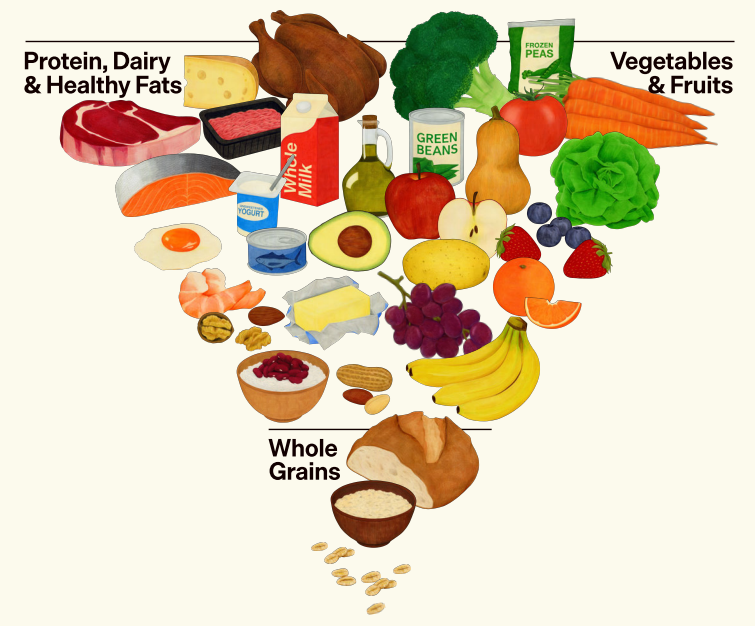
Dietary Guidelines 2025–2030 Released: Updated Pyramid Prioritizes Animal Protein and Full-Fat Dairy
- Finding: The new U.S. Dietary Guidelines introduced a revised dietary pyramid emphasizing animal-based protein, full-fat dairy, and saturated fats—a departure from prior editions.
- Population: Policy guidance for U.S. federal agencies, nutrition professionals, and the general public
- Takeaway: This represents a significant shift in official nutrition advice; however, Harvard Nutrition Source and Lancet experts note the updated guidelines diverged from prior USDA/HHS scientific advisory committees on saturated fat and raise questions about the evidence-review process used.
Dietary Evidence and the 2025–2030 US Guidelines: Expert Commentary in The Lancet
- Finding: Lancet commentators questioned the extent to which the 2025–2030 guidelines align with high-quality nutritional evidence, particularly on saturated fat and full-fat dairy recommendations.
- Population: Commentary by nutrition scientists reviewing policy
- Takeaway: A gap appears to exist between peer-reviewed evidence (which continues to show benefits of plant-forward, lower-saturated-fat diets) and the revised guidelines' emphasis on animal proteins and full fats. This points to a broader controversy about how nutrition policy is informed by evidence.
Debate of the Week
The 2025–2030 U.S. Dietary Guidelines Evidence Crisis:
The newly released Dietary Guidelines for Americans prioritize animal-based protein and full-fat dairy products, reversing decades of recommendations to limit saturated fat. However, Harvard's Nutrition Source and Lancet editorialists are questioning the scientific basis for this shift. Harvard Nutrition Source reports that instead of the standard USDA/HHS Dietary Guidelines Advisory Committee process, a "federal contracting process" was used to select individuals to conduct a supplemental scientific analysis—raising concerns about conflicts of interest and methodological transparency. Meanwhile, peer-reviewed evidence (particularly from Nature Medicine's 30-year cohort on healthy aging and large observational studies on cardiovascular outcomes) continues to associate plant-forward, lower-saturated-fat diets with longevity benefits.
Both sides: Critics argue the new guidelines lack adequate evidence review and may reverse public health gains on heart disease prevention. Supporters claim the updated guidance reflects evolving understanding of individual variation in metabolic responses to fats and proteins. Resolution would require: (1) full transparency of the contracting agency's scientific review process, (2) independent reanalysis of submitted evidence by an academic committee, and (3) head-to-head trials comparing the new guidelines-recommended diet to plant-forward, lower-saturated-fat patterns in cardiovascular and mortality outcomes.
Expert Commentary
Harvard T.H. Chan School of Public Health (Nutrition Source):
"The 2025–2030 Dietary Guidelines represent an important shift in federal nutrition guidance. However, [the updated process] raises questions about scientific rigor. The reliance on a supplemental analysis conducted by federally contracted reviewers—rather than the standing advisory committee process—differs from prior editions and warrants scrutiny regarding potential bias and evidence weighting."
New England Journal of Medicine (May 2026):
"The 2025–2030 Dietary Guidelines for Americans introduce revised priorities... [but] the extent to which these recommendations are informed by rigorous, conflict-of-interest-managed scientific review remains an open question for public health stakeholders."
Trend Spotting
-
Ultra-processed foods dominate headlines: Following the 8.8 million-diet study, mainstream media is amplifying the link between UPF consumption and multisystem disease risk—suggesting a potential inflection point in public awareness and potentially driving policy interest in food labeling and formulation standards.
-
Guidelines-evidence gap widens: The 2025–2030 Dietary Guidelines update has exposed a transparency crisis in how federal nutrition policy is formulated, with academic and peer-reviewed experts increasingly questioning the scientific advisory process used to generate official recommendations.
-
Precision nutrition on the horizon: Both the Harvard Nutrition Source and emerging research (Nature Medicine cohorts, Stanford longevity work) hint at growing recognition that "one-size-fits-all" dietary guidance may be obsolete—pointing toward future personalized nutrition recommendations based on genetics, microbiome, and metabolic phenotyping.
Reader Action Items
-
Audit your UPF intake this week: Use the Newsweek article's indicators (e.g., packaged snacks, sugary cereals, ready-to-eat meals) to count UPF servings daily. Aim to reduce by one serving per day over the next month—small changes showed measurable health benefits in 2026 research.
-
Read the Nutrition Source's full analysis of the 2025–2030 guidelines before accepting all new recommendations at face value. Cross-check claims about saturated fat and full-fat dairy against peer-reviewed cohort studies (e.g., Nurses' Health Study, Health Professionals Follow-Up Study) at Harvard's site.
-
If you're 60+, consult a dietitian about time-restricted eating windows (e.g., 10–12 hour eating windows). While pilot data is promising, larger trials are underway; a professional can help you adapt the approach safely to your medications and health conditions.
-
Prioritize whole foods over guideline compliance: Whether the guidelines emphasize plant or animal protein, the consistent evidence favors minimally processed sources (beans, nuts, fish, poultry, eggs) over ultra-processed versions of either.
What to Watch Next
-
Full Nature Medicine 30-year cohort publication: More details expected on healthy aging dietary patterns—likely to inform 2030 guideline revision discussions and provide independent evidence on saturated fat and plant protein outcomes.
-
USDA transparency initiative: Potential congressional or agency pressure to release the full scientific review documents underlying the 2025–2030 guidelines by Q4 2026, which could shift the guidelines-evidence debate.
-
Larger time-restricted eating trials in older adults: Results from NIH-funded RCTs on time-restricted eating and cognitive aging expected in late 2026 or early 2027—will clarify whether the pilot finding is robust and identify optimal eating windows.
This article reflects data published or updated between 2026-09-25 and 2026-10-02. Older studies and expert commentary from prior weeks have been excluded. Always consult a registered dietitian or physician before making major dietary changes.
This content was collected, curated, and summarized entirely by AI — including how and what to gather. It may contain inaccuracies. Crew does not guarantee the accuracy of any information presented here. Always verify facts on your own before acting on them. Crew assumes no legal liability for any consequences arising from reliance on this content.
Powered by
