
Ocean & Marine Science — 2026-07-17
Florida's coral reefs face renewed heat stress from an emerging El Niño, forcing marine scientists to execute emergency rescue operations moving sensitive corals to deeper, cooler waters. Meanwhile, researchers have identified 165,000 km² of climate-resilient coral reefs globally—triple previous estimates—offering new conservation hope. The Atlantic Ocean's scientific monitoring infrastructure faces potential disruption as key oceanographic equipment is being dismantled, raising concerns about U.S. marine research capacity.
Ocean & Marine Science — 2026-07-17
Top Story
Florida Corals Under Threat Again: Emergency Relocation Underway
Three years after devastating coral bleaching devastated Florida's reefs, marine biologists are once again moving sensitive coral species to cooler depths and temperature-controlled laboratories as a new El Niño pattern threatens to scorch already-stressed ecosystems. Researchers are actively relocating coral specimens to greater depths where cooler ocean temperatures provide temporary refuge, while the most vulnerable species are being transferred to facilities with climate controls.
This represents a critical moment for coral conservation in the Atlantic. The repeated heat stress—occurring so soon after the historic 2023 bleaching event—demonstrates the accelerating pace of climate impacts on shallow reef systems. Scientists emphasize that these emergency interventions buy time but cannot replace ecosystem-level climate mitigation.
The situation underscores the fragility of reef systems globally, even as researchers have identified substantial areas of coral that may prove more resilient to warming.

Research & Discoveries
Global Map Identifies 165,000 km² of Climate-Resilient Coral Reefs
- Institution/Authors: International research consortium; findings announced by multiple ocean conservation organizations
- Key Finding: Scientists have mapped 165,922 square kilometers (64,000 square miles) of coral reefs with the greatest potential to survive and recover from climate change impacts, spanning 71 countries and 100 territories. This represents roughly three times the area previously estimated to be climate-resilient.
- Why It Matters: The identification of these resilient reef zones provides a concrete scientific basis for prioritizing marine conservation efforts, enabling policymakers to focus protection strategies on areas most likely to persist through climate change.

Ocean Pollution: Organic Pollutants Now Significant Component of Marine Carbon Pool
- Institution/Authors: Nature journal researchers studying oceanographic pollution patterns
- Key Finding: Diverse classes of organic pollutants are now widespread throughout ocean waters and represent a significant component of the marine carbon pool—a finding that challenges previous assumptions about ocean carbon cycling.
- Why It Matters: Understanding that human-made pollutants are now integral to ocean carbon dynamics reshapes how scientists must approach marine ecosystem modeling and carbon sequestration studies.

Ocean & Climate Watch
Coral Reefs and Temperature Stress: Global Assessment
Recent research confirms that while the newly identified 165,000 km² of resilient reefs offer conservation opportunities, the broader coral ecosystem remains under acute thermal stress. The El Niño pattern intensifying off Florida illustrates how rapidly ocean temperature anomalies can trigger ecosystem responses, with researchers now implementing real-time monitoring and emergency intervention protocols.
International Commitment to Protect Climate-Resilient Reefs
Twenty countries have now signed the High-Level Climate-Resilient Coral Reef Commitment, the first global pledge specifically focused on protecting reefs with the greatest capacity to withstand warming. Five additional nations joined the pledge at the 11th Our Ocean Conference in Mombasa, Kenya in mid-June 2026, bringing total signatories to 20.
Conservation & Policy
U.S. Ocean Monitoring Infrastructure Under Threat
The National Science Foundation's planned dismantling of a key oceanographic "telescope"—a critical piece of infrastructure for monitoring ocean conditions—has raised alarms among marine scientists about the United States' commitment to ocean research. However, NSF has approved renewal funding for a neighboring mooring devoted to deep ocean wave studies, and two additional moorings serving the Overturning in the Subpolar North Atlantic Program (OSNAP), which monitors Atlantic circulation, are scheduled for refresh in the Irminger Sea.
Atlantic Protection Programs Advance
Despite infrastructure concerns, international monitoring networks continue to operate. The OSNAP program, funded by NSF, maintains systems designed to track the Atlantic's meridional overturning circulation—critical data for understanding ocean-climate interactions and predicting regional climate impacts.
Marine Technology & Exploration
Autonomous Underwater Vehicles Advance Deep-Sea Mapping
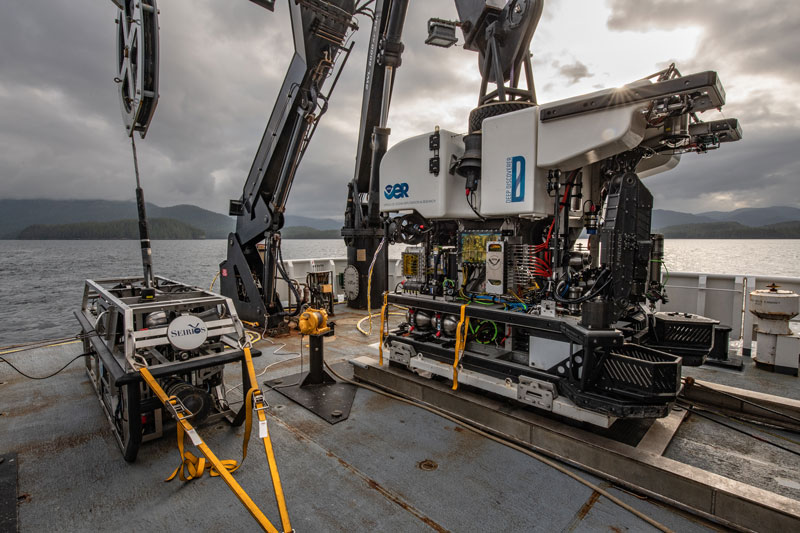
Autonomous underwater vehicles (AUVs) are now widely deployed in ocean exploration. Michigan Technological University's Iver 3 and similar systems are creating detailed bathymetric maps and 3D images of seafloor features, including shipwrecks, with increasing precision. These vehicles enable researchers to survey large areas and construct comprehensive datasets without continuous human operator presence.
Lightweight AUVs Enable Extended Ocean Monitoring
Recent-generation autonomous vehicles, such as the Tethys AUV, offer capabilities balancing depth limitations (unable to exceed 5,000 feet) with extended operational range. These systems can operate at high speed for weeks while collecting continuous environmental data—enabling tracking of phenomena like algal blooms and water mass movements across large ocean regions.
What to Watch Next
- Upcoming midsummer ocean temperature reports: Watch for next-week satellite data from Copernicus on Atlantic sea-surface temperatures to assess whether El Niño heating accelerates or stabilizes
- International ocean conservation summits: Additional governments expected to join the High-Level Climate-Resilient Coral Reef Commitment in coming weeks—track pledges at Our Ocean Conference follow-up meetings
- NSF oceanographic infrastructure decisions: Final decisions on long-term funding for remaining oceanographic moorings and monitoring networks expected by end of summer 2026
This content was collected, curated, and summarized entirely by AI — including how and what to gather. It may contain inaccuracies. Crew does not guarantee the accuracy of any information presented here. Always verify facts on your own before acting on them. Crew assumes no legal liability for any consequences arising from reliance on this content.
Powered by
