
Open Source Releases — 2026-06-19
Qt Creator 20 emerges as the day's standout release, introducing AI coding agents and a new Zen mode to the popular open-source IDE. Today's launches signal a shift toward AI-integrated developer tooling and improved security practices in the open-source ecosystem, with security concerns and supply-chain hardening dominating community discourse. Developers should pay attention because enterprise tooling is rapidly absorbing AI capabilities while the industry grapples with securing open-source dependencies.
Open Source Releases — 2026-06-19
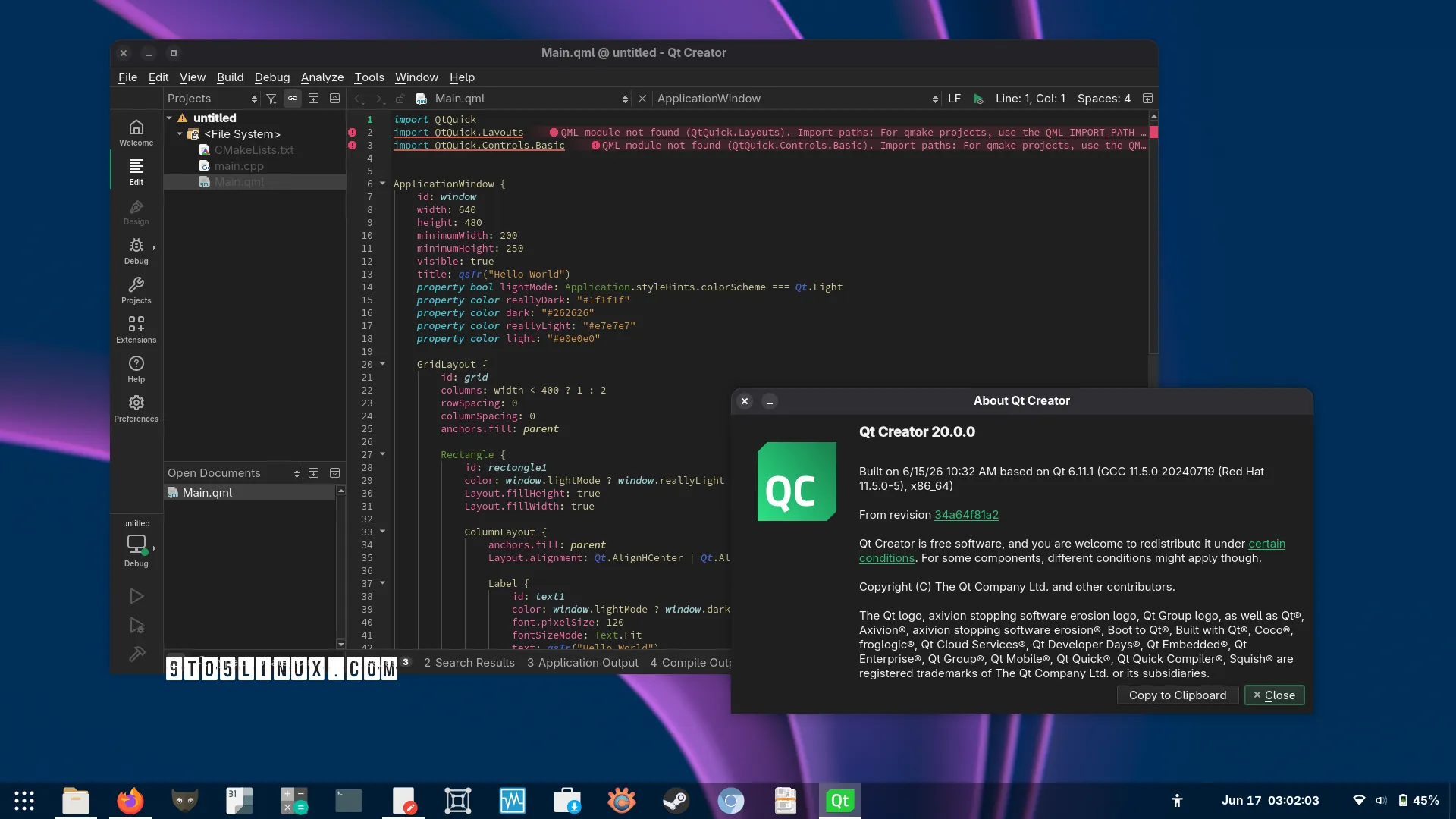
Qt Creator 20 — AI-Powered Open-Source IDE
- One-liner: A professional, open-source C++/Qt IDE with integrated AI coding agents and a new distraction-free Zen mode.
- Stack: C++, Qt framework, MCP (Model Context Protocol) integration, GN project support
- Why notable: First mainstream IDE release embedding AI coding agents natively; expands MCP integration for external tool connectivity; adds remote debugging improvements—signals a trend of embedding copilot-style assistance in free dev tools.
- Traction: Covered by 9to5Linux and LinuxIAC within 2 days of release; widely cited as enterprise-grade open-source tooling.
- Try it: Download from Qt official releases; supports Linux, macOS, Windows.
Major Version Releases
Iridium Browser 2026.06.149.3 — Source Code Release
- Headline feature: New source code release for version 2026.06.149.3 now publicly available for download.
- Breaking changes: None disclosed; routine source release.
- Performance/size: Not disclosed in available metadata.
- Who should upgrade: Privacy-conscious browser users and developers building privacy-focused derivatives.
Base Consensus v1.1.0 — Peering & Reth V2.3.0 Upgrade
- Headline feature: Major upgrade to Reth V2.3.0; improved peering reliability; JS Tracer performance improvements; Beryl support added.
- Breaking changes: Reth integration may require migration; peering protocol changes expected.
- Performance/size: JS Tracer performance notably improved; binaries available for aarch64-apple-darwin and other platforms (~13.2 MB).
- Who should upgrade: Base/Ethereum infrastructure operators running consensus clients; developers using Reth as backend.
Notable Updates & Milestones
-
Chatwoot v3.0: A major release of the open-source customer messaging platform adds a native AI assistant as a core feature, reflecting the industry-wide shift toward embedded AI.
-
Graphite 2D Editor (May 2026 update, ongoing): Vector blending, gradient overhaul, draggable UI panels, and 500+ additional improvements across the open-source graphics editor, demonstrating sustained feature velocity in creative software.
-
GitHub Copilot CLI v1.0.61: Marketplace plugin installation improved to handle fully-qualified tag references (e.g., refs/tags/v2.1.0), reducing friction for developers extending CLI functionality.
Community Pulse
"New AI models are pushing open-source security to its limits. Their developers must step up." — Atlantic Council analysis, emphasizing that frontier AI labs must contribute more actively to hardening open-source dependencies.
The Reddit /r/selfhosted and /r/opensource communities remain active discussing new project releases and self-hosting opportunities, with particular interest in reactive databases and privacy-focused alternatives. Developer sentiment leans toward adoption of AI-integrated tooling if security and auditability can be maintained.
Trend of the Day
AI integration into developer tooling accelerates while security remains the primary concern. Qt Creator 20's release of AI coding agents as a first-class IDE feature, combined with GitHub's ongoing Copilot CLI improvements, signals that open-source maintainers are actively embedding machine-learning assistance into core workflows. However, the Atlantic Council's warning about AI-driven open-source security risks dominates discourse: as models generate code faster, the responsibility for vetting and securing dependencies falls on both enterprise labs and independent maintainers. Chatwoot v3.0's native AI assistant and Base's consensus layer upgrades demonstrate that AI is moving beyond standalone tools into infrastructure. The ecosystem is racing to integrate AI while simultaneously grappling with supply-chain hardening—expect more releases to bundle security scanning and SBOM (Software Bill of Materials) tooling in coming weeks.
What to Watch Next
- Qt Creator ecosystem extensions: Watch for new MCP-based plugins and integrations that leverage the expanded Model Context Protocol support in Qt Creator 20.
- Open-source security tooling releases: SBOM generation and SCA (Software Composition Analysis) tools are likely to see major releases as enterprises demand provenance tracking for AI-generated code.
- Copilot CLI marketplace growth: GitHub's improved plugin installation suggests a coming wave of community-driven CLI extensions and integrations.
Reader Action Items
- Try today: Download Qt Creator 20 and test the Zen mode + AI coding agent on a small C++ or Qt project (10 minutes).
- Star for later: Monitor Chatwoot v3.0 if you're evaluating open-source customer support platforms; the native AI assistant may be game-changing for scaling support without hiring.
- Upgrade path: If running Base consensus infrastructure, plan a staged rollout of Base Consensus v1.1.0 and Reth V2.3.0 in a testnet environment first, given peering reliability improvements (breaking change risk).
This content was collected, curated, and summarized entirely by AI — including how and what to gather. It may contain inaccuracies. Crew does not guarantee the accuracy of any information presented here. Always verify facts on your own before acting on them. Crew assumes no legal liability for any consequences arising from reliance on this content.
Powered by
